


Shrewsbury College’s engineering workshop is a large, modern and impressive facility
replete with, among other technologies, a range of high-performance CNC and manual
machine tools. In 2021 the college upgraded the machining capacity and capabilities of its
workshop by acquiring 10 manual milling machines, 10 lathes and a pedestal drill from
MACH Machine Tools. Shrewsbury College followed up this main investment in 2022 and
2023 with the acquisition of a second pedestal drill and two more manual milling machines.
The acquisition of 24 new MACH machines in total, in such a relatively short timeframe, is
proof of the college’s committed to continuous improvement. Shrewsbury College’s stated
intention of building and maintaining a world-class engineering resource for students,
apprentices, employers and the wider community, remains a primary focus. The machines
comprise 12 MACH VS-1 (Classic) manual turret-type mills, 10 MACH L-1340 manual lathes
and two MACH SB 30 pedestal drills.
Since 2016, Shrewsbury College has been on an investment mission, improving and
upgrading its engineering, manufacturing and machining resources to “better meet” the
training and recruitment requirements of local and regional employers.
Recent investments, facilitated in part by sizeable grants from the Marches Local Enterprise
Partnership (LEP) combined with funding from the college itself and other partners, has
seen the college radically transform its engineering workshop. The facility now includes a
state-of-the-art CAD and design suite with advanced 2D/3D modelling software, additive
manufacturing technology, CMM equipment, a Festo FMS Industry 4.0 ‘Smart Factory’ suite,
and a range of CNC and manual machines. Also on site are MIG, TIG and MMA welding bays,
plasma and laser cutters, a CNC press brake, and a robotic welder.
Says Andrew Lee, who is Shrewsbury College’s director of apprenticeships & employer
partnerships, as well as the curriculum director for mechanical, manufacturing,
electrical/electronic & automotive engineering: “2016/17 was a watershed moment for the
college and the investments made in advanced technologies. It helped elevate our profile
and increase and enrich our engineering provision.”
Shrewsbury College is constantly improving and expanding its engineering curriculum to
keep pace with technological developments, help combat the ongoing skills shortages of
employers, and prepare students and trainees for the changing world of work. Upgrading
the capacity and capabilities of its workshop is therefore crucial in making sure the college
can meet these objectives.
“We regularly meet up with local and regional employers, collectively and individually, to
better understand their needs,” says Lee. “These discussions provide us with accurate
market intelligence that we use to help shape and direct our provision.”
It was, in part, this intelligence gathering and employer feedback that led the college, back
in 2021, to audit and benchmark its existing manual machine tool capacity and capabilities.
“The review revealed that our manual machine tool provision needed expanding and
upgrading to ensure the skills we developed with our students and apprentices, met the
needs of industry,” he says. “The increase in engineering courses and apprenticeship
programmes on offer, combined with larger numbers of students/apprentices, was putting
pressure on our existing manual machine resource.
“We needed to more than double the number of manual mills and lathes in the workshop to
ensure the quality and relevancy of the practical and skill-based content of our engineering
courses. We also had to acquire an additional stand-alone manual drill to handle routine
drilling and tapping operations.”
Shrewsbury College prepared and advertised a detailed open tender inviting potential
machine tool companies to submit comprehensive proposals to supply of a range of manual
machines (10 lathes, 10 mills and one drill. Every submission was reviewed against
evaluation criteria and weightings to determine which proposal offered the best-value
regarding price to performance.
MACH Machine Tools, with its extensive manual machine tool line-up and experience of the
education sector, scored highly with its tender submission and was duly shortlisted.
Following a visit by Shrewsbury College representatives to MACH Machine Tools’ facility in
Bristol, and a secondary visit to Neath and Port Talbot College, which had recently invested
in similar MACH machines, the company was awarded the contract.
MACH Machine Tools’ tender response was successful for several reasons, including: the
technical quality, price and availability of the machine tools recommended; the level of
service and support on offer, including delivery, installation and training; and the scope,
scale and value of ‘social’ support available (i.e. sponsorship, promotions and advertising).
Says Lee: “MACH Machine Tools submitted a competitive tender that represented real
value. We hadn’t dealt with MACH previously, but the quality, build and specification of the
machine tools they recommended, in addition to their price point and the company’s
aftersales service and support, put them in the box seat.”
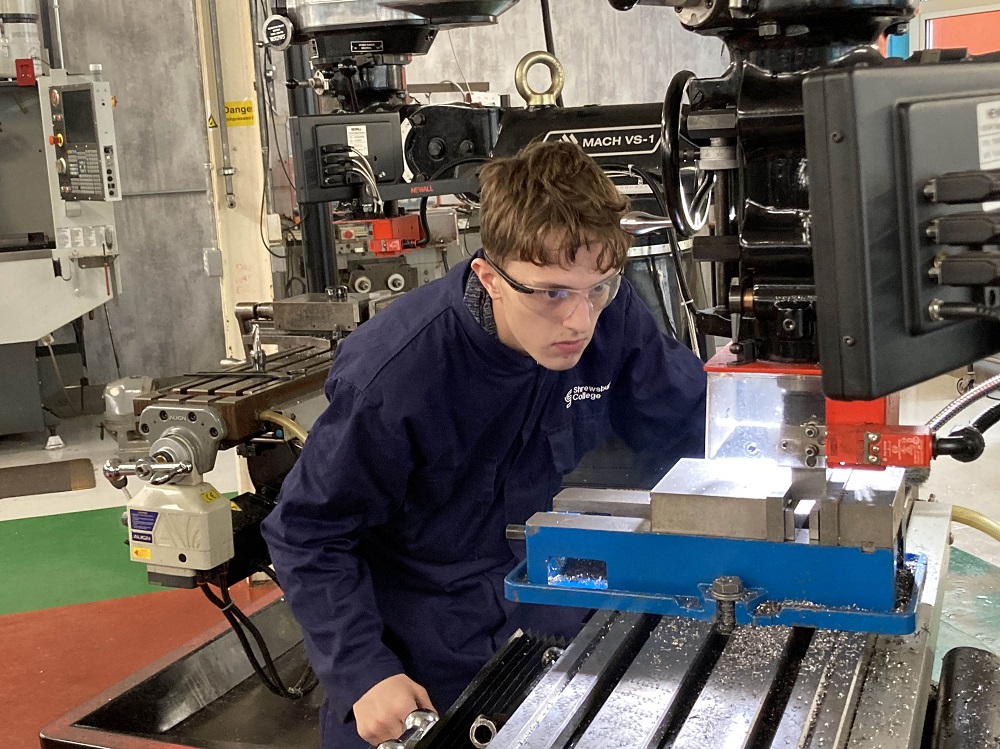
MACH VS-1 Classic manual mills feature a rigid design and build. They feature large
worktables (1219 x 229 mm), variable-speed 5000 rpm spindles and two-axis DROs. MACH L-
1340 lathes are compact machines equipped with quick-change tool posts and tailstocks,
and feature anti-vibration and stress-relieved beds, backlash eliminators, and two-axis
DROs. MACH SB 30 pedestal drills are supplied with 405 x 505 mm tables, 1.5 hp motors and
a 75-3140 rpm spindle capable of drilling various materials.
Concludes Lee: “The MACH machines are great performers, proving accurate, flexible and
reliable. Their acquisition has strengthened our manual machining capacity and capabilities,
enabling us to provide students and trainees with relevant, practical and transferable skills.”
The machines are in constant use – six hours a day, five days a week, 45 weeks a year, and
must always be reliable and ready for action.
“We were so pleased with the initial tranche of machines supplied in 2021 that we followed
this up in 2022 by acquiring a second MACH SB 30 drill, and again in 2023 when we ordered
another two VS-1 manual mills.”
More information www.machinetoolsalesonline.com