

Boeing and AMRC renew partnership

Boeing has renewed its long-standing relationship with the University of Sheffield’s Advanced Manufacturing Research Centre (AMRC). The tier-one partnership agreement will continue two decades of innovation and collaboration for another five years, extending Boeing’s access to the R&D capabilities of the AMRC.

“Renewing Boeing’s partnership with the AMRC demonstrates our commitment to Sheffield and showcases what we have created together over the past 20 years: jobs, innovation, inspiration and inward investment,” says Sir Martin Donnelly, president of Boeing Europe and managing director of Boeing in the UK and Ireland. “At its core, the agreement looks to the future and what more we can achieve through world-class researchers and industry working together.”

For further information www.amrc.co.uk

EOS extends 3DP training offer

EOS, a technology supplier in the field of industrial 3D printing for metals and polymers, is further expanding its offer in the areas of training and knowledge transfer. Back in 2016, EOS founded the consulting unit Additive Minds, which supports companies in tapping the vast potential of industrial 3D printing. The digital training of the Additive Minds Academy now complements this provision, bundling together many years of experience from consulting and
technical training.

Through blended learning formats and online/remote training, the Additive Minds Academy is taking a step towards conserving resources and thus reducing not only travel times but also training costs. The Additive Minds Academy offer includes individual learning modules and comprehensive learning paths (in English) that prepare for various roles in additive manufacturing – from machine operator and application specialist, to production manager. Customers receive support for on-boarding new employees, as well as further training for existing staff members.

For further information https://is.gd/lexeyi

Parting geometry for high feeds

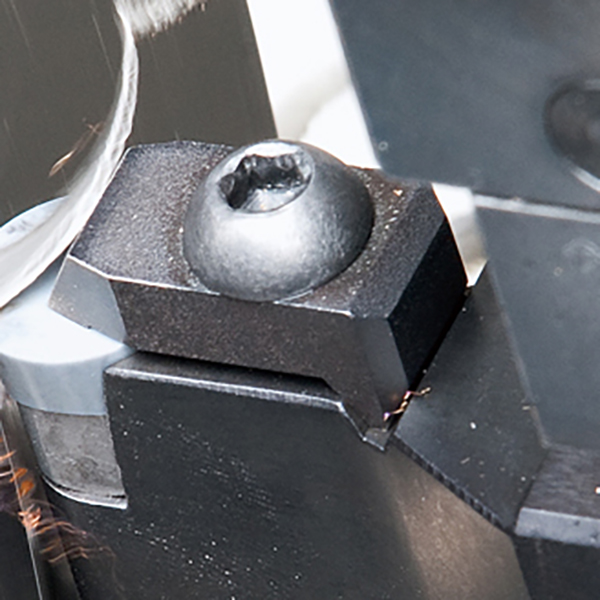
For parting-off at high feed rates, Horn has introduced EH geometry, a development based on the manufacturer’s S100 grooving system. The single-edge insert is available in widths of 3 and 4 mm. Notably, the stable cutting edge enables feed rates in the range of 0.25 to 0.4 mm/rev during grooving and parting, leading to fast cycle times.

High infeed requires a stable machine, as well as secure clamping of the workpiece. From a feed rate of 0.3 mm/rev, Horn recommends reducing the infeed for the first 3 to 4 mm during grooving and parting-off.

Due to their stability, S100 holders and cassettes for grooving along the Y axis are first choice when machining at these elevated feed rates. The process enables high-performance, vibration-free parting with high cutting values, leading to short machining times, reports Horn.

Especially when parting-off workpieces of larger diameter, high moments of force begin to manifest. The space available in a machine often does not allow the use of tools featuring larger cross-sections. With the new insert arrangement in the tool holder, the cutting forces are absorbed by the main cross-section of the parting tool holder, resulting in greater overall rigidity for a given tool width and, subsequently, higher feed rates. Alternatively, it is possible to deploy a narrower holder to achieve the same system rigidity.

For further information
www.phorn.co.uk

Automation sector acquisition

Belgrave & Powell, a specialist engineering services group, has acquired 100% of the shares of Autotech Robotics, based in Plymouth, UK. The acquisition will form part of Belgrave & Powell’s Machine Technology Group (MTG). Established in 1989, Autotech Robotics is a provider and integrator of robotic systems across the automotive, aerospace, marine and metal-processing industries.

Paul Ward, a partner in Belgrave & Powell who will lead the company as part of the MTG, says: “Coupled with our other machine tool, engineering and automation specialists, the MTG now has sizeable scale and capability across a range of robotic and automation platforms. Our focus will be on automated cells for machine loading, vision systems, robotic welding, cutting, forming, painting and handling, initially for the metalworking industries, but followed by expansion into other sectors.”

For further information
www.autotech-robotics.com

Bending large parts from thick material

Amada has extended its range of HFE3i intelligent press brakes by adding a 400 tonne machine in 4, 5 and 6 m lengths. Aimed at heavy-engineering sectors such as agriculture, commercial vehicle, rail, construction, mining and shipbuilding, the new HFE3i HT (High Tonnage) model can bend mild steel up to 20 mm thick.

A high-rigidity frame offers optimum performance in high-tonnage applications, while Amada’s design of the lower table guarantees parallel beam deflection. Furthermore, the strong and flexible back gauge combines payload and positioning accuracy via its five motorised axes.

The standard single Delta-X finger, which can move forward and backwards independently of the other, allows high gauging flexibility and is particularly useful when bending asymmetrical workpieces. Optionally, customers can select Delta-X on both fingers.

HFE3i HT machines feature a range of equipment designed specifically for high-tonnage applications. For instance, Digipro uses wireless technology to transmit the measured angle to the control before the machine compensates to provide a precise bend angle. At all times, operators can use a hand wheel to make manual adjustments to each axis. If required, an optional device for active angle measurement is available: the Bi-M laser can measure and correct the angle in real time.

A further benefit for customers is Amada’s Eco inverter technology, which means the machine stops using power as soon as the bend is complete. As well as saving energy, this smart hydraulic power system reduces maintenance requirements, oil consumption and noise.

The HFE3i HT can be optionally fitted with Amada SF200 sheet followers (200 kg per arm) to help improve accuracy and safety. SF200 units follow the bend speed as folding takes place.

For further information
www.amada.eu