Neoprec now supplying CMZ

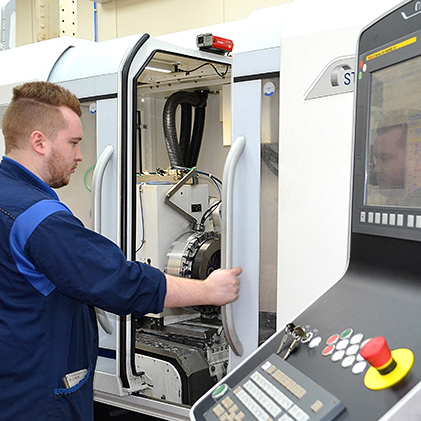
Neoprec, the new 8000 sq m machining plant of Spain-based lathe-building specialist CMZ, is taking its first steps. After the completion a few months ago of construction works and assembly of the machinery necessary to start running, Neoprec has started to supply the production line for CMZ’s digital-control lathes. The aim now is to reach a cruising speed, so that in five years’ time the company will reach its target of delivering over 800 lathes a year.

The plant has an automated warehouse capable of handling 1752 pallets, while the metrology room has temperature control to within 0.1°C and features a trio of 3D measuring machines. Once the Neoprec plant is fully equipped it will be capable of running for 48 hours without human intervention.

Neoprec starting its operation is one more step in the strategic plan that aims to double CMZ’s current manufacturing capacity in the coming five years. The arrival of new machines is imminent: bit by bit the plant is receiving all of the machinery it needs to carry out its activity at full throttle.

Construction of the Neoprec facility entailed an investment of €17m. CMZ strives for continuous growth aimed at increasing the company’s production capacities. The first estimates already suggest that the target of 800 machines delivered annually will be reached within its desired timeframe.

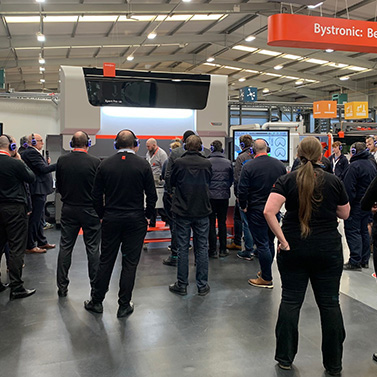
Word about the new plant is spreading fast. Students taking a higher diploma in industrial mechatronics and mechanical manufacturing production programming visited Neoprec recently and had the opportunity to look around the recently opened facility.

For further information
www.cmz.com

Machine shop boosts production by 80%

Some years ago, ebbing oilfield business conditions spurred LeanWerks, based in Ogden, Utah, to pursue work in other industries (including aerospace and high-speed automation) to establish a more balanced customer base and steadier work flow.

Reid Leland, company president and co-founder, points to one example: an aluminium investment casting for a jet engine fuel filter housing. LeanWerks considered how it might take advantage of the milling capability of its Mazak Integrex i200S turn-mill to minimise the number of times the part is touched during machining. However, the part with its complex datum structure requires tight tolerances, including true-position tolerance of 0.25 mm on some widely separated features, and size tolerances of 0.01 mm and true position tolerances of 0.05 mm for other, less separated features.

To enable the effective machining of five faces of the investment casting in a single set-up, one of the measures adopted by LeanWerks was the integration of a touch-trigger probing system. As the turn-mill featured only one probing channel, LeanWerks retrofitted the machine with a Renishaw RMI-Q radio receiver and installed a PLC card in the main machine control panel to handle a second probe signal. The short probe uses a 25 mm long stylus, while the long probe uses a 50 mm long stylus mounted on a 200 mm extension. Both use a Renishaw RMP60 probe body.
The probing routines were programmed using Renishaw’s Inspection Plus software, and the resulting code was added to the machine program at the appropriate locations.

Alongside other measures, the process LeanWerks developed to machine this investment casting job on its turn-mill machine improved the production rate from 10 hours per part to less than two hours.

For further information
www.renishaw.com

Industry urged to be COSHH compliant

A UK-based oil mist extraction expert is urging manufacturing and engineering companies to ensure they are COSHH compliant. Telford-based Filtermist Systems is making its customers and wider industry aware that the HSE is continuing to run its Fabricated Metals inspection programme. Inspectors are paying particular attention to exposure to metalworking fluids and welding fume, both of which can cause respiratory and skin conditions.

Craig Woodward, divisional sales director at Filtermist, says: “Despite COSHH regulations being introduced in 1989, we’re still seeing many companies who either don’t use local exhaust ventilation [LEV] at all, or don’t think they need it on every machine tool. However, LEV can lead to many benefits, including increased productivity, lower cleaning bills, consistent component quality and support in the recruitment and retention of employees.”

For further information www.filtermist.co.uk

New capabilities for spring manufacturer

When Sertec made the decision to close its springs and wire forms division and put some assets up for sale, Emma Burgon, engineering director at Stalbridge-based William Hughes Ltd, spotted an opportunity to not only bolster her company’s existing capabilities, but introduce new ones.
“Because of the transfer of assets we’ve been able to increase our welding capacity, while we’ll also be adding a further four bending machines, taking us up to 10 in total. In addition, we’ve introduced a three-axis XYZ vertical machining centre and an EDM wire eroder, which we’re in the process of refurbishing. We’ve never had EDM capability before, but our tool-room manager is convinced that it will speed us up because it can pre-cut blocks prior to CNC milling. Our customers don’t normally give us very much time to make weld jigs, but if we can get off tools quicker than anybody else, we’ll win the project, so speed of weld jig design and manufacture is definitely a big plus.”

For further information www.wmhughes.co.uk

£500,000 advanced skills boost

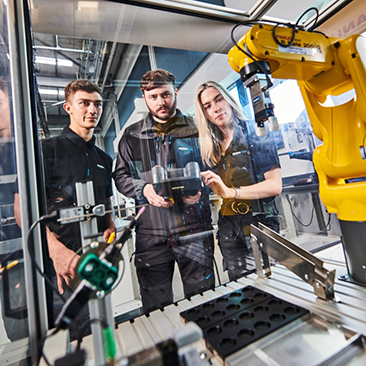
Hundreds of workers across the West Midlands have the opportunity to upskill thanks to a new initiative by The Black Country & Marches Institute of Technology (IoT). Companies can now access specialist training for members of staff aged 19+ on one of three Level 4 technical courses in automated machining, robotics and QA. The £500,000 In-Work Skills pilot, which will be delivered by the Marches spoke of the IOT at In-Comm Training in Telford, is free of charge and can be completed part-time and in modules, giving both staff and employers complete flexibility.

“Brexit and Covid has placed a lot of financial pressure on businesses and, in some cases, training budgets have been cut, meaning employees and bosses are missing out on vital skills development,” says Bekki Phillips, COO at In-Comm Training. “The In-Work Skills pilot has been designed to bridge this gap and will give manufacturers access to high-quality Level 4 technical courses at no cost to them.”

For further information https://in-comm.co.uk/