

VISI ‘connects’ Alpha’s mouldmaking team

An injection mould manufacturer has seen a recent resurgence of tool making in its native Irish Republic, and says CAM software helped it through the recession by giving the company a competitive edge to work in high-end markets.
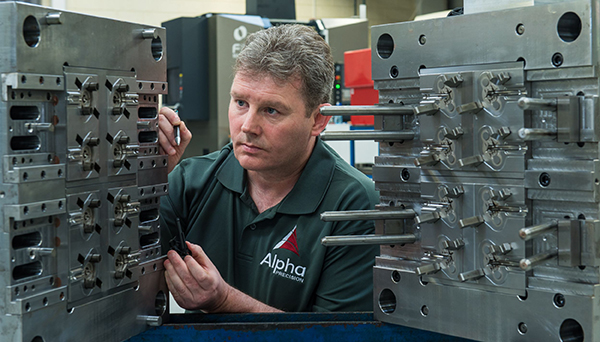
Alpha Precision, based in Tubbercurry, County Sligo, operates an almost full suite of VISI modules, which director Brendan Feely describes as a seamless communication tool.
“Several years ago Ireland experienced an exodus of tool-making contracts as work went overseas, particularly to China. At the same time, VISI CADCAM software for the mould and die industry was rapidly developing and adding new features. Even companies which weren’t computer literate were investing in the technology to survive. The software had a huge effect on the tool-making industry, giving us a competitive advantage to weather the storm.”
He says it’s now “high end all the way” for Alpha Precision – high-end staff building high-end mould tools with high-end software. “The technology promotes a more automated process, and means our staff need a different skillset nowadays, to use VISI to its full potential.”
To explain fully how he feels VISI is the seamless communication tool that acts as the glue in the complete tool-making environment, he likens his tool room to a football team. “We need our goalkeeper, defenders, midfielders and strikers. We have a variety of different machines doing different jobs, so our operators have different skills. The software is applied on the back of the machining, and because there are several disciplines, such as design, milling, wire and spark eroding, the software fits naturally into its given area. The operator in that area is just trained on the one particular VISI module.”
Continuing the “team” analogy, Feely says the tool room is like a group of people from different countries with none of them speaking a language other than their own. “One language is design, with others including flow analysis, milling, wire EDM and spark erosion. VISI is the common language that unites all processes, ensuring everything moves fluently through the tool room from one discipline to another.”
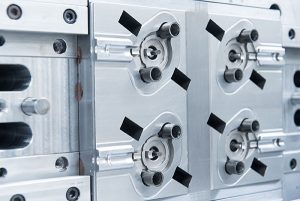
Operating with 12 employees, the company produces an average of around 40 tools a year, ranging in size from 100 x 100 mm, up to 600 x 1000 mm, mainly for the automotive, medical, packaging and electronics sectors.
Two of the company’s current projects are: producing a number of high cavitation tools for one of its many medical customers; and a contract for two-shot plastic injection tools, which involves an over mould. “Although two-shot production adds another element by involving a second material and process, VISI keeps it simple and efficient.”
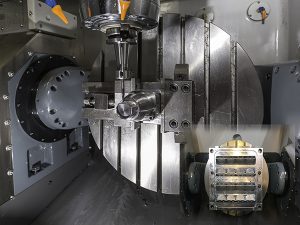
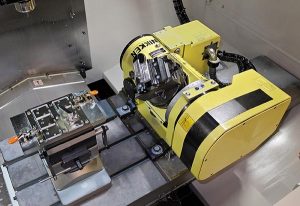
With VISI programs running the company’s high-speed milling on Röder and Makino machining centres, the challenges posed by the medical industry’s requirement for very fine micro levels, are readily overcome. “We use a 42,000 rpm spindle speed for very small detail finishing, and cut our electrodes on a Makino F3, with high definition being done on an F5. And we can also machine a cavity in just one night, which would otherwise take a week. Using VISI Machining we can quickly produce a highly polished medical part with fine detail, a milled finish and a split line, within micron accuracy.”
VISI also powers Alpha Precision’s Charmilles EDM machines for spark eroding and Mitsubishi wire eroders. He says parts of the tool will have been cut on each of the machines, and when it’s ready for shipping it is a very fine micron, accurately finished tool for, typically, the medical or automotive industry.
Having invested in many VISI modules including Modelling, Analysis, Flow, Mould and Progress, wire cutting and electrode systems, along with 2D Milling, 3D Milling and High Speed Milling, the software is used at every stage of the company’s process, beginning with providing an accurate quotation for the customer. “We use VISI’s analytical tools to check the drafts and all the different features we’ll need to build into the mould, such as the core and side pieces.
“When the order’s been placed, we work closely with our customers’ moulders on the design concept, including flow analysis and tool layout. Once the 2D design is broken down and we have the tooling in full 3D, we really begin to see the huge power of VISI, which controls everything from design, through milling to wiring in one environment. As we’re not going across translators there’s a perfect understanding within the technology, taking it right through every stage.”
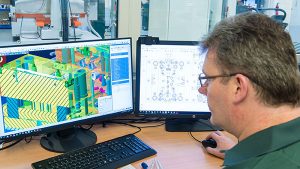
Combining VISI’s Compass technology with its 2D and 3D milling capability, all milling for hard prepping and high-speed finishing is handled quickly and accurately, which Feely says is vital to the company’s operation. “We make a lot of one-off components for each mould, meaning we only run a program once. As pattern cutters we need to be very good at generating CNC code time after time, and VISI is exceptional at doing that job for us.”
Although injection mould tools form Alpha Precision’s core business, the company also provides a blow-moulding and forming-tool service, and has experience in specialised press tooling. However, Feely concludes by saying that the business is currently embarking on an exciting new journey, working closely with a major customer on injection rubber.
For further information www.visicadcam.com
Davturn enters new turning arena

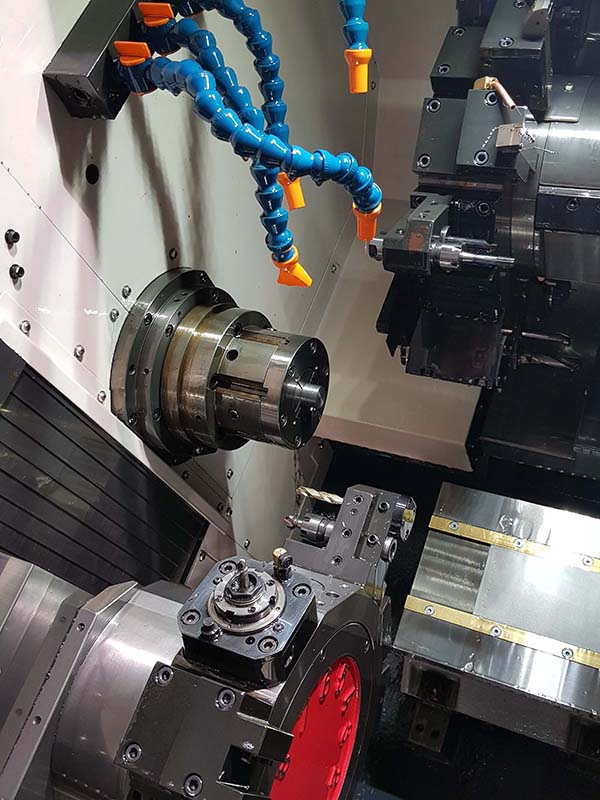
Davturn, a small family-owned precision subcontract machinist based in Bromsgrove, has found increasing its production capability by installing a Miyano BNE-51SY6 turn-mill centre has added fuel to the burning desire to expand the five-people business into larger premises. As a result, managing director Mark Birley maintains, such has been the impact of the new machine that moving premises will then allow further Miyano installations by Citizen Machinery UK to increase its operational capability.

“We installed the multi-axis 51 mm bar size Miyano BNE-51SY6 in June to join our existing Miyano BNA-42DHY, which had already proven to be a success for the business since its installation in 2012,” he says. “At that time, it enabled us to increase the size of bar we machine from our bank of five sliding-head machines, which limited our capacity to 32 mm. Now, with 51 mm capacity, this immediately brought in a host of new orders.”
Birley has been entrenched in turned-part machining since he left school, which led him to take his skill and set up Davturn 13 years ago, basing the business on his experience in cam autos. He bought his first CNC machine in 2007, which set the firm on its steady growth pattern, and in the same year was joined by his son Matthew. Matthew had decided he would rather have a longer skill-based future in machining than he would as an early-career footballer when he played for Birmingham City. Indeed, under his father’s training he progressed to become a director of Davturn, having learnt very quickly to become a skilled programmer and machine setter. The firm also has two apprentices who, like Matthew, are being taught how to competitively apply and use the technology involved in modern machining techniques.
Today Davturn has some 20 active, mostly Midlands-based customers, from sectors that include hydraulics and pneumatics, electrical, door-closure, fastener, construction, vehicle and rail, as well as control cabling. This means the company faces a broad brush of component types from batches of 1000 to almost continuous production of 500,000 with cycle times varying between 15 seconds and 5 minutes. Materials range from plastics to aluminium and high-grade steels.

Since its installation, the BNE-51SY6 has not stopped producing components, with the machine running seven days around-the-clock. During the night and at weekends, machine monitoring creates a call-out in the event of any stoppages to production.
Says Matthew Birley: “The capability of the machine to hold so many tools on the two 12-station, all-driven turrets means we can easily accommodate a suite of common tooling and rarely need to change a tool holder. As a result, resetting is generally prepared and quick; most operations take less than 40 minutes, which helps keep our utilisation of the machine very high.”
He then explains how he uses the latest Citizen Wizard programming aid for both Miyano machines: “This certainly enables new multi-featured parts, often involving difficult materials, to be efficiently programmed with good balance to the cycle between the two spindles.”
Matthew Birley follows on to describe one part produced in a batches of 2000 from 25 mm EN16T bar for use in truck suspensions: “We held 0.025 mm in the bore and 0.02 mm on the outside diameter, which has a 0.8 CLA surface finish without any interruptions for adjustment.”
The part involved all tools being able to be used in overlapping operations between the two spindles and two turrets: “With the power available and the inbuilt rigidity of the machine, it was very straightforward to achieve a balanced machining cycle between each spindle.”
The part involved turning, drilling and counter-boring, the rolling of an M10 internal thread, and the milling of an 18 mm hexagon, which were all completed in a 2 minute cycle.
The Miyano BNE-51SY6 has been developed for single-cycle machining with the ability to cut using three tools that simultaneously overlap when needed at both ends of a workpiece. This capability is supported by the high rigidity of the 7.8 tonne machine, which features box-way slides. The machine has a 15 kW main and 7.5 kW secondary spindle, both having maximum speeds of 5000 rpm, as well as 12-station all-driven turrets.
Having the flexibility of the new BNE has also helped win a contract involving 1000 windscreen wiper assemblies a month for the railway industry. Here a range of component sizes in 303 stainless steel benefitted from balanced machining cycles involving drilling, turning, boring and threading M26x1 each end with 45 mm lengths using both spindles.

“This capability was an important factor in establishing a competitive price to win and succeed in the contact,” says Birley. “Investing in the Miyano, and with the level of support from Citizen’s application team, means we are now riding high.”
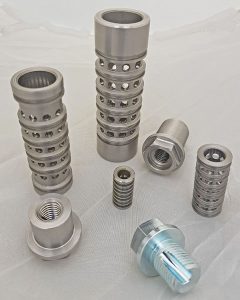
He goes on to provide details of a further contract won following the machine installation. This involves a six part series of hydraulic valve sleeves complete with spools between 16 and 30 mm diameter in 440-C stainless steel.
“We are able to machine the largest of these in under 5 minutes, with the most complex having 11 grooves in the outside diameter and 50 holes pitch-drilled 5 mm diameter from the grooves into the bore, which has 0.05 mm tolerance,” he explains. “As we are able to simultaneously combination gang-drill the holes using both turrets and fully deburr in-cycle, we are utilising a totally different capability that we could never even have dreamt about before.”
For further information www.citizenmachinery.co.uk

Five-axis search ends at XYZ

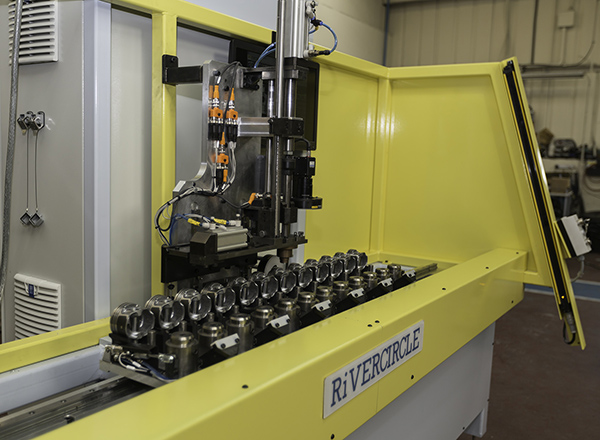
For over 30 years Peterborough-based Rivercircle has developed its business as a designer and manufacturer of special-purpose test and assembly machines, and multi-cavity rubber and plastic mould tooling. The company prides itself on being able to provide a complete service, keeping as much as possible in-house, from design, through to final mechanical and electrical assembly and testing. This strategy includes machining.

A policy of continuous investment in people and machine tools has seen Rivercircle create extensive capability, with its machine shop now populated almost in its entirety with CNC machinery. Three- and four-axis machining centres with capacity up to 1700 x 1000 x 1000 mm are complemented by turning centres, grinders and spark-erosion equipment. The one thing missing was five-axis machining capacity.
“Our investments in machining capacity had led us to ever more complex machines and we had been considering five-axis for a few years, but always struggled to justify the price versus capability argument,” explains Jonathan Theobalds, managing director at Rivercircle. “The size of machine we needed always appeared far too expensive, while the machines we felt we could justify on price just didn’t have the performance or capacity, limiting the potential gains for the business. Therefore, when we were introduced to the XYZ UMC-5X, which was in the right ball park as far as price and performance were concerned, we went for it!”
In its standard configuration, XYZ says that the UMC-5X is a highly competitive package, with its gantry-style design and rigid construction ensuring a capable machine. A team from Rivercircle visited XYZ’s headquarters in Devon to see the machine in action and talk through its potential with the company’s sales and applications teams. Given the type of work undertaken by Rivercircle, particularly on its mould tools where materials such as P20 tool steel is commonly machined, spindle performance and overall machine rigidity where vital to the purchase decision.

“There were several factors that swung in favour of the XYZ UMC-5X,” says Paul Langan, Rivercircle’s production manager. “The machine construction and design gave us the confidence that it would perform as we expected and, with our mould tool work, the high-torque (260 Nm), 15,000 rpm spindle is perfect for roughing and finishing tool steel. Another key point was the option of the Heidenhain CNC, as this is a control system that we favour here. Not having that option would have been a barrier to us placing an order. As it was, we only required one day of training to familiarise ourselves with the machine, and our CAM programming engineer, Steve Goodson, has fully embraced the move to five-axis with no further requirement for programming support from XYZ. We have also fully integrated our Mastercam software with the machine control; the post-processors were all updated during the installation of the machine, making it a seamless process.”
The XYZ UMC-5X has the option of either the Siemens 840 DSL ShopMill or Heidenhain iTNC 640 HSCI control, both of which feature traori (transformation orientation)/kinematic functions, respectively, for improved accuracy during five-axis simultaneous machining. In addition, the UMC-5X also benefits from built-in thermal-growth compensation for enhanced accuracy and repeatability, and integrated (and patented) smart machining technology for improved productivity.
Other key features of the machine are its C axis with 90 rpm rotation via direct drive, low-maintenance, high-torque motor; ±120° on the tilting A-axis, with 2.5 sec for full movement, and rigidity aided by the use of identical sized bearing at both ends of the axis; front loading for ease of access; linear scales on the X, Y and Z axes; 600 mm axis travel in X and Y (500 mm in Z); and a 600 mm table diameter with capacity to carry components up to 600 kg.
The arrival of the XYZ UMC-5X at Rivercircle will initially allow the company to improve efficiency by transferring work from three- and four-axis machines that require multiple operations. New opportunities will also be created for the subcontact side of the business.

Ultimately, continuous investment in the latest design and manufacturing technologies with integrated CAD/CAM systems enable full 3-D machining of complex forms to be undertaken. The addition of an XYZ UMC-5X vertical machining centre brings high-precision, high-speed, simultaneous five-axis machining to Rivercircle’s capabilities
“Whether it is for our own production, or for subcontract work, we operate in a very competitive sector supplying first and second tier customers in the automotive, transport, pharmaceutical, construction and petrochemical sectors, among others,” says Theobalds. “Lead-times are often short, so we have to be able to meet our delivery promises at the right quality and at the right price. This move to five-axis machining with the XYZ UMC-5X will enhance our ability to meet customer demands. The support we had from XYZ prior to placing the order and the competitive price for such a capable machine made this transition straightforward.”
For further information www.xyzmachinetools.com

Cycle times reduced by up to 70%

Even after extending the day shift, Mildenhall-based subcontractor CTPE was still having difficulty producing aluminium covers for a medical housing in two operations quickly enough on an ageing, 40-taper, three-axis machining centre after the customer raised the call-off rate to 100 per week. However, a new production route proposed by Whitehouse Machine Tools based on the supply of a Japanese-built 30-taper machining centre from Brother, also a three-axis model, promised a halving of the cycle time and consequent elimination of the problem.

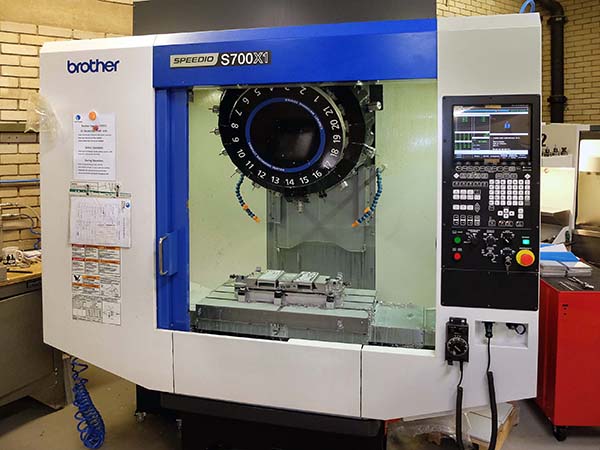
So, a Brother S700X1 was installed in August 2016. Whitehouse edited the existing program and, although it is still a two-operation job, the cycle time was indeed reduced by 50% to one hour, as had been demonstrated during time trials at the supplier’s Kenilworth technical centre and showroom.
The saving is principally a consequence of four times faster tool changes (at 1.4 seconds), a 16,000 rpm spindle with through-coolant rather than the 6000 rpm of the previous machine, four times faster acceleration (at 2 G) to linear rapids of 50 m/min instead of 18 m/min, and the fact that the program runs much faster in the latest Brother CNC C00 control.
Tool change time on the Brother S700X1 is minimised by optimising the operation of the magazine and improving the Z-axis acceleration, in addition to the shorter start and stop time of the spindle. Further reduction of waste time is achieved by positioning the X/Y and additional axes simultaneously with tool change operations.
Since the machine was installed, CTPE has gone a step further by optimising the program to machine six parts on the table with 14 tools, and adopting new types of cutters. The effect has been to reduce the cycle time per part further to just 30% of the original.
In another example to demonstrate the magnitude of the savings obtained, an aluminium flow housing for a customer in the scientific sector was previously produced in three operations on a three-axis machine in 15 minutes and is now produced in an Op1/Op2 cycle on an S700X1 in six minutes, representing a 60% time reduction.

Alex Taylor, who runs the subcontracting firm with his father Chris, says: “It was our first machine from Brother and also our first 30-taper capacity. We were impressed with the quality, compact footprint and speed of the machine when we saw it in Kenilworth, and comments about Brother both online and by word-of-mouth were complimentary.
“After the S700X1 arrived, we were able to get one to two weeks ahead on the medical cover job, whereas before we were always struggling to keep up with the current week’s production,” he adds.
Such was the success of the project that, when a second multinational company in the medical sector, a long-standing CTPE customer, asked for a new family of 6061 aluminium parts to be produced, Chris and Alex Taylor had no hesitation returning to Whitehouse for an identical S700X1, this time fitted with a two-axis Nikken table. The machine replaced another three-axis vertical machining centre in June 2017.
Previously, the parts were being machined in the USA, but the German-based OEM wanted a single source of supply and was confident of the Suffolk subcontractor’s capabilities. Six components are required, half of which are suited to three-axis metalcutting, while the others benefit from five-face machining in two operations using 3+2-axis cycles, as otherwise they would need eight set-ups on a three-axis machine.
“We like the three-axis Brother and two-axis Nikken combination, as we are able to mount the compound table on one side, leaving the rest of the machine table free for fixturing a second component in a vice for three-axis machining,” says Chris Taylor. “In this way, we can get two-operation components off complete each time we open the doors.”
He adds that, in a similar price bracket the company looked at a number of 40-taper, five-axis replacements for CTPE’s old machining centre, but they could not compete with the speed of the 30-taper machine. The smallest cycle-time saving achieved to date by swapping an existing job on to an S700X1 is 40%. CTPE has also won new five-axis work as a result of having the capacity on the shop floor, and some of those jobs have already repeated.

The Brother machines are especially appropriate for CTPE, which processes a lot of aluminium. One of the new medical parts is quite large for a 30-taper machine at 180 x 50 x 50 mm, but the Brothers cope with it well, despite more than three-quarters of the billet’s material being removed.
Precision is down to ±5 µm positional tolerance, better than is possible on many 40-taper machines. Chris Taylor points out that CTPE also produces components in steels, including stainless on the S700X1s, although a 30-taper machine would not be appropriate if doing that type of operation all day.
On a final note Alex Taylor says: “Before we bought the Brother machines, other users had commented on their reliability. Tooling suppliers, who tend to keep their ear to the ground, reported similarly. Certainly we have not had any downtime on either S700X1 since they were installed.”
For further information www.wmtcnc.com

Rapid expansion at anodising centre

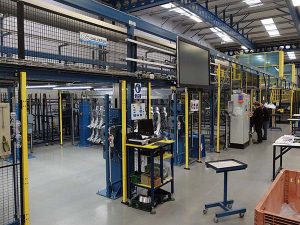
BCW Treatments in Burnley is an aluminium anodising facility that opened in early 2015 to provide a full service to companies using the subcontract machining services of BCW Manufacturing Group’s machine shops on the same industrial estate. Anodising is carried out in a Galvatek automated finishing line supplied by Turbex, which was deemed to be the best all-round package of three alternatives considered. Currently, an average of 2600 sq m of product per week are finished across more than 240 part lines.

One of BCW’s automotive contracts involves the production of aluminium components, mainly from A365 castings, 6060 extrusion, superplastic 5083, and 5754 sheet for a premium automotive customer in the UK specialising in manufacturing luxury sports cars and grand tourers.
More recently, the subcontractor has received further business from another prestigious UK automotive customer that produces high performance 4×4 and special operations vehicles. The work will start at the end of 2018 and entail the installation in an adjacent factory of a line for passivating components as a corrosion-resistant pre-treatment.
Enquiries have also been received for finishing lightweight components for aircraft, such as cabin seating, and for electric cars, hybrids, amphibious vehicles and trucks. Consequently, by the end of the decade, the firm is destined to become a major force in component finishing in the north of England.
Dr Andrew Wilson, managing director of BCW Treatments, says: “Although more than a century old, modern anodising is an exacting discipline requiring extremely close control to achieve the highest quality and, even more importantly, the correct film properties.

“Some manufacturers’ car parts are adhered rather than welded, and a nominal thickness of the anodic layer of 2-10 µm is required, above which there is a risk of components pulling apart under stress. A tolerance band of 4-6 µm is achieved using the Turbex line, so precise is the process.”
An ERP system drives the finishing process in Burnley, raising each manufacturing order and triggering the issue of material. The line’s control system learns which aluminium products are mounted on which universal or part-specific jig by scanning the manufacturing order. Once the part number is known, the correct program is automatically selected.
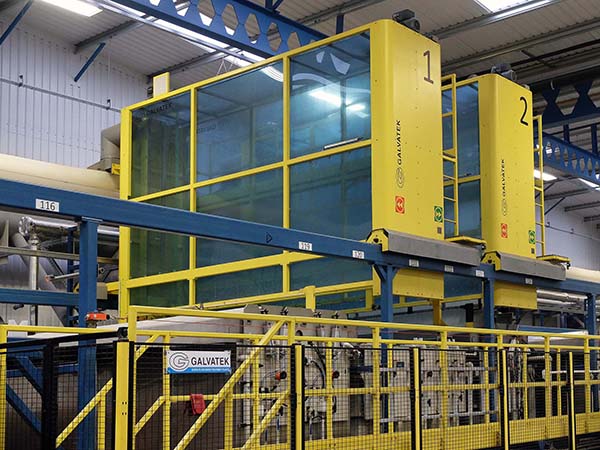
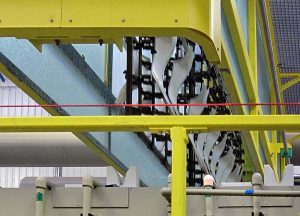
There are four load/unload stations at one end of the line, where components are loaded on to flight bars that progress to a buffer station from where they are picked up by one of two overhead transporters and dipped into 15 tanks sequentially. Up to five jobs can be processed simultaneously in the line.
Automatic dosing stations are provided for metered dosing of chemicals into several of the tanks, the quantity being worked out automatically according to the amount of surface area to be anodised on each flight bar. The working environment is clean and fume-free, as each tank is hermetically sealed and the lid is not opened until a transporter is directly above it. Positive pressure pulls the fumes through the handling system and extracts them to a scrubbing unit.
After processing, flight bars are returned to four load/unload stations adjacent to the loading area and the test pieces are taken away for analysis, which includes pull and shear tests after adhesive has been applied. Following each successful test, the ERP system is advised that the components are ready to deliver to the customer.
As a conveyor is not involved in transporting flight bars around the system, the anodising process starts in the centre of the line and progresses away from the load/unload stations. Alkaline degreasing takes up to one hour in the first tank for the most soiled castings and the solution is rinsed off in water in the next two tanks, the water being recycled between the second and third stage.

Tank 4 is a chemical etch using sodium hydroxide to remove pre-existing aluminium oxide from the surface of components. Immersion time is controlled to avoid unduly changing of the geometry of the components. It also precludes the need to plug holes, resulting in a cost saving and eliminating the risk of parts being returned by the customer if plugs are inadvertently left in at the time of delivery.
An eco-rinse cycle in water is performed in the next three tanks, again with recycling between the stages. The following process, which takes place at the far end of the line in tank 8, is the removal in a mix of nitric acid and hydrofluoric acid of alloying elements on the surface of components, especially of castings, that remain after chemical etching. Two further eco-rinse immersions in tanks 9 and 10 bring the pre-treatment to a close, by which time the components have travelled back past the centre tank towards the load/unload stations.
The actual anodising stage of the process is in tank 11, which contains sulphuric acid, and lasts between eight and 10 minutes, during which time a nominal 4-6 µm film thickness is deposited. An ecological feature of the equipment is continuous dosing of the acid, instead of recycling the fluid when the aluminium content reaches say 20 g/l. Avoidance of waste is made possible by employing a pump to recirculate the fluid through a retardation unit, where the aluminium is filtered out.
A clean rinse in three successive tanks containing deionised water, which is produced locally in the line, ends with an ultra-clean rinse to ensure that conductivity requirements are met.
The last stage, prior to the flight bar being taken back to the unload station, is hydrothermal sealing at 96°C in a proprietary chemical blend. Reserved for high-end applications and involving 30 µm particulate filtration, the process seals microscopically small pores created on the surface of components as a result of dielectric breakdown during anodising.
For further information www.turbex.co.uk