

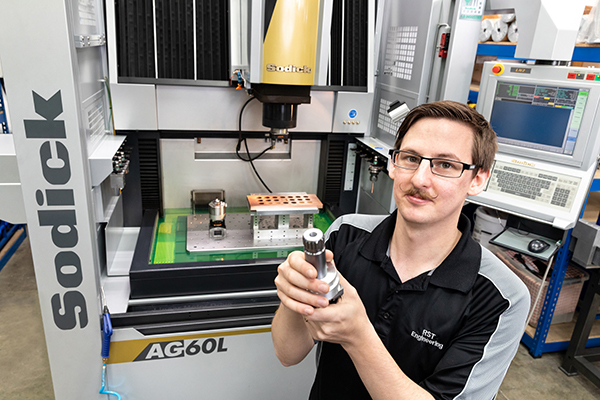
Investment differentiates R&M from the rest

R&M Assembly, part of the R&M Electrical Group, has over 20 years’ experience in the assembly, modification and distribution of specialist power distribution and control systems for use in hazardous (explosive) environments.

The company supplies a diverse range of customers across the oil and gas, nuclear, rail and marine sectors, to list but a few. A major advantage of R&M Assembly is its ability to provide bespoke systems in short lead times. This brings its own challenges as the company must overcome production bottlenecks caused by some manufacturing processes. Investment in new machining capacity has not only overcome these bottlenecks, but enabled R&M Assembly to generate new business from existing and new customers.
“Our business model is a reactive one in which we have to respond quickly to demand from our suppliers and customers,” says R&M Assembly division manager Martin Goodall. “One of our main tasks, therefore, is to iron out peaks and troughs in production to deliver a managed service and, where possible, avoid any unexpected issues. The limited machining that we have to do is one of those areas, as on a major project we may have over 2000 holes to drill and tap, and we can only do that at a certain speed with our existing equipment. The option to outsource this work was considered, but the loss of control over deliveries and quality saw us look to expand our in-house capability.”
In order to justify the investment in new machining capacity, Goodall had to identify efficiencies through in-depth time and motion studies, and with limited machining experience he called on XYZ for assistance in the form of area sales manager Keith Ellis. The initial thought for Ellis was to double-up on an existing XYZ SMX 2500 bed mill as the control was familiar and easy to use. However, talking through the needs of R&M Assembly, it became clear that to achieve the necessary versatility and productivity, a machine with a tool changer and fourth-axis unit would bring greater benefits.
“If we had gone with another SMX we wouldn’t have required any training and so it would have made our life easier initially, but in conversation with Keith it became obvious that a step-up was required and the new XYZ 500 LR vertical machining centre would have a significant impact on how we do business,” explains Goodall.

R&M Assembly’s projections, based on a major customer project valued at £1m, suggested that the addition of the XYZ 500 LR would generate savings of up to six weeks in labour, or £64,000, based on which the machine would have a payback period of just 16 weeks.
“Our projections also indicated that the addition of the tool changer would allow much greater unmanned operation, freeing-up operator time every day by as much as 6.5 hours, during which they could be doing other tasks,” says Goodall.
These projected savings were enough to justify investment in the machine, however, they must then be delivered upon. By maximising the capability and capacity of the XYZ 500 LR, with its 13 kW, 8000 rpm spindle, 12-position tool carousel and 510 x 400 x 450 mm of axis travel, combined with the agility of the linear rail technology on all axes, an immediate positive impact on efficiency was seen. Typically, a batch of 200 electrical junction boxes would take 2-3 weeks to produce, with drilling and tapping multiple holes being the bottleneck. Now, by utilising the XYZ 500 LR, machining is completed in two days and the batch fully processed within a week. Machining efficiency has seen gains of up to tenfold by reinventing the processes to match the machine’s capabilities.
The benefits of investing in new machining capacity for the R&M Electrical Group go beyond simple cycle-time savings and efficiencies; the machine is being used as a sales tool to drive new business for the group and typical of this is its partnership with Hawke International, a manufacturer of cable glands and electrical enclosures.
“With investment in the XYZ machine, Hawke has recognised our commitment and is supporting us as an extension to their manufacturing capability, allowing us to gain EAC certification, which will differentiate us from our competitors – all from buying an XYZ machine tool,” says Goodall. “The investment in the machine, along with our relocation to new premises, has allowed us to review many processes and techniques. This is seen as a sign of confidence, especially for customers servicing the oil and gas sector, which is coming out of its downturn.”

The XYZ 500 LR is part of the recently introduced range of linear rail machining centres from XYZ Machine Tools. LR series machines make use of the latest developments in linear rail technology, while providing a cost-effective entry into the world of vertical machining centres, says the company. These machines provide a natural progression or complementary solution for customers moving from manual or XYZ ProtoTrak-controlled machines. The LR range is in addition to XYZ’s recently extend HD range of vertical machining centres, which continue to make use of the box slideway construction, offering greater capability and capacity when required.
For further information www.xyzmachinetools.com

Daily challenges of an integrated fastener company

In engineering, a lot of focus is centred on complex systems and assemblies. Every manufacturer has a signature approach, or systems that help to define a brand. However, from a logistics point of view, every component is of equal importance. A shortage of a single, small bolt over an entire assembly can cause a production shutdown. Optimas, a global industrial distributor and service provider of C-class components, employs fastener experts on the ground at its partner manufacturing facilities to combat this issue.

“The first step of any fastener relationship must be to gain familiarity with the customer’s operations,” states Ian Larkin, customer application engineer at Optimas. “Past experience in an industry can be important here, but leading manufacturers will enact varying approaches to achieve a finished product, so gauging specific customer requirements is important. Hence the advantage of having a fastener expert on the ground. In contrast, someone operating off site would not be able to reach the level of understanding required to accurately address specific fastener issues.
“As a fastener partner, we have to fit an ‘ideal standard’,”
he continues. “We are working with big global customers who are driven to succeed, so we have to respect current processes and enhance the component policy to the specific requirements of the manufacturer.”
The easiest way to gauge these requirements is during a line walk. An Optimas expert will travel the entire production line looking at points of use, while asking basic questions to see what can be tweaked or possibly improved. This way, the expert can meet key figures on the line, while also taking a focused approach to tackling fastener problems on the ground.
“We don’t want to tear up the customer’s rulebook, but if we can point out a cost saving or alternative option to production staff, we will do so,” says Larkin.
A good example of the benefits this strategy can provide to manufacturers is highlighted by one particular Optimas customer in the US.
“We noticed a washer was being added to a flange screw even though it wasn’t particularly necessary,” says Larkin. “These washers were identified at multiple points of use, so we posed the question to the assembly team. It turned out that during the design of the product, the head engineer had requested the inclusion of washers to improve the aesthetic of the overall product. We were able to demonstrate that the washers were unnecessary for the application, and as a result, delivered an annual cost saving of $30,000.
“You can utilise engineering expertise as part of a sales function, but it also adds value to our customers. By making sure that we don’t make presumptions, we start an open relationship with the customer in close proximity. This builds trust and lessens the impact of implementing new methodologies. By getting involved with the product and seeing how it is used, people on the ground can get a deeper insight into possible solutions.”

Another customer application engineer at Optimas, Gerry Abraham, adds: “A key aspect of integrating with a manufacturer’s operations is responsiveness. Such businesses work to exacting timeframes in all aspects of their work, whether full scale production or prototyping a new product. Fastener suppliers who simply supply components can leave manufacturers with the impression that if a component problem arises, they alone must solve the issue. Optimas aims to differentiate itself by working together with purchasing, design and engineering teams to aid problem solving.
Abraham says that one project comes to mind, which was in relation to design engineering activity for a new diesel engine. A bolted joint for the turbo mounting was backing off during testing. As a result, the turbo itself was coming loose, producing excessive noise in operation. The manufacturer approached Optimas for a solution.
“We connected the customer with a number of suppliers to help rethink the situation. The customer trialled three or four recommended locking-type fasteners to replace the problem part, before selecting a preferred option. Ultimately, we wanted to give the customer choice and a chance to improve performance, so they could be confident in the part going forward.”
Another key element in providing an integrated approach is cross-departmental communication, as engineering program manager Chris Sterner, points out: “By starting this dialogue from the beginning, efficiency and response is improved. In addition, close contact means that specific fastener solutions can be enacted across multiple projects. Open dialogue regarding each other’s projects allows wider implementation of identified solutions, instead of starting from scratch every time a potential problem arises. By standardising solutions, you also deliver cost and efficiency benefits.”
Consistent presence is clearly important for these customers. Optimas tries to breed familiarity by being present at design reviews, which is a lot more beneficial to the manufacturer than simply being on the end of a phone. It also allows Optimas to share solutions, as each fastener problem solved allows the company to convince these varied groups within a business that it can be trusted to deliver.
“Providing guidance on fasteners affects the activities of the purchasing, design, engineering and assembly teams – so being able to balance the requirements of each of these groups is paramount,” says Sterner. “Regular face-to-face contact is the optimum method, helping to build relationships between teams and delivering a fast response. Ultimately, a fastener expert must communicate across each department to achieve the perfect balance.”
Becoming a fully integrated fastener expert means taking the emphasis on component knowledge away from the manufacturer. Manufacturers therefore are not required to brush up on standard parts, availability, material standards or overall usage – enabling time to be spent on other areas of the business.
“One story really fits this philosophy,” says Sterner. “An Optimas expert was asked to demonstrate some fasteners that were mentioned during a customer meeting. As he didn’t have these samples readily available at the meeting, he took pictures of the fasteners that were installed on his own car. He even took out a number of fasteners from the vehicle so he could share samples with the customer and demonstrate their usage. While quite an extreme approach, it was certainly effective in demonstrating the solution to the customer.

“The capabilities of the service also go a long way,” he continues. “Our access to failure mode analysis and full technical studies means we can provide exact answers to tackle fastener application issues. If we don’t have an answer ready for the customer immediately, this capability means we can react as fast as possible with a high technical proficiency. If it’s a unique problem, as fastener experts we can also learn from similar experiences, so the benefits of shared knowledge are also available.”
Fasteners are the only assets on a production line that are used uniformly, but with engineering typically focusing on landmark innovations, the emphasis upon them can be diminished. As a fastener expert, challenging this preconception is all part of the job.
“Fasteners may be the most inexpensive components that a manufacturer utilises on a production line, but they are one of the most critical,” concludes Sterner. “A lack of fasteners will shut down production just as much as complicated components, so we must demonstrate to our customers that the expertise we deliver can provide reliable service, no matter the challenge.”
For further information https://global.optimas.com

Engine plant cuts cycle times by 33%

Two more twin-pallet, horizontal machining centres (HMCs) from Heller have been installed at the Booth Drive, Wellingborough factory of Mahle Powertrain, an independent company specialising in the design, development, test and manufacture of combustion engines. A four-axis Heller H2000 has joined two identical models in an eight-machine production line dedicated to manufacturing cylinder blocks, while a larger five-axis FP6000 has been added to expand the capabilities of a flexible machining cell.

At the end of 2016, Mahle’s project manager Geoff Brown, production engineer Bob Price and others decided that the decade-old line producing aluminium engine blocks for a major British OEM needed to be upgraded. The line comprises six HMCs each performing separate operations plus two bore-honing machines positioned at the end. All HMCs were originally supplied by a Japanese manufacturer, but in early 2017 the first two machines in the line were replaced with UK-built Heller H2000s.
“We were already familiar with Heller machines, as we operated 21 of them very successfully for more than a decade at our facility in nearby Ryle Drive,” explains Brown. “They were used for manufacturing cylinder heads and blocks for a British off-road machinery manufacturer, although that contract has now ended and the machines have been sold. I also had experience of working with Heller horizontal machining centres at another engine manufacturer that operated more than 20 of them in a transfer line.
“We sent some V8 cylinder blocks to Heller’s Redditch technical centre, where they carried out Op 10 and Op 20 trials on an H2000, which is ideally sized for the work,” he continues. “Op 20 was particularly successful as, with the addition of new fixtures, it overcame a problem we were having in machining a side port in the new cylinder block model currently in production.”
As a result of the successful trials, the first two machines in the production line at Booth Drive were replaced with Hellers, and the benefits were immediately noticeable.

“The cycle time for each of the first two operations is one-third faster on the new machines: eight minutes instead of the previous 12,” says Price. “Impressively, the 33% time reductions have been achieved despite including some sections of the Op 40 cycle into Op 10, and parts of Op 30 into Op 20.”
The raised productivity is largely down to the rigidity of the H2000s, the higher speed (16,000 rpm) spindles with HSK63A interface and programmable through-coolant up to 70 bar, all of which support faster cutting feed rates. Rapid traverse is quicker than before, and further time savings derive from integral hydraulics for automatically clamping the engine blocks, along with air detect for checking that the component is seated correctly. A probe in the tool magazine for identifying broken cutters further reduces time by removing that function from the cycles.
Brown points out that all these features are fitted as a matter of course to the Hellers, whereas many other machine manufacturers class them as extras, increasing both cost and delivery lead-time. The offer of generously equipped, standard machines, with the enhanced back-up that their manufacture in the UK promised, was a significant factor in Mahle’s choice of the H2000s. So also was the efficient swarf management, essential to removing large amounts of aluminium chips efficiently from the machining area and avoiding hours of costly machine stoppage.
No-scan/no-run safety software is run through the Siemens control to prevent a component from being machined unless its barcode has been scanned. Linked into Mahle’s new SAP ERP system, which became operational at the start of 2018, the data provides traceability to ensure stock accuracy.

Capex approval to replace the third HMC was given by the Mahle board in mid-2017, and another Heller H2000 was ordered. Built in Redditch and commissioned at the beginning of this year, it took over Op 30 from its predecessor during February 2018. Again, the previous 12-minute cycle has been cut to eight minutes, despite taking some of the load from Op 50. When the fourth H2000 assumes responsibility for Op 40, it will carry out some of the Op 60 cutting scheme in addition to delivering a more efficient Op 40 routine. By then, the TAKT time for the whole line will be 10 minutes. Performing Ops 50 and 60 on Hellers in the future will lower it further to eight minutes.
Another ongoing project at the Booth Drive facility is the reorganisation of the shop floor so that all six HMCs and the two bore-honing machines are in a straight line, as at present some zig-zagging is involved. This configuration will allow two operators to be deployed on other work, one from Ops 50 and 60, and one from the honing section, helping to amortise the capex more quickly. The overhead gantry is being extended and reconfigured so that the existing Dalmec equipment can be retained for handling the 45 kg aluminium blocks in and out of the machines.
A further notable advantage of the rearrangement will be to slash work-in-progress to two or three components, whereas at present there are sometimes as many as 100 queuing on the shop floor. The beneficial consequences will include major savings in tied-up capital, reduced double handling, minimal risk of damage and less space occupied on the shop floor.
The line currently operates 24 hours a day, five days a week, saving overtime compared with when it ran 24/7 due to a previously longer TAKT time. Tight tolerances are held, including 50 to 70 µm on true position of some features and 10 to 12 µm on holes up to 16 mm diameter. Prior to honing, each cylinder bore and crank bore is pre-machined to 28 µm roundness, 0.15 mm true position and 50 µm squareness.
In another development elsewhere in the factory, at the start of this year a Heller FP6000 five-axis HMC built in Germany was added to a pre-existing flexible machining line that already comprised a vertical machining centre and three HMCs of a different make; all five-axis models. During a recent open day at the Wellingborough factory, it was explained that the line has been relaunched as a facility for the manufacture of heads and blocks, as well as a wide range of other prismatic parts, from one-offs to runs of up to 20,000, for customers in any industry.
For further information www.heller.biz

Workholding precision boosts Michell Bearings

As the inventor of the hydrodynamic bearing more than 100 years ago, Michell Bearings has spent the last century constantly developing its product range to meet the ever-changing needs of the company’s global customer base. The use of the latest production technology, decades of in-depth experience and the application of stringent quality systems, has resulted in the South Shields-based company gaining an impressive reputation in bearing design and manufacture for both the industrial and marine engineering sectors.

As the efficiency, reliability and longevity of any bearing depends largely on the quality of the methods used in its manufacture, Michell Bearings employs a wide range of CNC machine tools and advanced production aids.
The recent installation of a Hermle C60 UMT five-axis CNC machining centre prompted Chris Kemp, Michell Bearings’ manufacturing engineering manager to contact Tony Lewis of Thame Workholding with the intention of exploring ideas that would enable the company’s new acquisition to maximise its potential.
“As a designer and manufacturer of self-contained white-metal bearings and PTFE-faced hydrodynamic bearings, our products can be found in a range of challenging applications throughout the world,” states Kemp. “We have a long history of manufacturing bearings that withstand the test of time, and have products installed with 35 of the world’s navies on more than 300 vessels. Meticulous production and inspection methods ensure the quality of our bearings and help safeguard the global standing of the company.
“In accordance with our ongoing quest to enhance the company’s capabilities and further increase production efficiencies, we recently purchased a Hermle C60 UMT five-axis CNC machining centre with a capacity of 1200 x 1300 x 900 mm in the X, Y and Z axes. Our new machine tool allows the dynamic processing of workpieces up to 2000 kg in weight.”
With the aim of achieving the highest possible yield and looking to guarantee that the machine consistently met the demanding standards of precision at Michell Bearings, Kemp recently contacted Tony Lewis of Thame Workholding.

“After studying our new machine’s specification and capabilities, while also considering our objectives, we concluded that a work-holding arrangement, incorporating Thame Workholding’s Lang QuickPoint system and Samchully jaw boxes, would be ideal for our needs,” says Kemp. “By working together, Tony and I developed a system incorporating Thame Workholding’s products that has considerably reduced our new machine tool’s set-up and job change-over times, while greatly increasing its production availability. In addition to boosting efficiency, our new work-holding system’s ability to securely grip workpieces helps us to guarantee that the required levels of accuracy and surface finish are achieved on
a consistent basis.”
The work-holding arrangement conceived by Lewis and Kemp consists of several circular ‘slave’ plates that can be set-up offline. These slave plates have Lang QuickPoint studs attached to their bases and a series of QuickPoint plates that remain loaded on the machine table. The slave plates also feature T-slots that allow Samchully jaw boxes to be moved into position, tightened on to the workpiece, then centralised ready for machine loading.
On completion of a machining routine, the slave plate holding the finished part can be removed by crane, after which the next slave plate holding the new workpiece can be lowered into position. Upon quickly securing the new slave plate to the machine’s table, the next machining operation can begin.
The Hermle CNC machining centre’s spindle is able to move clear of the table, a useful capability that ensures the working area is completely unrestricted and accessible. As a result, completely unhindered crane loading is possible from directly above the machine table’s centreline.
According to Thame, the Lang QuickPoint system provides precise and repeatable mounting of fixtures and other elements on to machine tables, indexers, cubes, rotary tables and mill-turn machine tools. QuickPoint’s height of only 27 mm makes it the lowest profile zero-point-system currently available, says the company. Manual clamping is achieved with just one tightening screw (hydraulic or pneumatic clamping is also possible). The use of this simple and sturdy system allows a maximum pull-down force of 6000 kg.

“The QuickPoint location system is based on four wedge bolts in the pallet that engage with four grooved locating bolts screwed to the vice or fixture,” explains Lewis. “The highly repeatable nature of QuickPoint guarantees that Michelle Bearings’ slave plates can be loaded with workpieces off-machine, then quickly and precisely attached to the Hermle machining centre’s table. Now, rather than wasting valuable time setting-up a workpiece when the machine is idle, then performing machining operations as subsequent activities, these processes are capable of being completed concurrently within the machine’s cycle time. Deploying this strategy can help deliver outstanding machining efficiencies.”

For further information:
www.thameworkholding.com
www.michellbearings.com

Fabricator reports flood of new work

Established in 1967, Stevens & Carlotti produces metal fabrications at its Sandwich, Kent factory for customers in the UK and continental Europe. A jump in turnover of 25% in 2017 compared with the previous year looks set to be followed by a further 50% increase in 2018, which has unsurprisingly caused some production and logistical issues. The situation has resulted in an increase in headcount from 70 to 100 staff in the past 18 months, as well as a £1.5m investment in new machinery since September 2017.

Part of this sum was allocated to the purchase of a Bystronic fibre laser-cutting machine of 3 x 1.5 m sheet capacity, together with two press brakes from the same manufacturer. The three machines are installed in one unit, forming a lean production cell on the Sandwich site for processing mild steel and aluminium from 1 to 25 mm thick, and stainless steel up to 15 mm.
Managing director Marco Carlotti says: “Orders have flooded in recently across the board for batch sizes ranging from one-off to several thousand. They are being placed by existing and new customers, from sectors such as power generation and pumps, through street furniture and road sweepers, to electronics, filtration and construction. Our success is partly because we offer a complete subcontract solution, including cutting, bending, machining, welding, assembly and painting.
“Several cutting methods are in use here, each of which has specific advantages that give our customers best value for money,” he adds. “Laser cutting is the lead technology, however, and we have been using CO2-powered equipment for nearly 20 years.
“Due to the current higher level of business, we decided to replace one of our two second-generation 4 kW CO2 machines with a Bystronic ByStar Fiber 3015 fitted with a 6 kW power source and a ByTrans Extended automated sheet loading and unloading system. The benefits have been astounding. On thinner sheets, say around 5 mm, the machine is four to five times faster, accuracy of cut is better and it is possible to produce finer detail than on a CO2 machine. Fibre laser cutting is also not so expensive to run, as it consumes less electricity, does not need any laser assist gases and maintenance costs are lower.”

At the end of 2016, Carlotti visited the Euroblech exhibition in Hanover where it was obvious to him, and his two accompanying machine operators, that fibre technology had moved forward so quickly that it had become the new standard in modern laser cutting. Both of his incumbent CO2 laser-cutting machine suppliers offered a fibre alternative with automation, but he decided in favour of Bystronic following a visit to see the machines being built in the Swiss factory, which he describes as “impressive”.
The ByTrans handling system provides the best of both worlds in that it stores up to 6 tonnes of material, enough typically for a couple of hours’ lights-out production at the end of a day shift. Yet it also allows convenient manual intervention at a moment’s notice to fulfil a rush job if necessary. A tower system would not have been so flexible, due to the difficulty of accessing the shuttle table to place a sheet by hand.
Another feature of the ByStar Fiber that Carlotti likes is the control system, on which the interface is more akin to that of a tablet than a PC, making entering a program for an interim run easier. Conveniently, the same BySoft 7 software in the CNC system is also to be found in the controls of the latest Bystronic Xpert 150-tonne/3 m and 40-tonne/1 m capacity press brakes on site (the fabricator’s fourth and fifth from this source over the past 10 years). This software synergy speeds throughput when a component needs to be both laser-cut and folded.
An extra piece of Bystronic software that is about to be harnessed at the Sandwich facility is Plant Manager, which will provide visual support to the machine operator when planning which materials to stock near the machine for the next jobs, and when unloading cut parts. All components belonging to a particular customer order can be colour-coded on the cutting plan so that they are distinguishable from parts associated with other orders. Moreover, the first and last cut component can be labelled so that the operator knows when an order begins and when it is completed.
Carlotti concludes: “We have been impressed with the performance of the ByStar Fiber. The only problem we have is that it is so fast it can be difficult at times to feed the machine with the next sheet quickly enough.
“We are going through a major reorganisation of our site at present,” he continues. “As part of that, we will be rearranging the cantilever racking holding material for supply to the ByStar Fiber and will also be redesigning the breakout area to speed parts removal. If business remains buoyant and carries on increasing the way it has over the past couple of years, we will be looking to add an extension to the factory unit and integrate a tower storage system with the ByTrans to expand the cell’s automated production capability.

“Overall, the efficiency and accuracy of fibre laser cutting are allowing us to deliver competitively priced goods in a highly competitive industry, without having to compromise on quality or service. It is also helping to mitigate today’s higher material costs, so we do not have to eat into our margins too much.”
For further information www.bystronic.com