Automatic mitre-cutting bandsaw unveiled

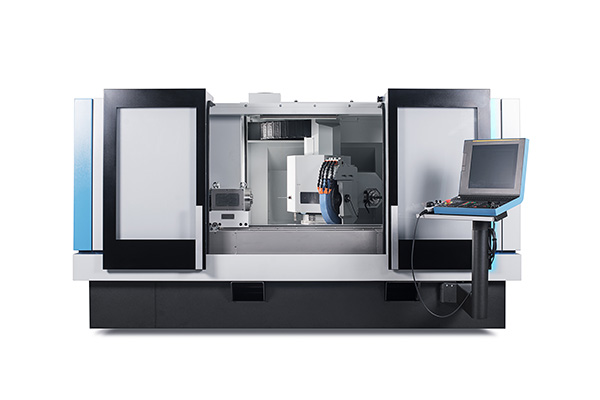
With the latest automatic machine from its HBE series, Behringer says it has come up with a way of combining the benefits of high-performance machines for one-off sawing tasks, with the solid, tried and tested characteristics of a classic mitre saw. High cutting outputs, simple handling and precise angular cuts are said to be among the key attributes of the new Behringer HBE320-523GA mitre-cutting bandsaw.

With a cutting range on flat materials of 520 x 320 mm, and bilateral mitre cuts of 45° (and up to 30° on the left), the saw has many features in common with the HBE Dynamic series. The guidance system in its torsionally rigid gantry design and bilateral band wheel bearings are intended to ensure quiet running and precise cuts. The band-guiding components are made of vibration-damping grey cast iron, which has a positive impact on the quality of the cut surface, and makes for longer blade life, says the company. Electrically powered chip brushes clean the saw blade of adhering chips synchronously with the saw drive system.
The inclined position of the band wheels helps prolong the life of bandsaw blades by reducing fatigue due to cyclical bending. A fully automatic height adjustment facility for the saw frame, and lowering of the saw when in rapid traverse, help cut non-productive time to a minimum.
The inclined position of the bandsaw blade allows components such as girders, angled steel and U-profiles, as well as hollow rectangular profiles, to be sawn at higher speed and with less burr.
For further information www.behringer.net

Bandsaw halves cutting times

Sawing tough, highly tempered steel bar for a medical engineering application presented a challenge to Bavarian tool and workshop equipment manufacturer, Werner Weitner, as cutting times were long. However, the installation of a KastoWin Pro AC 5.6 bandsaw has made production more efficient by halving processing times.
Department manager Florian Winhard says: “We had to process a highly tempered V2A [304 stainless] steel over a large range of diameters for a medical engineering customer. Our existing saws could only use bimetal blades, so cutting times were up to 15 minutes, which we felt was unsatisfactory.

“As a result, we sent a material sample to Kasto ready for trials on different saws,” he continues. “The results obtained on the KastoWin Pro AC 5.6 automatic bandsaw using a carbide blade were impressive. Cycle times of 7-8 minutes were achieved, around half the time needed by our other saws.
“A major advantage is that we can switch between carbide blades and less expensive HSS bi-metal blades at any time. So we can cut not only difficult-to-machine materials, but standard steels, economically.”
The KastoWin pro AC 5.6 is designed for a variety of applications in steel stockholding, steel production, forging mills, machine manufacturing and the automotive industry. A notable feature is the frequency-controlled, 11 kW drive motor, which allows carbide as well as bimetal blades to be used. Users can therefore be flexible in their choice of tool, reducing costs and optimising cutting speed and efficiency.
The working range of the KastoWin Pro is 560 mm and the smallest dimension that can be cut is 25 x 25 mm.
For further information www.kasto.com

Smart machining event success

A machining solutions provider staged an ‘Irish’ first when it hosted its Smart Factory Machining event last week. The Engineering Technology Group (ETG) threw open the doors at its County Kildare showroom on 6-8 March to provide around 140 delegates with an insight into the latest CNC machine technology, turnkey solutions, automation and shop floor data systems.

Working in partnership with cutting tool partner Guhring, there was a host of live demonstrations on a Hardinge V710S three-axis mill, a Quaser MF400UH five-axis machining centre and a Nakamura WY150 twin-turret, twin-spindle lathe with Y-axis functionality on both turrets. Visitors also witnessed a Hyfore workholding and tooling display, and the Halter U20 LoadAssistant in action, unloading and loading billets to a simulated lathe with three-jaw chuck – the first time this technology has been showcased in Ireland.
For further information www.etgireland.ie

Rotary tables support larger cuts

The Detron GFA series of five-axis rotary tables is now available in the UK from YMT. Critical faces on the rotary tables are ground rather than just turned for indexing accuracy and concentricity.

Users can also increase productivity with larger cuts and benefit from smooth braking without deformation of the table surface. This latter attribute is supported by Detron’s patented dual-piston clamping technology and a fully enclosed brake-drum ring operating at high pressure.
Integrated radial and axial bearings, where the spindle and bearing is one unit, add to the rigidity of the rotary table. Additionally, the dual lead worm uses a large tooth depth resulting in a contact surface 33% greater than conventional worms. To ensure long service life, reliability and thermal stability, the worm is positioned at the bottom, so that it is totally immersed in oil. These features help ensure the table is suitable for heavy-duty five-axis machining.
The motors on the Detron GFA series are control-specific, so YMT tests the installation in-house before delivering it to the customer. All Detron GFA series rotary tables have ports in the table so that they are automation-ready, giving a clear upgrade path for end users.
For further information www.ymtltd.co.uk

Clamping devices of the future

A choice of effective clamping devices for tool and workpiece avoids expensive changeover times and helps to utilise the machine tool’s potential more effectively. With this in mind, the Precision Tool Association in the VDMA (German Engineering Federation), under the aegis of the METAV exhibition last month, hosted the 3rd Clamping Technology Forum.

Intelligent holding and clamping systems are becoming progressively more important in manufacturing operations, particularly as companies are increasingly having to deal with thin-walled and very small workpieces, as well as lightweight components. Here, intelligent clamping systems offer a huge potential for optimisation, although they also have “advantages when machining medium and small batch sizes with automated parts handling, and wherever comprehensive process monitoring is required”, says Henrik Schunk, managing partner of workholding specialist Schunk GmbH.
At Metav, Schunk gave a presentation on the importance of the toolholder in the production process. The company introduced an app with which a user can receive operating states of angle heads as raw data on his mobile terminal, enabling him or her to take countermeasures against production errors conveniently over a smartphone.
Angle heads are “very cost-efficient and flexible components designed to significantly expand the functionality of machine tools. Nowadays they are essential in an innovative metalcutting strategy,” explains Konrad Keck from Benz GmbH. Advantages and possible applications of magnetic and vacuum-based clamping techniques were also showcased at Metav.
Overall, experts presented numerous solutions, which thanks to the optimised deployment of clamping devices, can render the production process more efficient and cost effective.
For further information www.metav.com