

Faro TracerSI boosts laser-guided assembly

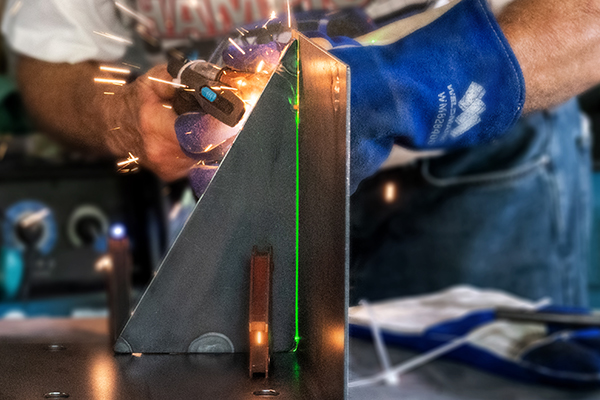
Faro has released the next generation of its Tracer platform for laser-guided assembly and verification: the TracerSI laser projection system. TracerSI is a fully integrated solution that includes improved hardware built upon the previous TracerM product and BuildIT projector software.
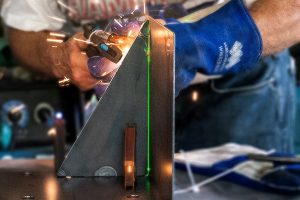
Like TracerM, TracerSI uses 3D CAD information to project 3D laser images on to a physical surface and provide a live, visually rich virtual template that assemblers can use to quickly position components with confidence. This solution can deliver significant ROI as organisations no longer have to invest capital in physical templates, such as wood or metal moulds or tools, which also have to be built, maintained, stored and sometimes repaired. Additionally, real-time manufacturing errors are minimised and, as a result, costly scrap and rework costs are reduced. There are actual, documented cases where rework and scrap savings alone lead to payback periods as short as 90 days, says Faro.
TracerSI is said to represent the first of its kind laser scanning camera, with projection and high-resolution image scanning capabilities throughout its entire projection volume. Since the laser scanning camera does not rely on lenses or conventional image capture, the depth of field is equal to the full projection range. In addition, there are no lighting limitations since it is laser illuminated, and there are no restrictions on frame size or resolution.
Faro’s TracerSI moves guidance assembly forward through its native support of feature-based alignment. As a result, retroreflectors (special targets that reflect light back to the original source) do not have to be placed on or around the object or assembly. This convenience substantially reduces the time required for set up.
For further information www.faro.com
Boosting manual 2D inspection

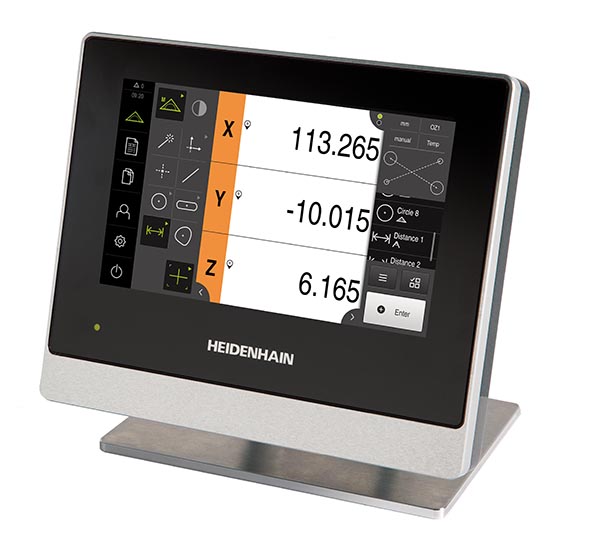
If the manual inspection of 2D components on a measuring machine, optical profile projector or measuring microscope is too time consuming or not sufficiently precise, the newly developed Quadra-Chek 2000 from Heidenhain can solve the problem.

Equipped with embedded evaluation software and a high-resolution, 7”, hardened colour touch screen, the unit has a built-in power supply, rugged aluminium housing and fan-less cooling. Heidenhain says these factors make it suitable for applications on the shop floor as well as in the inspection room.
Point acquisition using X and Y hand wheels, and perhaps also stage rotation, is simple using crosshairs or via a connected optical edge detector. The latter enables a high level of repeatability and reduces measurement uncertainty by eliminating subjective error. Predefined geometry tools record the co-ordinates of 2D features such as points, lines, circles, slots and squares, and measure the distances and angles between them. A ‘Measure Magic’ function simplifies inspection further by using the acquired points to recognise, select and fit the geometry automatically.
When dealing with complex contours and repetitive inspection, a user can automatically record the measuring routine and run it at any time. Quadra-Chek 2000 keeps track of the presets, sequence of measurements, tolerances and data output commands. When the recorded program is executed again, the unit displays on-screen user guidance detailing all of the features to be measured.
The menu-driven software is context-sensitive, showing only those functions that are available in the current measuring situation. Results are captured and displayed graphically.
For further information www.heidenhain.com

Lighting factory uses CT for quality control

Heavy-duty industrial lighting manufacturer Nordic Lights is using computed tomography (CT) to avoid the expense of destructive testing and eliminate critical measurement errors caused by powder spraying for part preparation.

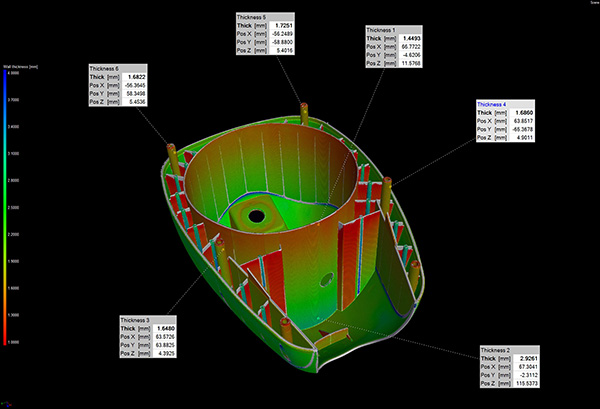
To supersede the company’s previous white light system, a new measurement solution was required capable of dealing efficiently with a variety of materials as well as both internal and external feature inspection. The Nordic Lights team consulted various suppliers to determine the best solution. A Nikon CT machine, XT H 225 ST, with dual reflection and transmission targets, has since been installed to inspect and approve components before assembly.
The primary purpose of the CT system is to validate samples from suppliers, as well as new parts and modified components from new moulds. A secondary purpose is troubleshooting. During the test phase, if there are any failures, complete assemblies can be scanned to identify the cause without having to open or destroy the product. The system has, for example, been used to search for air pockets or voids in the silicone glue between the aluminium housing and the lens of a light that has suffered water leakage. This would not have been possible with the white light system.
Test engineer Carl-Anton Manns, who took part in the search for a new inspection system, says: “The instrument needed to be able to analyse smooth reflective surfaces with high precision, which the XT H 225 ST does with repeatable accuracy. Being a non-destructive process was also a big plus point.”
For further information www.nikonmetrology.com

Okuma wins Good Factory Award

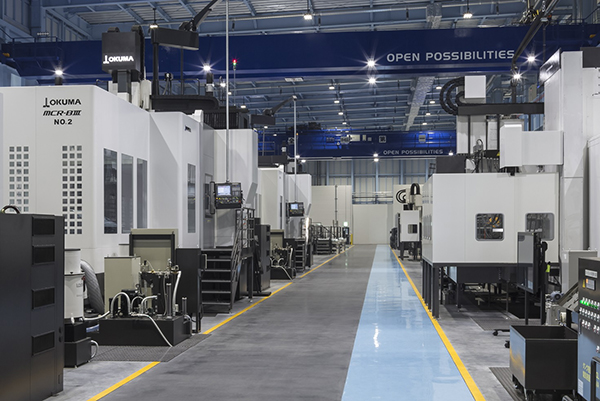
CNC machine tool manufacturer Okuma, which is represented in the UK by NCMT, has won the Good Factory Award issued by the Japan Management Association for Dream Site 2.

The facility incorporates state-of-the-art innovations developed by the company’s machining experts to achieve high-mix, low-volume manufacturing at productivity levels on par with those of mass production. The site was praised for its comprehensive and coherent use of digitalisation, its high degree of automation, and its ability to continuously optimise processes through real-time data processing.
For further information www.okuma.eu

New flagship range of measuring arms

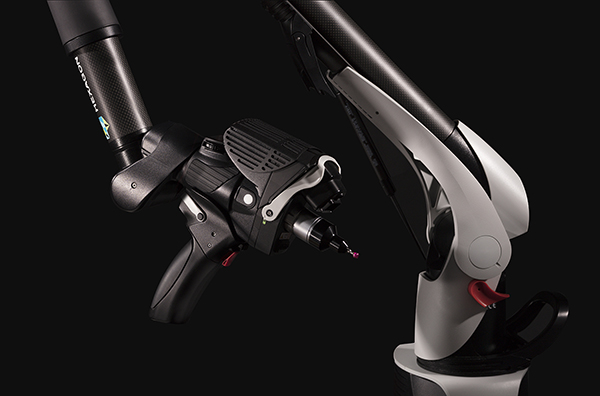
Eight years after the launch of the first Romer Absolute Arm, Hexagon’s Manufacturing Intelligence division has unveiled the latest Absolute Arm range, complete with a ground-up redesign.

A standout feature of the new Absolute Arm is its modular wrist design that allows both the RS5 laser scanner and pistol grip to be completely removed, facilitating easy probing in tight spaces. When reattached for laser scanning applications, a variety of grip sizes are available to ensure the best fit for every user. The newly developed wrist also features a display screen that allows for measurement result oversight, profile switching and calibration right at the point of measurement, reducing time spent switching attention between the arm and its control computer.
“Over the past eight years we’ve received a lot of positive and constructive customer feedback, and hopefully people will see how this has informed our design,” says Anthony Vianna, product manager for the Absolute Arm range. “Many customers told us they needed to measure in smaller and smaller spaces, like cavities or inside complex fixtures, and it was that sort of direct-from-the-user intelligence that drove us to create the most compact scanning configuration on the market today.”
The new Absolute Arm models are also available in a six-axis version designed for dedicated probing applications. Within this category is the new Absolute Arm Compact, with accuracy now to within just 6 µm. The full Absolute Arm range is available across seven sizes, with measurement radii from 1.2 to 4.5 m, and three levels of accuracy, resulting in 36 unique arm configurations.
For further information www.hexagonmi.com