

How to saw pure exotic elements

The conventional user of bandsaws and circular saw machines is familiar with sawing structural steels, tool steels, stainless steels, high-strength nickel-based alloys and titanium. But relatively few have ever machined pure elements.

For Hermsdorf-based HC Starck, sawing elements is daily practice. The company is a specialist in the supply of semi-finished products and components made from refractory metals such as molybdenum, tungsten, tantalum and niobium.

The company recently sought a suitable sawing solution for the task of cutting recycled Mo-ingots or rods made of high-purity tantalum (Ta) and niobium (Nb) with a cross-section of 160 x 60 mm, as well as round material up to 207 mm diameter, which are then cut into thin sheets. Since Behringer had no experience with element sawing applications, cutting tests took place at the company’s technology centre in order to assess various machine and tool combinations, and identify a suitable sawing solution.

“Positive sawing attempts with tantalum, which has a density of around 16.6 g/cm³, were ultimately the main reason for selecting with Behringer,” explains Andreas Mund, project engineer at HC Starck. “The sawing process is very hard; the belt rumbles constantly and you can hear how difficult it is to cut tantalum. In order to achieve reasonable cutting quality, you need a very stable base frame.”

This is where the solid machine base of the HBE321A Dynamic automatic bandsaw scores points, combining a stable frame made of vibration-damping grey cast iron and a precise guide system in a portal design. Control of the saw feed comes courtesy of a precision ball screw and servo motor.

For further information
www.behringer.net

Automated saw line drives efficiency

Ficep UK has installed a new automated saw line at Norway-based Contiga AS, helping the business to improve production processing time by up to 40%. The new system consists of a Ficep Orient, a CNC-controlled drilling and combined thermal coping line equipped with rotary single spindle. To prove the time and cost savings of the system and process, Ficep prepared time studies that presented clear indications of the returns achievable from the investment.

Contiga AS designs and develops steel solutions tailored to individual projects, delivering between 7-8000 tons of steel structures to the Norwegian market every year.

Says Mark Jones, Ficep UK managing director: “We overcame several challenges, not least that the machinery was installed during a period of Covid restrictions, but also that the space was limited, and it was important to minimise disruption and reduce operational downtime. There were also added contractual obstacles to overcome due to Contiga now being part of the huge Heidelberg Cement group, with additional levels of communication required across several countries.”

Thor Egil Einarsrud, factory manager at Contiga in Roverud, adds: “We use modern technology and work processes, as well as the best machines, to guarantee that all our steel products offer high quality. To ensure competitiveness, automation is absolutely necessary, and we’re already seeing that in several of our production processes. We save up to 50% in time by using the new automated sawing plant compared with manual operations. The system has transformed our business, allowing better efficiency and precision.”

For further information
www.ficep.co.uk

Starrett growth plans attract funding

South of Scotland Enterprise has awarded LS Starrett Company £181,000 towards a £500,000 investment project that will accelerate growth plans at its Jedburgh distribution facility. The company – which is a specialist in bandsaws and saw blades – is aiming to not only grow its current business in the UK but diversify into new sectors. This diversification will aim to create new skills, jobs and opportunities across the Scottish Borders in the coming years.

The announcement is welcome news for both Starrett and Jedburgh, which have a long association since the US firm set up its UK factory in the Scottish Borders town in 1958.

Last year, the business announced a restructure of its global manufacturing operations which resulted in the risk of losing over 100 jobs. Since then however, Starrett’s new management team – supported by 78 staff at its Jedburgh base – has successfully begun to rebuild the business, which has recorded 34% growth over the past 12 months.

Starrett is also supporting the further development of skills and opportunities through the rental of factory space to IndiNature, a sustainable construction materials business.

Says Starrett’s finance director Nicky Richardson: “Thanks to support from SOSE we’re now very excited and energised to accelerate growth into new markets as part of our half million-pound investment in the Jedburgh site.”

Commercial director Robert McKechnie adds: “Diversification into these new markets will be challenging but SOSE’s support allows us to recruit the best talent into our great team and continue driving the business forward.”

For further information
www.starrett.co.uk

Sharpening shop benefits from automation

The global pandemic has impacted businesses around the world, but for Aiguisatek, the impact was compounded by stringent local regulation in the Quebec province that all but shut down manufacturing in the area. Luckily for the Delson-based company, its investment in a Vollmer CHD 270 eight-axis TCT circular saw blade sharpening machine with Vollmer ND250 automation station enabled Aiguisatek to run unmanned production throughout the pandemic.

In 2015 Aiguisatek expanded into PCD cutting tools, increasing its offering and market share with existing customers, and gaining new clients. Since this diversification, the company has witnessed 25% year-on-year growth, expanding beyond its local customer base to support clients across the Quebec and Ontario areas. Of course, such aggressive growth, not just in PCD tooling but also TCT saw blades, required additional investment. So, in 2019 Aiguisatek acquired a Vollmer CHD270 eight-axis tooth-top and face-grinding machine with ND250 automation solution as part of a $1.5m investment programme.

Alluding to this growth, Aiguisatek president Lisa Goulet says: “PCD tooling has been a game-changer for us and has accelerated our growth. In a short time, the breakdown of our products is now 35% PCD and 65% carbide tooling. Simultaneously, our TCT saw blade department has grown by an average of 15% annually and we’re now servicing over 1000 saw blades a week. We wouldn’t have sustained this growth without our investment in the Vollmer CHD270 and ND250. Almost 90% of our customer base is in the woodworking industry. We now have three staff delivering/collecting saws and tools daily to manufacturers of everything from cabinets and furniture, through to windows, doors and the construction industry.”

For further information
www.vollmer-group.com

Robot supports sawing operations

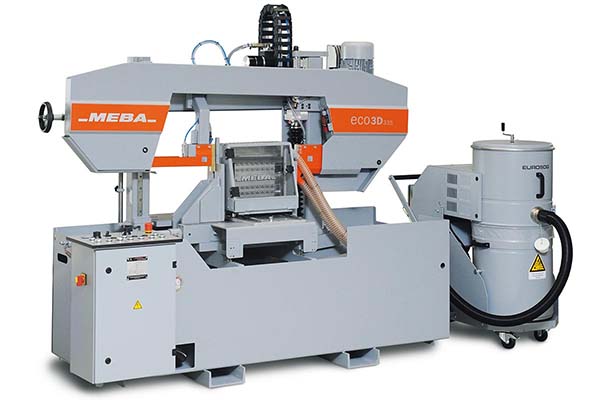
The fast, thorough cleaning of sawn parts and their location-appropriate storage: an employee of a different kind now performs this work at Schwilk Automatendrehteile – a robot. The manufacturer of turned parts from the town of Heroldstatt has opted for the MEBArobots solution in the course of further automation, matching its MEBAmat 330 bandsaw.

Managing director Jochen Schwilk says: “The robot offers us significantly more flexibility in the resource planning of employees. It takes care of tedious cleaning operations after sawing, removing chips and stubborn cooling lubricant. The robot also provides the positional storage of parts in a grid box or on special pallets.”

Previously, our employee had three Meba bandsaws under his care. However, thanks to the robot, he can now prepare other orders and has expanded his range of work in the material warehouse and incoming goods facility.

In the past, Schwilk’s cleaning process repeatedly led to production plant stoppages. However, since the robot now performs this task, stoppages are almost a thing of the past. MEBArobots is in use around the clock and delivers the same high level of work. Often overnight, the new ‘colleague’ produces parts unmanned. Should a problem occur at night, such as breaking a bandsaw blade, the robot reliably ensures that the system stops and that no consequential damage occurs to the saw or the robot.

MEBArobots contains know-how specifically geared to sawing applications. Not just any robot is connected to a saw. With the robot manufacturer Nachi and Meba, two professionals co-operate to ensure that robots and saws communicate smoothly with each other. The user receives a customer-specific system from a single source: an integrated solution.

For further information
www.meba-saw.com