

Hypertherm puts on a show

With a record number of visitors to the stand, the 19th edition of the recent Schweissen & Schneiden exhibition (Netherlands, October) was a huge success for Hypertherm. The introduction to X-Definition – the new class of plasma, the live cutting demonstrations and the interactive stand were highly appreciated by visitors.
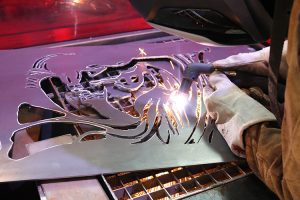
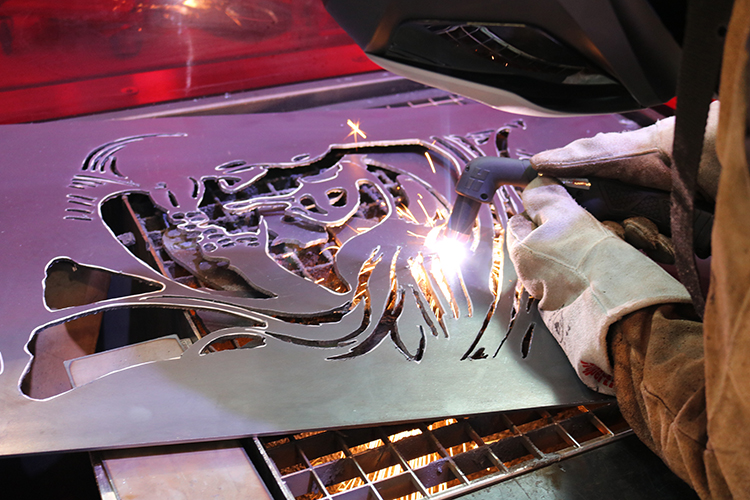
Those attending the show could attend impressive cutting displays. For instance, metal artist Marcel Boonen demonstrated the capabilities of the latest generation of Powermax plasma cutters, the Powermax45 XP, by creating steel paintings and other metal art live on the stand.
Through a live, online connection with Hypertherm’s Cutting Technology Centre at its EMEA headquarters in the Netherlands, the cut quality and speeds of the new XPR300 and XDefinition plasma were ably demonstrated.
Interactive tables that allowed visitors to browse product information, along with the virtual reality game ‘Be amaze-d’, completed the visitor interactive experiences on the stand.
“The technologies we used on our stand clearly portrayed our ‘Shaping Possibility’ company vision”, says Theo Cornielje, regional director for the EMEA region. “They allowed us to explain our technologies in depth, show the systems’ capabilities and guide visitors to the solution that best fits their cutting needs.”
Hypertherm designs and manufactures advanced cutting products for use in a variety of industries such as shipbuilding, manufacturing and automotive repair. Its product lines include plasma, laser and waterjet cutting systems, in addition to CNC motion and height controls, CAM nesting software, robotic software, and consumables.
For further information www.hypertherm.com
Mazak launches laser automation cell

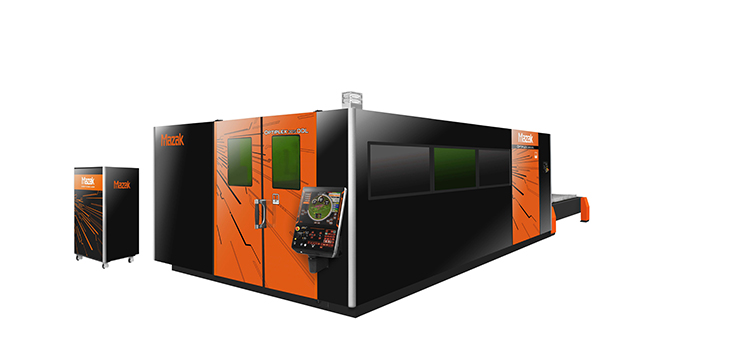
Yamazaki Mazak unveiled its latest laser automation cell at Blechexpo in Stuttgart last week. The OPTIPLEX 3015 DDL 4.0 kW laser processing machine features Direct Diode Laser technology unique to Mazak, complete with a new robotic automation system. Those requiring ultra-fast cutting and high-quality edges are set to benefit most.

According to Mazak, the OPTIPLEX DDL series can cut thin material 20% faster than fibre lasers, and thick materials with high surface quality. The machine has an axis acceleration of 1.8 G and benefits from rapid traverse rates of 120 m/min. Positioning accuracy is maintained to within ±0.05 mm per 500 mm in the X and Y axes, and to within ±0.01 mm per 100mm in the Z axis. The machine also offers repeatability accuracy of ±0.03 mm in the X, Y and Z axes.
Crucially, the OPTIPLEX DDL is a machine capable of a wall plug efficiency of 40-50%, compared with 10% for a CO2 resonator, 15-20% for a disc resonator and 30-40% with a fibre resonator.
At Blechexpo, the machine on display was shown as part of a new automation cell that incorporates a robotic arm mounted to rails adjacent to the cutting table, to load and unload workpieces. The arm can quickly change between sorting tools – which are mounted directly to the robot’s base – depending on application and the size and weight of the workpiece. To deliver fast and accurate machining, the cell’s laser table is equipped with an automatic clamp to secure the workpiece’s position on the table. This is especially useful for cutting thin vinyl-protected material.
For further information www.mazakeu.co.uk

KME upgrades Kerf plasma cutter

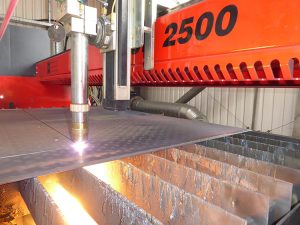
Littleborough-based Ken Mills Engineering (KME) Ltd has upgraded its Kerf plasma cutting machine with a new and larger RUR2500p. Replacing its predecessor, the new RUR2500p has an 8 x 2 m bed and a more powerful and precise Lincoln Electric Spirit II 275 A plasma unit with the very latest Ultrasharp cutting technology.

Alluding to why the company replaced a machine that has delivered exceptional performance levels, director Andy Mills says: “Our components are primarily small-to-medium batches that are cut from single sheets, which rarely exceed the 4 m bed length of the previous machine. We recognised that by increasing the bed length we could load one side of the machine while parts are being cut on the other end of the bed. This pendulum loading has effectively eliminated non-productive set-up times and reduced overall production times by an additional 50%.
“The new Kerf RUR2500p has the very latest Ultrasharp cutting technology and this has improved the precision and surface finishes of the profiles and holes we cut,” he continues. “Additionally, there is less cleaning, no secondary hand finishing and less dross from the process.”
As well as offering precision levels in the ±0.5 mm range, the Lincoln Electric Spirit II plasma unit has the capacity to pierce materials up to 35 mm thick.
Concluding on the benefits of the machine acquisitions, Mills says: “In combination with a new press brake, the Kerf machine is saving us upwards of £250,000 a year in subcontract costs. Added to this, we are saving around £150,000 a year in material, and there are fewer transport costs as we don’t deal with subcontractors.”
For further information www.kerfdevelopments.com

Revealing the future of laser technology

Trumpf presented tomorrow’s laser technology at the ‘Laser – World of Photonics’ trade fair in Munich last month.
A new beam guidance concept for ultra-short pulse lasers took centre stage. At the moment, it is technologically impossible to send ultra-short laser pulses down a flexible glass fibre to the workpiece – the laser pulse is so intense that it destroys the glass fibre. However, Trumpf has a new concept that gets around this problem and enables new ways to flexibly integrate lasers into machines and facilities.
“This is a real game-changer,” says Klaus Löffler, managing director and head of sales at Trumpf Laser und Systemtechnik GmbH. “Some 30 years ago the first laser light cable suitable for industrial use proved the breakthrough for solid-state lasers; our new beam guidance concept promises to do the same for ultra-short pulse lasers today.”
New diode laser technology was another highlight at the show. With it, Trumpf says it is laying the foundations for “green production” in industrial manufacturing. The company presented a diode laser that is not only suitable for conventional applications such as soldering, hardening and laser deposition welding, but can also handle industrial applications that require significantly higher beam quality. A clear advantage of diode laser technology is its high efficiency.
The TrumpfDira product range, specially designed for applications in the research sector, was also on display. These laser amplifiers deliver high-energy picosecond pulses combined with high repetition rates; for instance, to pump optical parametric amplifiers.
For further information
www.trumpf.com

US banker becomes UK sheet metal subcontractor

Former investment banker Troy Barratt believes passionately in promoting manufacturing in the developed world – so much so that he gave up his career in Wall Street and then the City of London to buy a subcontract sheet metal fabricating business in Sittingbourne.
In 2012 he purchased 28-year-established sheet metalworking and fabrication company, Contracts Engineering Ltd (CEL) from the previous owners, who wanted to retire. By 2016, turnover had doubled to £2 million per annum.
Part of the £600,000 invested during that time has been used to purchase a BystronicBySprint fibre laser cutting machine capable of processing sheet up to 3 x 1.5 m using a 2 kW fibre laser source. Bought in January 2017, it replaced a 3 kW CO2 laser cutter of the same sheet size capacity dating back to 2002. The new machine joins two pre-existing 100-tonne Bystronic press brakes on the shop floor and a turret punch press acquired in 2013.
“When we took over CEL, the CO2 laser machine’s utilisation rate was under 50% over an 8-hour day shift plus nearly daily overtime,” says Barratt. “We quickly moved to a double shift, 16 hours a day, put a Bystronic service contract in place, and were able to raise the time the machine was cutting to 60%. This is among the highest in the industry for subcontract manufacturers.
“Since the BySprint started operating in early February, utilisation has increased further due the machine’s reliability and efficiency features,” he continues. “We ran it 24/5 for a while to remove a backlog of work and get in front of orders, which allowed us to minimise the cost of bought-in subcontract services during the transition period.”
For further information
www.bystronic.co.uk