

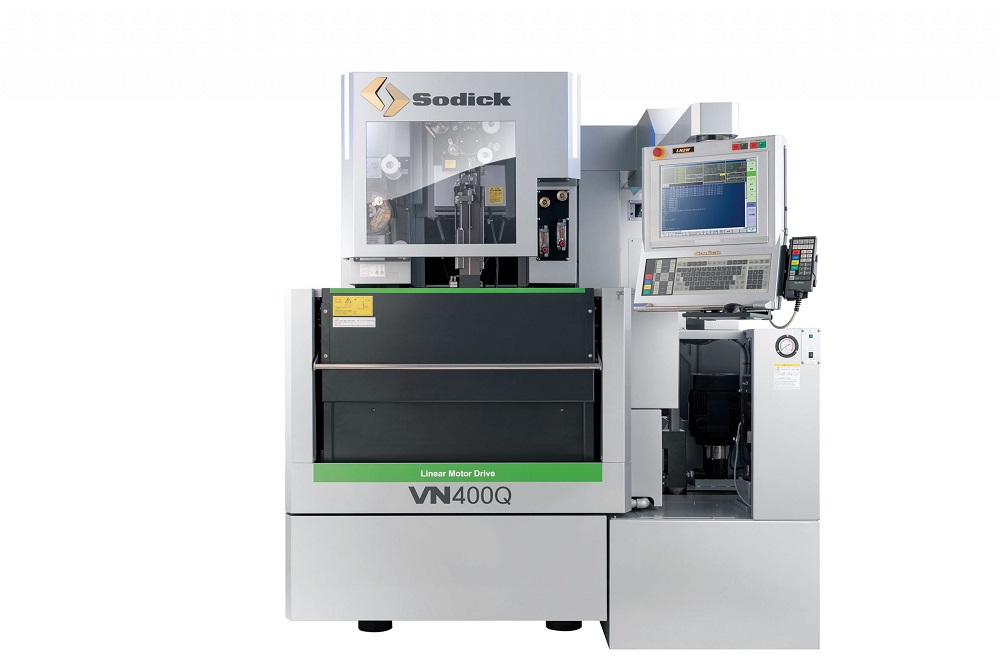
Eliminating wire breakage and reducing consumption

GF Machining Solutions’ new iWire technology automatically adjusts wire speeds to changing part/feature heights and erosion conditions, thus helping to optimise the wire EDM process.

iWire technology, available on advanced AgieCharmilles wire EDM machines, automatically identifies and adjusts wire speeds to changing erosion conditions, helping to eliminate wire breakage and reducing overall wire consumption per job by over 25% in some instances.The iWire function works in tandem with the company’s Intelligent Spark Protection System (ISPS), both being key features of the company’s UNIQUA control.

Building on its technological knowledge of the EDM process, the company’s machines identify and measure the exact location of each spark along the length of the wire.This information enables iWire to adjust the wire spool speed accordingly, preventing the chances of wire breakages. GFMS says this capability is a tangible business benefit during lights-out and unattended operations when machining complex ‘stepped’ parts and/or features that have variable heights, for example.

Both ISPS and iWire help prevent wire breakage and, as a consequence, reduce wire usage and assist in controlling consumable costs and increasing machine uptime.In recent tests, iWire working in tandem with ISPS prevented wire breakage on a part with numerous features with varying heights.The cut started at a standard spool speed then, when the cutting height reduced, the speed slowedautomatically. As a result, the company observed wire savings equating to about 480m or 0.2kg, and processing times saw a corresponding reduction of 30%.
For further information www.gfms.com

£400,000 investment marks 50-year anniversary

Erodex Group, a UK specialist in the design and manufacture of graphite electrodes, tooling and fixtures, is celebrating 50 years in business by investing £400,000 in automation at its machining facility in the West Midlands.

This year marks half a century of trading for the family-owned firm, whichis looking to the future with the purchase of an automated pallet loading system to work in co-ordination with its existing high-speed machining centres.As a result of the investment, the company expects to maximise efficiencies and output within a high-volume area of the business; creating capacity without the need to layer-in additional shift patterns.In addition, the alignment of existing machining capacity with automation provides Erodex with a portfolio that it has previously been unable to offer customers, therefore creating new business opportunities.

The company’s state of the art machining facility in Wednesbury has been established for over 35 years, enabling Erodex to machine its wide variety of graphite grades into highly complex components for a range of industries.

Steve Rolinson, director at Erodex Group, says:“Further investment in our machining facility represents the next stage of business evolution. Since the mid-1980s, the Erodex Group has enabled customers to benefit from the capabilities of our ISO9001-accredited graphite machining facility, which is widely regarded as the best graphite machining facility in Europe.Continued planned investment as part of our continuous improvement programme – including in automation – means we’re well placed to capitalise on market opportunities moving forward and further reinforces our position as UK leaders in the design and manufacture of graphite electrodes, tooling and fixtures for the aerospace and IGT sectors.”
For further information www.erodex.com

Wire EDM sparks productivity gains for Go Tools

Set up in 2012 to deliver precision tooling to companies in the north of England, Go Tools Ltd is a specialist manufacturer of precision die-cast dies and injection mould tools for a multitude of sectors. With an unwavering commitment to quality and service, the company has invested in high-end machine tools from the Engineering Technology Group (ETG).

One point of concern was an ageing EDM machine.Recalling this, Go Tools technical director Steve Barrowcliff says: “Our old EDM machine had inconsistent cut quality and poor precision levels that made us rely on the expertise of our staff to retain tolerance and surface-finish requirements. As an old machine, it was also unreliable and a potential concern due to the amount of EDM work going through the shop floor. We investigated the market and the Mitsubishi MV1200R wire EDM was the perfect fit for our business. The programming platform of the Mitsubishi EDM was 10 times better, as was the accuracy and the speed of cutting. Simultaneously, we needed a spark erosion EDM, so we also invested in the OPS Ingersoll Gantry Eagle 400 – both machines were the result of the technical expertise and support of ETG.”

This first delve into Mitsubishi EDM technology proved a resounding success with productivity, reliability and quality improving significantly. So, when the company found its Mitsubishi MV1200R EDM at capacity some years later, the company naturally went out and bought another machine that was the same as the first.

“Our first Mitsubishi MV1200R improved our cycle times by more than 50% and the precision levels and surface finishes were impeccable, so when it came to buying a second machine, we didn’t need to look anywhere else,” concludes Barrowcliff.
For further information www.engtechgroup.com

AFRL upgrades rocket fabrication capabilities

The Rocket Propulsion Division, part of AFRL’s Aerospace Systems Directorate, recently modernised its fabrication shop in California with five new CNC machine, including a wire EDM machine, a die-sink EDM machine, a small-hole EDM, CNC milling machines and three CNC lathes.

“The recently upgraded machines provide AFRL with an increased capability to fabricate components of higher complexity and provide customers the benefit of being able to keep more of their work on-site, reducing program costs and turnaround time,” says Ben Gleason, lead fabrication technician. “The machines are equipped with similar CNC control units to lessen operator training. More accurate spindles and electronic part probing reduce set-up time and increase precision.”

Specifically, the new equipment will increase accuracy on multi-sided and complex parts, while improving operator safety and allowing for a cleaner, safer working environment.

“The unique skills of these devices allow them to machine tight tolerances with exotic materials such as superalloys, additively manufactured metals, polymers and composites,” says Lt Col Ammy Cardona, AFRL branch chief and materiel leader for the Experimental Demonstration Branch.

AFRL’s Rocket Propulsion Division designs and manufactures components for liquid rocket engines and solid rocket motors. The newly upgraded fabrication shop allows the laboratory to manufacture unique, one-of-a-kind rocket components that scientists and engineers can test in experiments, such as proof of concepts for new technologies.

The automation of the new machines will also ensure product quality and timeliness, which helps the team make accurate decisions of scheduling and production to meet the demand of AFRL’s test schedule.

“The new machines support highly precise cuts which eliminates waste and saves money on material and human error in the fabrication process,” says Gleason.
For further information www.afrl.af.mil

Protolabs posts new speed record with System 3R

When it is seen how Protolabs uses a System 3R pallet system in the ever-tougher ‘lead time race’, it is easy to see why the company asserts that it is the world’s fastest supplier of both CNC milled and injection moulded components.

Regarding speed, operational reliability and repeatable precision, Protomold and Firstcut, the two elements in the company’s operations, both benefit greatly from System 3R’s Macro system. This applies equally to the manufacture of moulding tools and the milling of components.

All workpieces are mounted on Macro pallets. Thanks to the properties inherently offered by the patented 3Refix system’s guaranteed positioning, Protolabs can move the pallets from one machining process to another without jeopardising precision, no matter how many such moves the total process requires.

“Over the past four years, System 3R has undoubtedly helped us cut lead times considerably, if not to say dramatically,” reveals Lee Ball, production director.“Speed is the essence of our mission to supply customers with injection moulded or machined components. Protomold is really fast in supplying injection moulded parts to customers. We would not be able to produce moulding tools fast enough if we couldn’t first make the necessary graphite electrodes. Macro is with us all the way. Furthermore, the system is so easy to use.”

By combining the production processes in its Haas CNC milling machines and Agie-Charmilles die-sink EDM machines, Protolabs can rapidly supply parts made in the desired material. This is vital not only in each prototype project but also in the production of test pieces and the reproduction of unavailable, obsolete or faulty components.
For further information www.system3r.com