


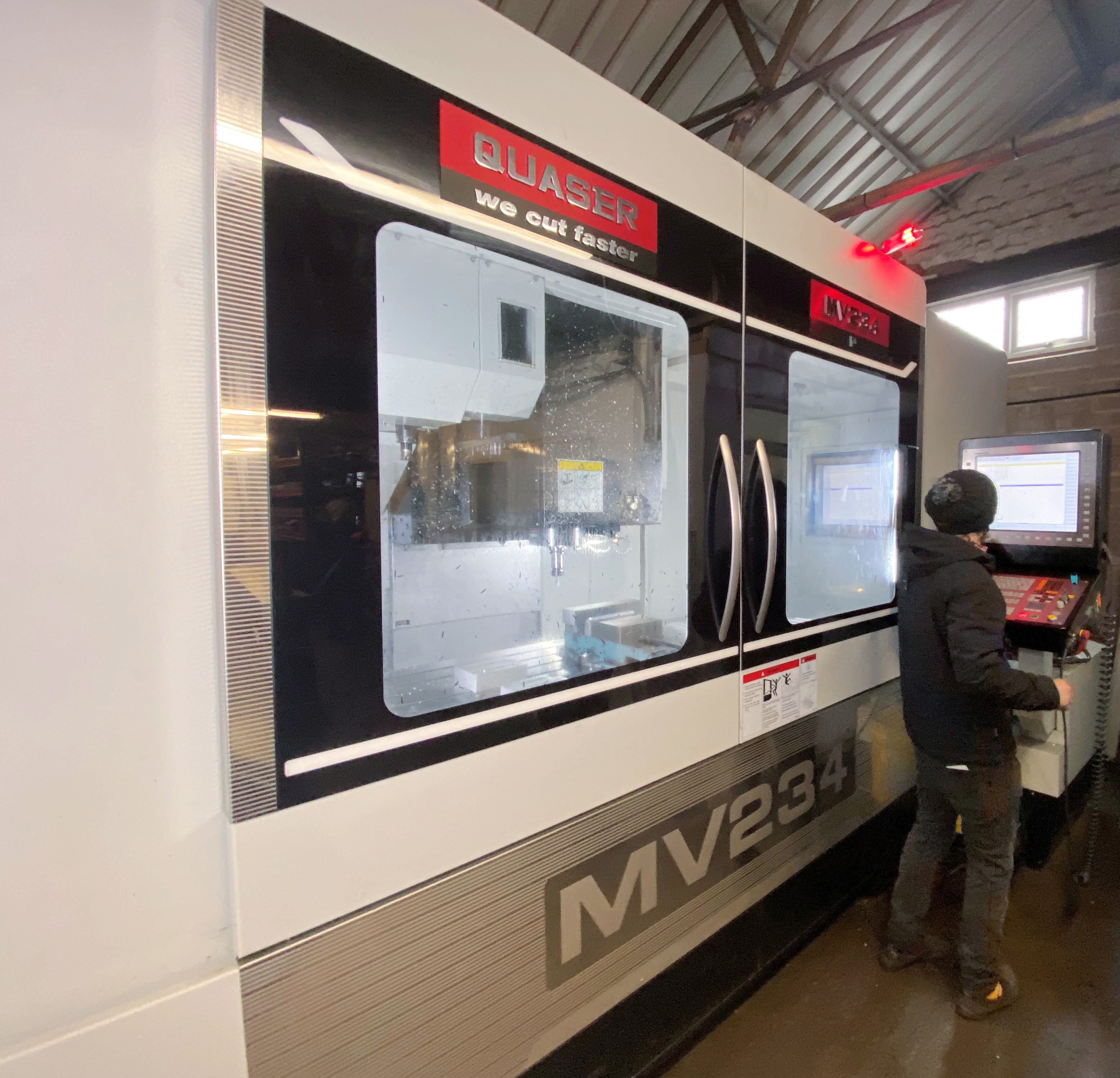
Founded in 2000 as a subcontract machine shop, Little B Engineering manufactures everything from prototypes and small batches to production runs for a diverse range of sectors. When the company recently needed to add capacity, the Banbury-based precision manufacturer opted for the Quaser MV234 machining centre, the company’s third machine from the Engineering Technology Group (ETG).
The nine employee business has a broad range of machine tools for servicing customers in industries that extend from Formula One and automotive, to construction and luxury goods. When the company won a new contract back in 2015 and it needed a new three-axis vertical machining centre, Little B Engineering opted for the compact Quaser MV154P, starting its relationship with the ETG.
Managing director Michael Banks says: “I wanted a new machine with a Heidenhain CNC, and all machines in our price range at that time had Heidenhain CNC units retrofitted, not factory fitted standard control systems. Another point we found was that lots of machine tool vendors offered machines at a great entry price point, but every feature was an optional extra at significant cost. The base model Quaser MV154P from ETG had everything we needed at a standard cost, and it has been a phenomenal machine.”
A year later the company needed a turning centre and, with the service from ETG proving far beyond that of alternate machine tool vendors, Little B opted for a Nakamura AS200L twin-spindle turning centre from ETG.
“The Nakamura AS200L has a twin-spindle, single-tool turret with Y axis and we use it for everything from small quantities of complex parts through to batches of 5000 and beyond, where it will run unmanned all weekend,” explains Banks. “It is, without doubt, the best and most flexible turning centre a subcontract manufacturer could buy.”
With the company progressing to large aluminium extrusion components and steel mould tool projects with new customers, the Oxfordshire business needed a large-bed machine.
“The Quaser MV234 gives our business plenty of flexibility, so if we want to machine something particularly large we can, but if we want to make smaller parts that is also feasible,” states Banks. “We’ve put up to 10 vices on the machine and, by using different fixtures, we’ve clamped up to 40 parts on the bed and let the machine run unmanned over the weekend. This gives us complete flexibility and the facility for both large parts and small part batch production. This is something that we need as a subcontractor.”
Discussing how the Quaser MV234 machining centre has supported growth at the company, he adds: “Firstly, buying this machine has given us extra capacity, which we needed. Secondly, it’s given us the facility to machine large aluminium extrusion components, which is a sector that is very vibrant in the UK at the moment.”
The Quaser MV234 machining centre was the machine of choice with its 2.25 m by 800 mm bed that can facilitate components beyond 2 m in length. In addition, the machine offers X, Y and Z-axis travel of 2040 by 800 by 661 mm, a table load capacity of 2000 kg and a BT40 spindle taper with 48 tool positions as standard.
As a company that has previously invested in Quaser machines from ETG, Banks says: “We’ve stuck with the Quaser brand because the machines are perfect all-rounders. The MV234 can do anything. It’s not a super-high-speed machine that can only cut aluminium, it’s a fast and powerful machine that can handle any material and provide us with impressively short cycle times.”
He continues: “We have it running both days and lights-out unmanned. When we have large, complex 3D milling work, we leave the machine to run through the night. It has a really nice feature when it automatically shuts down after it’s completed the machining of a part. The machine is generally running from 07:00 to 22:00 every day. We’ve made everything from small 19 mm diameter button components through to 2 m parts over 2 tonnes in weight. For a subcontracting company that machines a wide variety of parts in different batch sizes, the Quaser brand is bang on. The machines are fast enough to do very quick turnaround and flexible work, but are also robust in their build quality to cater for heavier and more demanding components.”
As standard, the robust Quaser MV234 package incorporates a host of high-specification features such as: an oil chiller; 4th axis preparation; BBT spindle attachment; remote pulse generator; coolant system with wash gun and 20 bar through spindle coolant; air blast; external chip conveyors; 20 m/min rapid feed rates; and positional and repeatability accuracy of 0.008 and 0.004 mm respectively.
“All of these features are standard on the Quaser, while it also has some quirky unique features like the internal swarf screw,” says Banks. “This rotates in the opposite direction to other machines, compressing the swarf and draining the coolant before the chips exit the machine, making it a much cleaner machine than any other brand we have.
“From a performance perspective, the MV234 allows us to run lights out, which is what we need,” he adds. “For example, we recently ran a batch of 10 parts on the machine in a single set-up and each component had a machining time of over 5 hours, which meant we could load the job to run all weekend unmanned. Additionally, the faster feeds and speeds and a more powerful control has seen us take some jobs from a 6 hour cycle time to just 30 minutes.”
Now having three machines from ETG, Banks explains why ETG is the machine tool partner of choice: “As a business, they look after us well and the support is great. No other company has supported us like ETG. When we bought our Nakamura-Tome AS-200L turning centre, they delivered and installed the machine within a week of us placing the order. On the new Quaser MV234, we wanted to wait 6 to 7 months before installation and ETG kept the machine available, so we could bring it in when it suited our business. As soon as we were ready to install the machine, we gave ETG the ‘go’ on a Friday and it was installed on Saturday and fully commissioned in another 3-4 days.”
For further information www.engtechgroup.com