Margins in subcontract machining are measured in microns and seconds, with every process
variable presenting a cost implication that demands scrutiny. Yet one of the most critical
elements, cutting fluid, is easy to overlook. At Numachine Ltd, that oversight has been
addressed through a partnership with Oemeta UK, which has delivered measurable
improvements in tool life, component cleanliness and operational sustainability.
Established in 2019, Numachine specialises in the CNC machining of complex components
where cost reduction, repeatability and accuracy are paramount. The company has invested
in the latest manufacturing and metrology equipment to build an enviable reputation in the
automotive, medical and aerospace sectors, where quality standards are uncompromising.
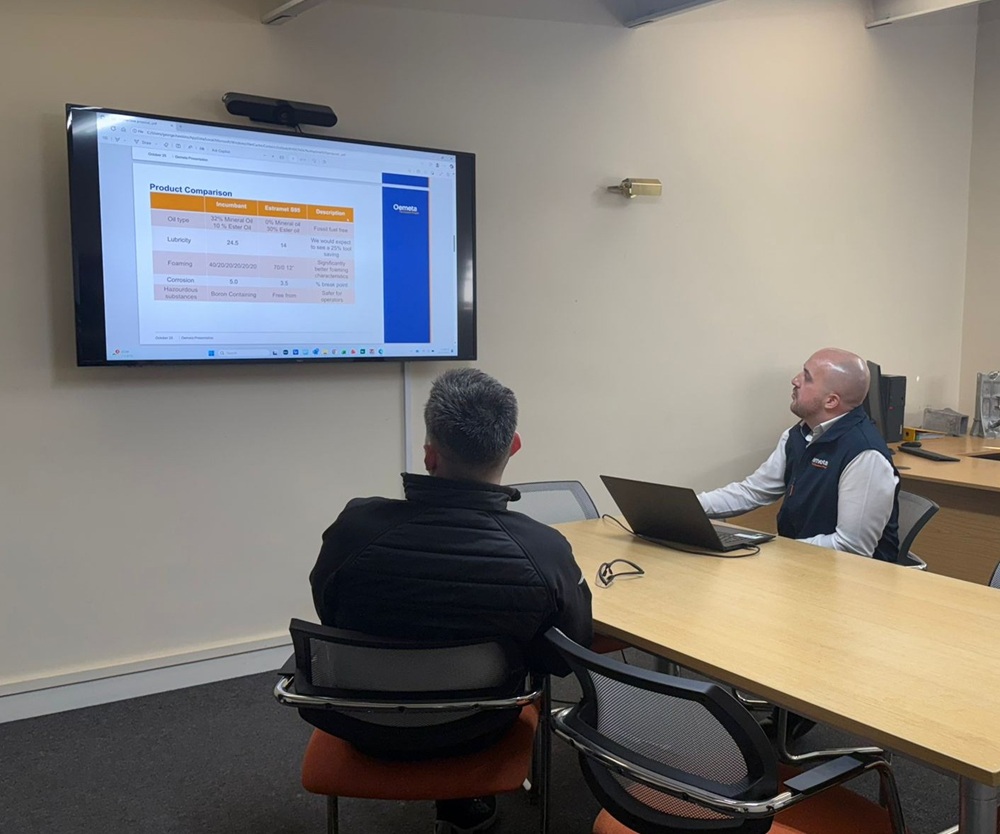
Roughly six months ago, Numachine invited Oemeta’s Ryan Aviles to assess its metalworking
fluid requirements. The company existing coolant was presenting persistent issues that
were impacting both productivity and profitability.
“Predominantly, we had issues with our tapping and threading on the machines, especially
in castings,” says managing director George Hawkins. “The taps weren’t lasting as long as
they should.”
He continues: “When tapping castings, if the tap breaks or wears it scraps the component,
which is a significant time and cost to us. Also, when we removed parts from the machine,
they carried a residue of coolant which would fall on the floor or the bench. This was not
only a cost but also a slip hazard.”
Aviles recognised that the challenges required a methodical, data-driven approach: “The
relationship with Numachine started six months ago. They invited us in for a meeting where
they shared their coolant challenges. They were spending too much on their tooling and
were facing sticky residues on components and machines. Numachine also wanted a more
sustainable solution.”
After analysing the situation, Oemeta’s technical team identified the root cause of the
residue formation.
“We identified two ingredients which could be the cause of the residue formation,
subsequently removing them from the process by introducing a replacement coolant,” says
Aviles. That coolant was Oemeta’s ESTRAMET S95, a metalworking fluid that addresses all
Numachine’s concerns simultaneously.
“We recommended ESTRAMET S95 as it’s free from fossil fuels. It’s made up of ester oil,
which is essentially a vegetable-based oil, providing Numachine with a sustainable solution.
Additionally, we looked at the data and realised we could also deliver a 20% increase in
tooling efficiency.”
The formulation of ESTRAMET S95 represents a significant advancement in technology.
Based on renewable ester oils rather than mineral oils, Oemeta says the fluid delivers
superior lubrication characteristics at the cutting edge, reducing friction and heat
generation during demanding operations such as the tapping of cast materials. This
enhanced lubricity translates directly to extended and consistent tool life, critical for
machining expensive castings that undergo a significant level of machining.
The ester base solution has a formulation that also exhibits low residue characteristics. This
means that components emerge from the machine clean and ready for subsequent
operations, eliminating the secondary cleaning steps previously required. Beyond
performance, ESTRAMET S95’s environmental credentials align with Numachine’s
sustainability targets. The elimination of fossil fuels reduces the carbon footprint of the
machining process, while the renewable ester base offers improved biodegradability
compared with traditional mineral oil-based coolants.
Before committing to a complete changeover, Numachine and Oemeta agreed to a six-
month trial period with clearly defined key performance indicators (KPIs). Following the
trial, Numachine is still witnessing improvements in KPIs such as tool life, misting,
component residue and foaming.
Reports Aviles: “From day one, Numachine noticed that coolant residue was eliminated and
parts were coming off machines clean, saving secondary part cleaning. Tool life also
improved, reducing tool spend to a level that covers the additional cost of the coolant and
more.”
The 20% increase in tooling efficiency translates directly to bottom-line savings, with
reduced tool purchases, fewer machine stoppages for tool changes and decreased scrap
rates from tool breakage.
“Since introducing Oemeta’s ESTRAMET S95, we’ve reduced our consumption and costs for
taps and thread mills by almost 40%,” says Hawkins. “Machining castings is a large part of
our business, so we’ve analysed this closely. On a regular batch of cast parts that require 42
holes tapped to 3xD, we were changing taps every 60 parts – it’s now every 90 parts.”
The benefits of ESTRAMET S95 extend well beyond tool life and component cleanliness. The
reduction of in-machine misting creates a healthier working environment and reduces part
changeover times. Furthermore, lower foaming characteristics ensure consistent coolant
delivery to the cutting zone, eliminating the performance variability that foam can cause in
high-speed machining operations.
Says Hawkins: “The misting of machines and coolant evaporation has completely
disappeared, while the noticeable smell of coolant in the workshop has gone. It makes the
working environment a much nicer place to be and, as we have a target of achieving ISO
14001 accreditation soon, we know that changing coolant will be a major benefit in our
drive to certification.”
Commenting on the rollout, Aviles adds: “We extended the trial to two additional machines,
topping up over Numachine’s existing coolant to demonstrate compatibility and avoid
complete tank dumps. This approach proves that ESTRAMET S95 can be introduced
gradually without the expense and downtime of complete system flushes. Six months into
the partnership, Numachine has started rolling out our coolant across all machines. With
our support, we aim to make the transition as smooth as possible, sampling all machines
initially to assess their condition.”
Reports Hawkins: “We used to go through a barrel of coolant every two to three weeks, but
since adopting Oemeta, we’ve only used two full barrels, which equates to one barrel every
six weeks – a 100% reduction in cutting oil consumption.”
For Aviles, supplying the product is only the beginning of the relationship.
“Aftercare is critical to everything we do. We need to make sure we’re keeping the coolant
in top condition. Our technician regularly visits Numachine to undertake coolant testing,
providing detailed feedback reports.”
This ongoing technical support ensures the coolant continues to perform optimally
throughout its service life. Regular monitoring identifies any developing issues before they
impact production, while the detailed reporting provides Numachine with quantifiable data
on coolant performance and condition. This proactive coolant management extends fluid
life, ensuring operational and economic benefits continue long-term.
“With Oemeta, the machines are much cleaner at our scheduled clean-out dates, making
our turnaround times much shorter and reducing our costs and labour input by 50%,”
reveals Hawkins, who is unequivocal about the value Oemeta has brought to Numachine.
“We chose Oemeta because of their technical support. Ryan monitored everything and
included us every step of the way. If anybody is looking for a new coolant supplier, I would
recommend Oemeta.”
Concludes Aviles: “We’re committed to delivering innovative, sustainable solutions that
make a difference for our customers. The successful partnership with Numachine
demonstrates our dedication to quality, performance and service. We look forward to
building a long-term relationship based on trust and shared success.”
More information www.oemeta.com