XYZ machines elevate stairlift specialist

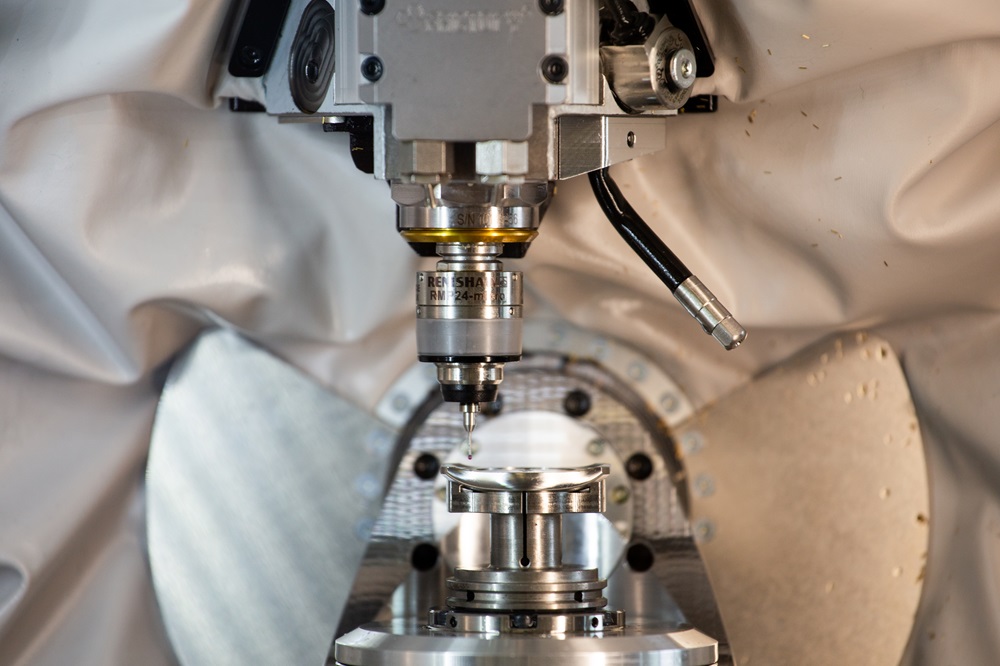
XYZ Machine Tools is helping Handicare to maintain the accuracy, rigidity and quality of its stairlifts by machining the mating surfaces of its tubular components using an XYZ RMX 3500 bed mill for straight sections and an XYZ RMX 4000 bed mill for curved sections.

Among Handicare’s UK manufacturing facilities is its Kingswinford, Birmingham plant, where the company designs and manufactures straight and curved stairlifts, producing more than 50 every day. The key element of each stairlift is a pair of tubular runners with welded gear racks. These support the seat and, with its pinion drive and rollers, allow it to transport the user smoothly and safely between floors.

Nabil Mohamed, production engineer at Handicare, says: “For straight stairlift sections, the tubes and gear racks are welded together by  a robot and cut to length. We leave an excess of 0.5 mm which we machine off using the XYZ RMX 3500. This process ensures that the gear profile on the rack is perfect when we join the tubes.”

The XYZ RMX 3500 is dedicated to straight sections and has a set of fixtures on the bed, each designed to lock into the gear profiles and position the tube in the exact position required to mill across the end and generate an accurate gear profile and tube length. The open design of the bed mill makes it possible to work with long tube sections that overhang the bed.

For curved profile stairlifts, the process is similar with tube sections machined on the XYZ RMX 4000. This machine has a larger bed of 1474 x 355 mm and fixtures loaded to suit the end-machining of curved sections.

For further information www.xyzmachinetools.com

ENERGY EFFICIENCY IN FULL FORCE AT HIGHLY AUTOMATED SANDVIK COROMANT PLANT

The Gimo, Sweden production facility of Sandvik Coromant, a specialist in the design and manufacture of premium metal-cutting tools and machining technology, is tapping into the benefits of VERICUT Force from CGTech. The company is using this physics-based software, which analyses and optimises cutting conditions during component machining, to deliver savings in both cycle time and energy consumption.

Sandvik Coromant’s Gimo production plant manufactures tool bodies (holders) for indexable-insert cutters used in milling, drilling and turning operations. The facility produces a catalogue of around 15,000 standard products, as well as customised tools. However, Gimo is no ordinary plant. In 2019, the World Economic Forum recognised the factory as just one of 16 digital ‘lighthouses’ worldwide for the fourth industrial revolution (Industry 4.0). And it is clear to see why.

The Gimo site is up and running 8760 hours per year and features extensive automation. In fact, the whole night shift is unmanned, operated by hundreds of industrial robots and automated guided vehicles (AGVs). Furthermore, a digital ‘thread’ runs throughout the factory that automates everything from customer order to despatch, with data feedback from production to the company’s systems supporting process analysis and continuous improvement.

“When a customer places an order it triggers an automated design process based on parametrics,” explains Sandvik Coromant production engineer Björn Ljunggren. “The next step is preparation for production, namely the automatic generation of programs for robots, measuring systems and machine tools. Machine programming includes comprehensive verification and simulation using VERICUT.”

VERICUT ensures stable processes, which are essential for unmanned operations. The site has been a VERICUT user for over 10 years, recording no machine crashes in that time. Now, the Gimo factory is introducing VERICUT Force for program optimisation to this part of its automated process.

At Gimo, the whole set-up simply runs by itself in the plant’s specially created automated batch mode environment. There are no design engineers or production engineers sitting in front of CADCAM stations. Instead, the system determines everything automatically, including workpiece material and lead-time requirements.

While machining optimisation using VERICUT Force serves to reduce cycle time, the Gimo site wants to leverage the benefits of this software to help with a bigger ambition: becoming carbon-neutral by 2035.

“Our goal is energy-efficient manufacturing: reducing energy consumption and increasing sustainability,” explains Ljunggren. “That’s why we’re moving beyond simulation and verification to optimisation with VERICUT Force. Reduced production time and energy-efficient manufacturing go hand-in-hand.”

The reduction of program time using VERICUT Force relates to less spindle time, fewer motors running, less coolant pumps in use and so on. As a factory, Gimo monitors its energy consumption very closely. This busy site currently consumes 56-58 MWh of electricity every day. To draw a comparison, UK energy regulator Ofgem estimates that a typical household in England, Scotland and Wales uses 2.7 MWh per year.

To assess VERICUT Force, Sandvik Coromant requested a trial involving the machining of a popular drilling product, CoroDrill DS20. The material for this drill is a premium tough steel with a high hardness value. Machining took place on a new STAMA CNC vertical machining centre featuring a number of sensors that help monitor electricity consumption, not just of the machine, but also the compressed air system, high-pressure coolant pumps and so on.

The trial involved the use of VERICUT Force on roughing operations, predominantly adaptive milling and slot milling in the chip space and flutes of the drill, while running the VERICUT Air Cut Optimization module on remaining compatible operations. Advanced data management software at the Gimo site logged all machine data for comparison purposes.

“When running VERICUT Force optimisation we saw a 15% reduction in energy consumption: that was our bottom-line result for the whole machining process,” states Ljunggren. “Of course, it depends on what components we run, our running hours and the price of a kWh.”

To provide transparency, the calculation was based on machining three drill holders per hour, with the machine running 16 hours a day. Comparing data from before and after VERICUT Force optimisation revealed a 0.59 kWh saving per workpiece: a 15.3% reduction. This equates to a saving of 1.77 kWh per day and more than 10,000 per year. At an electricity price of 28 cents per kWh the financial saving would translate to €3,000 per machine, per year.

This outcome shows that a typical machine shop running 10, 20 or 30 machines can achieve savings of up to €30,000 (10 machines), €60,000 (20 machines) or €90,000 (30 machines) per annum based solely on reductions in energy consumption. Further savings will result from faster cycle times, extended tool life and increased capacity.

With the trial based on just one machine, the potential net effect for Sandvik Coromant’s Gimo facility is huge, both in terms of financial savings and sustainability. The factory is home to around 400 machines.

“Of course, some extra savings come from a reduction in cycle time,” explains Ljunggren. “With Force optimisation our trial showed a total cycle time reduction of 12% for the drill bodies.”

The Gimo facility is now in the process of rolling out the use of VERICUT Force optimisation to other drill product families. Two cells housing six machines already run the software; this will rise to 11 machines by the summer of 2024.

“Force doesn’t take long to learn: you basically select the material, specify some optimisation parameters and just run it. We had great support from CGTech throughout the adoption process, both globally and here in Sweden, which really helped ensure the success of this project.”

For further information www.cgtech.com

Deal signed for largest UK robots

Aerospace automation specialist Loop Technology has signed a deal with FANUC UK for
seven new robots – including the largest industrial robot ever ordered in the UK, the FANUC
M-2000iA/1700L. Three FANUC M-2000iA/1700L six-axis robots will be delivered to the
University of Sheffield Advanced Manufacturing Research Centre (AMRC) for its new
innovation facility in South Yorkshire.
Part of Project Compass (Composites at Speed and Scale), the Loop/AMRC deal also
encompasses two further FANUC M-2000iA robots: a 1200L and a 900L model. As part of a
separate project, another 1700L model, along with an additional 900L unit, have been
ordered by Loop Technology to form part of a high-rate composite preforming cell for a
North American aerospace client.
For further information www.fanuc.eu

£10m heavy engineering plant

Subcontract manufacturer, WEC Group, is constructing a state-of-the-art 60,000 sq ft heavy
machining and fabrication facility in Blackburn. The development marks a significant
milestone in the group’s ongoing expansion strategy and is set to become one of the largest
subcontract machining plants in Europe, serving sectors such as nuclear, defence, offshore
and general engineering.


The facility will feature six large CNC machining centres capable of handling components up
to 20 m in length and 5 m in diameter. This will significantly expand WEC Group’s existing
capabilities, which include a trio of large Correa and an Asquith Butler travelling column
milling machines. The new plant is expected to create 60 new jobs, including 10 additional
machining apprentices.
For further information www.wec-group.com

Injection mould maker automates machining

Based in Budapest, Euroform provides an injection mould-making service from design to
production. The firm currently uses eight machining centres from DMG Mori for tool
production, including DMU monoBLOCKs, an HSC 75 linear and, most recently, a DMU 100 P
duoBLOCK. The latter features a PH Cell 2000 automation system for pallet handling to allow
unattended production at night and during the weekends.
The five-axis simultaneous machining of workpieces up to 1100 mm in diameter by 1600
mm long and weighing 2200 kg has already taken place on a DMU 100 P duoBLOCK.
Euroform’s experience with the machining centre was consistently good, leading to the
purchase in 2022 of a latest-generation model with a 1000 × 1250 × 1000 mm working
envelope.
When Euroform ordered the new DMU 100 P duoBLOCK, DMG Mori already had a large
pallet handling system in development, based on the smaller PH Cell 300. The bigger
capacity automation system handles pallets measuring up to 1100 mm in diameter, so is
able to deploy Euroform’s 1000 × 800 mm pallets. The PH Cell 2000 has 12 pallet positions
on two levels and can accept workpieces up to 1350 mm tall.
As Euroform almost exclusively manufactures one-offs, pallet handling such as the PH Cell
2000 is the optimal solution. Operators set up jobs offline on several pallets using a zero-

point clamping system while machining is in progress on another mould, so production
downtime is minimal, even at night.
Another focus area that supports business development at Euroform is digitalisation. The
mould maker is an enthusiastic adopter of the digital ‘my DMG MORI’ app when it comes to
online service requests.
For further information www.dmgmori.com