

Clamping force verification made easy

Workholding equipment manufacturer OK-Vise has announced two new systems for checking how tightly a component has been clamped, mindful that during automated machining in particular, the verification of holding force has always been a challenge. The products are available in the UK through 1st MTA.

The accuracy of workpieces, especially those that are delicate or of thin-wall construction, can be adversely affected if the clamping pressure is too high. Conversely, if the grip is too weak, there is a possibility of the part becoming dislodged during machining, risking operator injury, machine damage, tool breakage and scrap.
During automated hydraulic clamping, oil pressure is easy to measure, but other variables can also influence clamping force. In manual clamping systems, straightforward torque measurement is often used, although the relationship between torque and actual clamping force can be inaccurate. As a result, the approach that OK-Vise has taken is to integrate clamping force measurements directly into the company’s modular Multi-Rail RM fixturing system.
An on-screen digital readout of clamping pressure enables the operator to verify that a hydraulically secured component is held correctly. If required, an optional SCADA system can collect information from several displays over a standard Modbus connection so that historical data can be viewed and adjustments made as necessary.
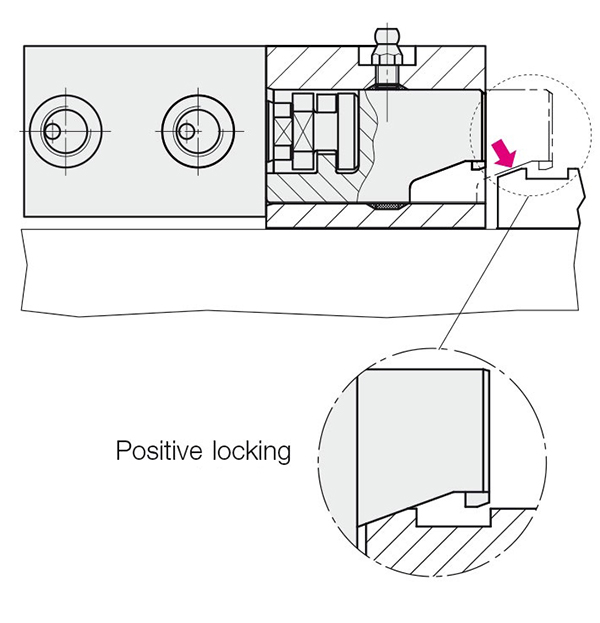
The system also allows the holding force of manually secured workpieces to be checked. Here, a visual red dot in a clamp module gradually fades to grey as a spanner is turned, showing when the holding force is correct. Various modules are available for different clamping pressures.
For further information www.1mta.com

Machining centre with universal appeal

Said to be universally applicable across the aerospace, mechanical engineering and mould and die sectors, DMG Mori has released its DMU 340 Gantry machining centre. The machine has a one-piece, thermo-symmetrical EN-GJS-600 cast-iron machine bed accommodating a working volume of 3400 x 2800 x 1250 mm, which is expandable to 6000 mm in the X axis and 1500 mm in Z.

Linear drives in the X and Y axes offer up to 0.5 G acceleration and (optionally) 90 m/min rapid traverse rates. The drives combine with a ram featuring an integrated, direct-drive C axis, as well as a B-axis milling head with direct drive and 50° swivel, to provide a fully interpolative five-axis machining platform for producing large, complex components. According to DMG Mori, the machine achieves surfaces finishes down to Ra 0.3 µm.
The standard machine version with 4400 x 2700 mm table accommodates workpieces weighing up to 10,000 kg, although the maximum load can be trebled on request.
A range of HSK-A63 and HSK-A100 motor spindles, manufactured in-house, is available rated up to 30,000 rpm (or 79 kW or 430 Nm). The SK40-SpeedMaster with 15,000 rpm and 130 Nm is standard. There is space for 30 tools in the chain magazine, although an optional wheel magazine can accommodate 63 tools, extendable up to 183 pockets.
DMG Mori deploys its CELOS app-based control and operating interface to a Siemens or Heidenhain CNC system. An Industry 4.0-ready interface, which is compatible with ERP systems and can be linked to CADCAM applications, integrates the machine into a customer’s production environment.
For further information www.dmgmori.com

Machine investment set to create jobs

Derby-based Riverside Medical Packaging, which has tapped into the capabilities of the Engineering Technology Group for a Quaser MV 184 PH to help support a ramp up in volumes and ensure its machining shop can meet growing demand from customers in the UK, EU,
India and Israel.

Riverside, a healthcare packaging specialist, is targeting up to 40 additional jobs and looking to more than quadruple sales of its ‘shawpak’ thermoforming machinery as the medical sector strives for more cost effective packaging solutions. The company has invested nearly £100,000 in developing a turnkey solution for the Quaser vertical machining centre, which utilises novel spindle technology, the latest Heidenhain controls, a newly developed grease replenishing system and two touch probe measuring systems from Blum-Novotest.
“As part of the expansion, we needed a vertical machining centre that offered us speed, accuracy and the ability to easily set and manufacture a variety of parts for use in our ‘shawpak’ machines,” states works and engineering director Alan Wade.” After much consideration and searching the sector for the best option, we decided on the Quaser MV 184 PH. It took just six weeks to get the machine into our Derby facility, signed off and producing various parts in volumes ranging from 2000 to more than 35,000 per annum. The MV 184 PH comes with greater memory, the latest Heidenhain controls and a grease replenishing system that makes lights-out manufacturing relatively easy.”
For further information www.engtechgroup.com

Mikron machine acquired by Renault F1

Oxfordshire-based Renault Sport Formula One Team has taken delivery of a Mikron HPM 800U five-axis machining centre from GF Machining Solutions.

Since installation, the HPM 800U has been put to work machining a diverse range of parts, including a number of gearbox inserts made from titanium. Apart from some wire EDM profiling operations, which take up to 12 hours to complete, the inserts are five-axis machined entirely on the HPM 800U. Material removal rates are high (over 85% of the titanium is removed during roughing and finishing operations), and the inserts are machined to a high accuracy and require an excellent surface finish.
“Despite such demands, our HPM 800U machines have not been found wanting and are among the most accurate, dynamic and reliable machining centres we have in our facility,” says machine shop manager Raphael Willie.
“A few years ago we made a strategic decision to increase our five-axis milling capabilities and selected GF Machining Solutions as the technical partner to help us achieve our objectives,” he adds. “The partnership means that we are able to acquire the latest Mikron five-axis machines at highly competitive rates, and have direct access to GF Machining Solutions’ technical and applications expertise.
“As a consequence we are able to fully embrace the concept of one-hit and simultaneous five-axis machining, and to experience productivity gains, improved machine tool utilisation, increased component accuracies, and reduced set-up and part cycle times.”
For further information www.gfms.com/uk

Five-axis portal mill for prototypes

A portal, five-axis milling machine has been introduced by German machine-tool manufacturer Zimmermann at the lower end of its price range. Available in the UK and Ireland through Geo Kingsbury Machine Tools, the compact FZU is intended primarily for prototype, tool and mould making, as well as machining composite components such as airframes.

Of thermo-symmetrical and stable design, the machine is suitable for manufacturing workpieces from aluminium, plastics and model board. Unlike other machines in the Zimmermann range, the FZU is shipped in one piece so does not need to be assembled at the customer’s premises.
The working volume is available from a choice of X-axis travels of 2000, 4000 or 6000 mm, a 3000 mm Y axis, and either 1250 or 1500 mm movement in Z. Acceleration is 3 m/s2 to the maximum 60 m/min feed rate. Table loads of up to 10 tonnes can be accommodated.
The fourth and fifth CNC axes are provided by the newly developed VH10 spindle head, now the smallest in the manufacturer’s range. Of slender design, it provides minimal interference contours and high clamping force for stable milling.
A HSK-A63 spindle is standard, delivering 34 kW of power and 39 Nm of torque continuously, and offering a maximum speed of 24,000 rpm. The A axis swivels through 220°, while C-axis rotation is 300 or 360° for the smaller and larger Z-axis travels respectively. Resolution in both rotary axes is 0.0001°.
Control is provided by either a Heidenhain TNC 640 or Siemens Sinumerik 840D sl. Other options include spindle probing, tool measuring, and capacity for 40 or 60 tools in the magazine instead of the standard 20 tools.
For further information www.geokingsbury.com