

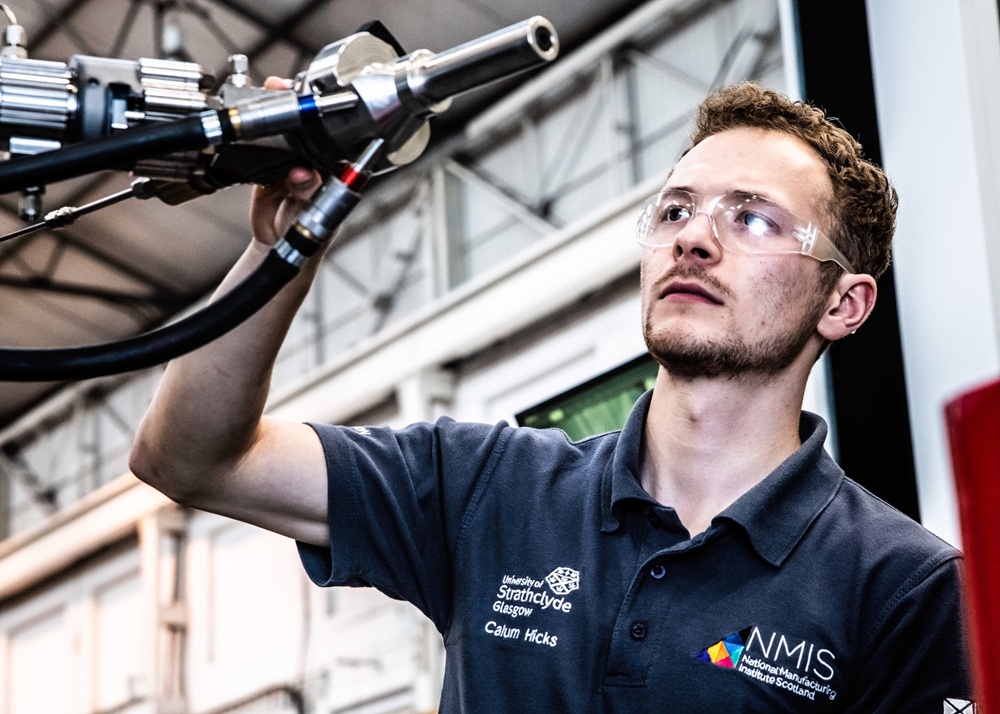
Aircraft operate in demanding environments that can compromise the integrity of wing skins. Corrosion remains one of the aviation sector’s most persistent and costly challenges, driving downtime, repeated maintenance interventions and disruption to operational schedules. Here, Calum Hicks (pictured), senior technologist at the Digital Factory, National Manufacturing Institute Scotland (NMIS), explains the importance of moving to cold spray application for wing skin repair.
Traditional repair methods, including epoxy fillers and doubler plates, can extend component life through reinforcement and material replacement. However, these approaches often require ongoing repairs, limiting long-term efficiency. As modern aircraft are designed with strict safety requirements and low tolerance for material degradation, the industry needs a more durable and resilient approach to wing skin restoration.
Cold spray manufacturing offers that solution.
This additive manufacturing process rebuilds damaged components by accelerating metallic powder at supersonic speed to restore material without melting it. By replacing corroded areas with new aluminium alloy, cold spray restores wing skins to their original dimensions while providing a more corrosion-resistant and longer-lasting repair than conventional epoxy-based methods.
Unlike many additive manufacturing technologies, cold spray can be deployed directly inside maintenance hangars thanks to its low operating temperatures and portable equipment. This enables rapid access to damaged structures and significantly expands the scope of repairs that can be completed on-site. Corrosion-affected areas can often be restored within hours, compared with traditional methods that may require days due to preparation and curing times.
Cold spray also supports aviation sustainability goals. By restoring existing components rather than replacing them, the process reduces material waste and extends service life, helping to lower the environmental impact of maintenance activities.
More information www.nmis.scot