
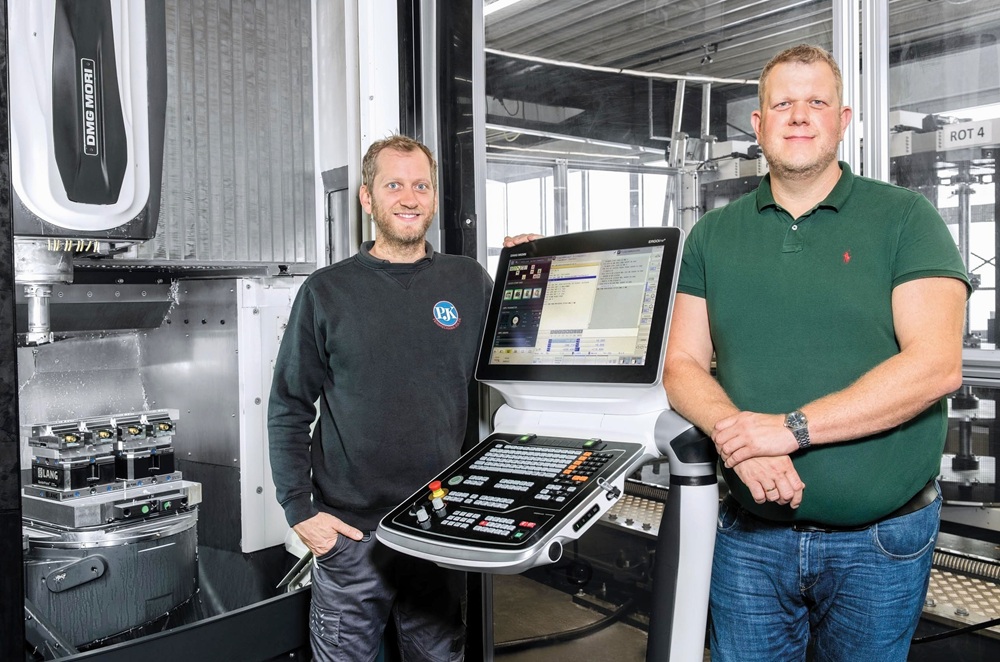
Since 1983, Peter Josef Klein Feinmechanik GmbH (PJK) – a 50-employee subcontractor based in Sankt Augustin near Bonn, Germany – has been producing precision components and assemblies from aluminium, titanium, stainless steel and high-performance plastics for customers principally in the medical, food and aerospace industries. For metal cutting, the company mainly uses machine tools from DMG Mori, including seven DMU 60 eVo machining centres, all of which feature automation.
Two of the machines are connected via a pallet handling system, which has 40 locations and can accommodate 300 fixtures that are exchangeable between pallets. An Erowa MTS zero-point clamping system serves as the basis for the flexible, automated cell.
Second-generation Peter Klein, who runs the company with his brother Julian, says: “Our main challenges are the extreme quality customers require and the high degree of competitive pressure. Our components are accurate to within microns, while at the same time we also have to continuously check and optimise our processes.”
One way of meeting these challenges is autonomous manufacturing, with PJK using automated cells to maximise machine utilisation since 2011. It means an employee can operate several machines during day shifts, while the company gains extra production output during unmanned running overnight and at the weekend.
To ensure precise and dynamic machining, the majority of DMG Mori machining centres on site at PJK are fitted with linear drives.
Says Julian Klein: “The machines produce our range of components efficiently by five-axis machining and meet our tight tolerance requirements. Customers stipulate accuracies down to single-figure microns, which we have to hold consistently. Five-axis machining contributes to our ability to control this level of quality, as the number of manual re-clamping operations is reduced or even eliminated.”
More information www.dmgmori.com