

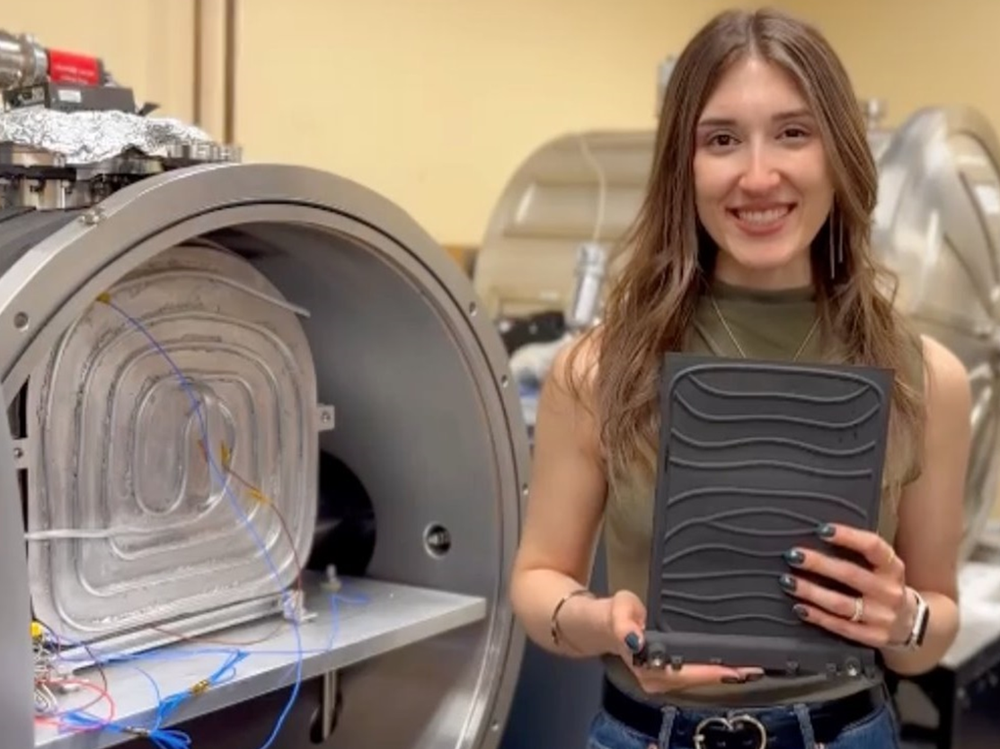
3D Systems is collaborating with researchers from Penn State University and Arizona State University on two projects sponsored by NASA intended to enable ground-breaking alternatives to current thermal management solutions for space exploration.
Severe temperature fluctuations in space can damage sensitive spacecraft components, resulting in mission failure. By combining deep applications expertise with 3D Systems’ additive manufacturing (AM) solutions comprising Direct Metal Printing (DMP) technology, tailored materials and Oqton’s 3DXpert software, the teams are engineering sophisticated thermal management solutions for the demands of next-generation satellites and space travel.
The project has resulted in processes to build embedded high-temperature passive heat pipes in heat rejection radiators that are additively manufactured in titanium. These heat pipe radiators are 50% lighter per area with increased operating temperatures compared with current state-of-the-art radiators, allowing them to radiate heat more efficiently for high-power systems.
Another AM project yielded a process to produce one of the first functional parts using nickel titanium (nitinol) shape memory alloys that can be passively actuated and deployed when heated. This passive shape memory alloy (SMA) radiator is projected to provide a deployed-to-stowed area ratio that is six times larger than currently available solutions, enabling future high-power communications and science missions in restricted CubeSat volume.
“Our long-standing R&D partnership with 3D Systems has enabled pioneering research for the use of 3D printing in aerospace applications,” says Alex Rattner, associate professor at Pennsylvania State University. “The collective expertise in both aerospace engineering and additive manufacturing is allowing us to explore advanced design strategies that are pushing the boundaries of what is considered state-of-the-art.”
More information www.3dsystems.com