
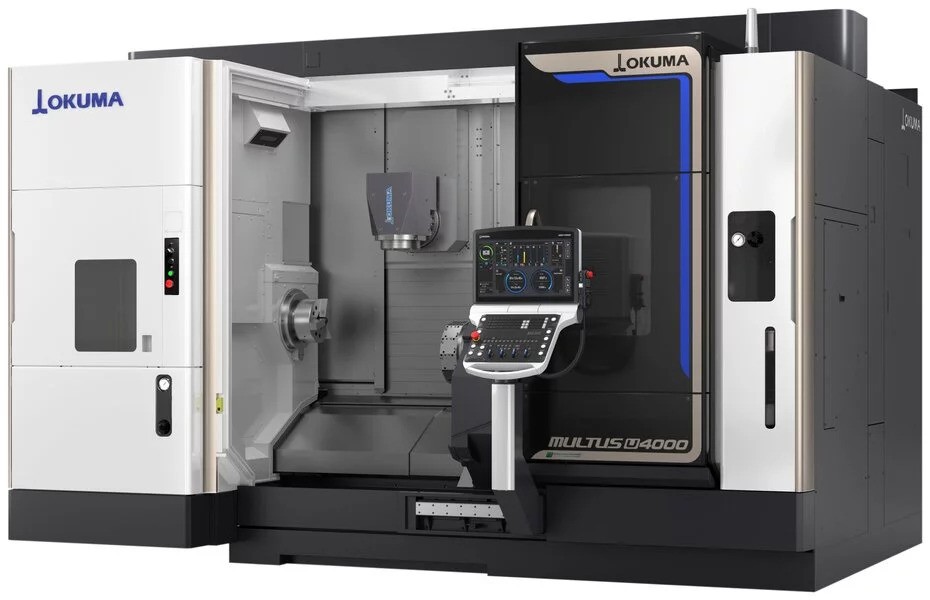
In 1975, Okuma introduced its first multi-tasking machine, the LM70-AT. It was capable of turning, drilling and milling in a single unit, providing a complete machining process. Okuma has continued to develop this principle over the years in line with market requirements. Today, Okuma says its Multus range is synonymous with technological innovation and the highest standards.
The benefits of multi-tasking machines for manufacturers are huge: they reduce the number of work steps, minimise the risk of manual errors or material loss thanks to continuous processes, shorten set-up times, and require less floor space. Order acceptance has also become more flexible: even urgent jobs can be accommodated quickly, requiring only a program change to the user-friendly CNC software. The same applies to jobs from new industries or to meet new regulatory requirements: Okuma says its multi-tasking machines enable companies to respond quickly to new requirements. This improves competitiveness, especially for small and medium batch sizes.
The Multus range comprises Okuma’s most advanced multi-tasking solutions. While the Multus BII series includes various standard models for simple entry-level applications, Multus B machines are suitable for complex workpieces with diameters up to 1 m and lengths up to 6 m. The Multus U series offers a choice of three models with an optional lower turret for increased productivity.
Okuma can also upgrade its multi-tasking machines with Okuma Armroid or robot cells for automation. This increases productivity and efficiency while maintaining the customary user-friendliness and precision machining.
As a further point of note, Okuma’s modern machine tools are increasingly focused on low and sustainable energy use.
More information www.okuma.eu