


Academic institutions are getting hands-on with additive manufacturing to create more
engaging courses that better prepare students for their careers ahead, writes Jesse
Roitenberg, an education specialist from Stratasys.
Engineering has an image problem. Too many young people think it is dull and difficult, and
unlikely to lead to fulfilling careers. The subject is often seen as “geeky” or overly academic,
and many students feel it lacks creativity or relevance to their daily lives. These
misconceptions are compounded by limited visibility of engineering in schools, along with
stubbornly persistent – and outdated – perceptions that it leads to narrow and poorly-paid
career options.
Indeed, a survey from Engineering UK, a not-for-profit careers body, found that less than
half of young people agreed or strongly agreed with the statement that “being an engineer
fits well with who I am”. That is a shame because engineering is one of the most stimulating
disciplines imaginable. Those who study it solve problems and push boundaries. And
sometimes, they go on to change the world.
So engineering is exciting – but industry must do a better job of getting this message across,
particularly in the wake of studies that predict growing skills shortages. A recent report from
Deloitte showed that US manufacturing could need as many as 3.8 million new employees
by 2033. Therefore, there is an urgent need to find ways of attracting more young people
into the profession, so that they can go on to solve the challenges of tomorrow.
How can it be done? One answer is to improve the quality and diversity of engineering
learning. There will, of course, always be a need for textbook-based study to understand the
core principles of the subject. However, there is scope to introduce practical and hands-on
activities that are more relatable to the world around.
That is where technologies such as additive manufacturing come in. Many academic
institutions have introduced additive manufacturing into the curriculum to make courses
more engaging and relevant. Investment in the latest machines also leads to new research
opportunities, often in collaboration with other partners.
Crucially, access to additive manufacturing equipment lets students hone new skills. For
instance, design for additive manufacturing – the process of designing products specifically
for production using additive manufacturing technologies – helps the next generation of
engineers to think in new ways, unshackling them from the restrictions of the past.
Young engineers get to explore new topologies, resulting in different shapes that cannot be
produced with traditional subtractive manufacturing methods such as milling. They also
create parts with multi-material designs, using varying material properties within a single
component to optimise functionally graded materials for high performance. And they get to
explore the opportunities for increased personalisation and customisation, ideal for
applications requiring bespoke solutions.
This sort of ‘learning through doing’ is critical for the next generation of engineers. It
increases engagement and commitment to the course and boosts employability, helping to
instil highly transferable skills desired by industry at large. It also makes the next generation
of engineers advocates for additive manufacturing – they tend to vouch for the technology
in the world of work as they want to carry on using it over their careers.
So, time to consider examples of how Stratasys collaborates with academia – from schools
and colleges to university departments and cutting-edge research laboratories – to deploy
technologies such as fused deposition modelling, material jetting, stereolithography and
powder bed fusion.
At Lancaster University in the UK, researchers have used the J750 3D printer and GrabCAD
Voxel Print software to develop advanced manufacturing techniques and explore the future
of CAD. The technologies have enabled teams to model complex objects with a high degree
of optimisation and explore applications in high-value manufacturing sectors. This approach
can transform design possibilities, including the development of shape-shifting materials
and 4D printing, which could lead to the creation of robots without hinges and aircraft wings
that morph in flight to enhance performance.
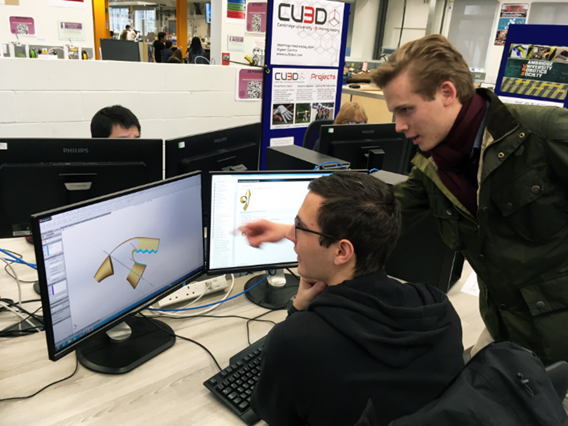
Meanwhile, at Cambridge University, the 3D Printing Society is a student-led group focused
on advancing the use of additive manufacturing across various disciplines. With access to
Stratasys 3D printers, the self-taught society members, primarily engineering
undergraduates, engage in a variety of complex engineering projects.
They aim to educate their peers and establish a national 3D printing network. Notable
examples of their work include collaborating with REMAP to create a robust 3D-printed
component for a robotic archery turret for paralysed children, and working with Open
Bionics to develop cost-effective 3D-printed prosthetic hands for amputees, which are
intended to be distributed in developing countries.
Interestingly, additive manufacturing has also moved from traditional areas such as
engineering and manufacturing into exciting new applications such as science and medicine.
Here, 3D printers are also being deployed to inspire academic-based innovation.
At the University of Pavia in Italy, for example, additive manufacturing is being used to help
improve surgical planning and patient care. By transforming CT scans into detailed 3D-
printed models, academic researchers are assisting surgeons to better prepare them for
operations, reducing theatre time and minimising risks.
The models have particularly benefitted complex spleen, kidney and pancreas surgeries. 3D-
printed kidney models have helped medical teams navigate intricate vascular systems
during transplant preparations, ensuring critical vessels are not damaged. This approach has
set a new standard in surgical preparation, improving medical outcomes and providing
patients with greater peace of mind.
Similarly, Bordeaux University Hospital in France deploys Stratasys J750 3D printers to
improve kidney cancer treatment by producing full-colour, multi-material 3D-printed
models for surgical planning. These models allow surgeons to visualise and plan complex
kidney tumour removals with greater accuracy, improving the success rate of these types of
surgeries. The realistic models, representing various anatomical structures such as arteries,
veins, and tumours, also serve as educational tools for patients and medical students.
So, there is a lot of exciting activity underway. But how does Stratasys forge links with
academia to ensure that students and educators get the most benefit from additive
manufacturing?
The answer comes in several parts. Firstly, Stratasys works with its partners to take
machines into educational environments for ‘show-and-tell’ sessions. Here, students get to
see the machines up close, learning about the broad range of additive manufacturing
techniques, while also understanding new materials and software. It is about ensuring that
students and teachers are up-to-date with the art of the possible, making them fully aware
of the benefits that additive manufacturing can bring.
Stratasys can also help educators shape and build the curriculum by creating certified
programmes for education. This activity ensures content is engaging and accessible. Free to
educators and students, in-depth lectures and class discussions provide students with
hands-on training to get immersed in the what, why and how of 3D printing. By the end of
these courses, students and educators can often produce fully functioning moving parts in a
single print. Giving students real-world projects and problems to solve is one of the most
effective ways to prepare them for the working world.
Stratasys is committed to supporting the most state-of-the-art research laboratories,
providing access to customised training, advanced materials and technical support to ensure
they excel in their chosen area of activity.
In conclusion, Stratasys believes project-based learning is the key to academic success.
When students learn something and then put it into action, it sticks.
Therefore, Stratasys is committed to being an ongoing partner for schools, colleges,
universities and research laboratories. By working together, it becomes possible to cement
the role of additive manufacturing as an exciting solution to the challenges of tomorrow.