The demise of the coal and steel industry and the 1980s recession delivered a gloomy
outlook for millions in the UK, but every cloud has a silver lining. For ex-coal engineer Mike
Garland, a relentless work ethic and an engineer’s attitude to delivering creative solutions
were the foundation blocks that started M&J Europe Ltd.
Founded in 1990 by Garland, his wife, Jasmin, and their son Chris, M&J Europe reclaimed
rollers and conveyors from closing coal mines, refurbished and repurposed them, and sold
the equipment to power stations, steel plants and furniture manufacturers among others.
The business has flourished ever since, and in the past two years, M&J Europe has invested
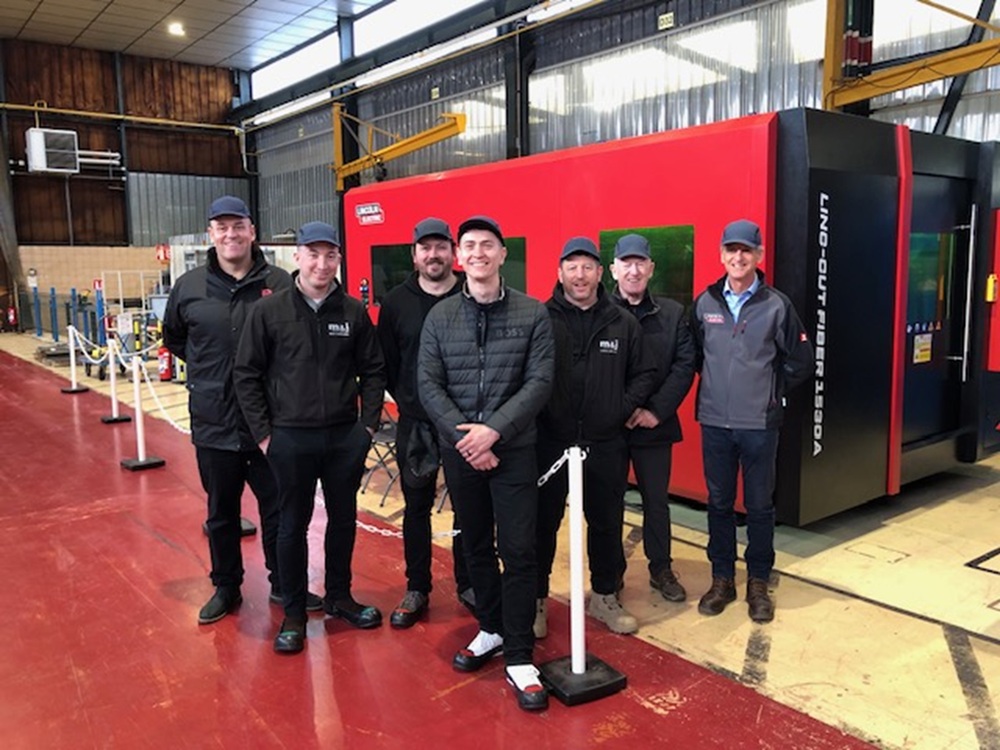
over £3m in buildings, plant and equipment. The most recent acquisition is a Lincoln Electric
Linc-Cut 1530A 6 kW fibre laser cutter from Kerf Developments.
In the 1980s, the Government offered a £40 a week allowance scheme for anyone starting a
new business. Garland took advantage of the grant and began M&J Europe from home,
selling solutions from the back of a Ford Escort van. The company now has a turnover above
£7.5m and employs more than 45 highly skilled engineers who design, develop and
manufacture production lines for some of Europe’s leading brands.
Working with household names as diverse as Warburtons, Braces and Domino’s Pizza in the
food industry to OEMs in the medical, oil and gas, furniture, automotive, FMCG, aerospace
and defence sectors, M&J Europe is tasked with developing new production lines that
deliver productivity, efficiency, quality and compliance to stringent regulations.
As part of its ongoing investment strategy, the Gwent-based company purchased a waterjet
cutting machine just over three years ago to process everything from metals to plastic,
Perspex, glass and other materials that may require trimming. However, with the company
processing an increasing level of brackets, excavators and machine guards made of mild and
stainless steel, it soon became apparent that waterjet cutting was a bottleneck. To
temporarily alleviate the bottleneck on a machine running 24/7, the company transferred
some of the work to its machining department. Serving as only a temporary solution, the
M&J Europe team visited MACH 2024 for a laser cutting machine.
“The waterjet machine was effective, but we needed something much faster,” states
Garland. “We took a team to MACH to buy a laser welder and look at three or four laser
cutting options. We found the Kerf Developments stand, met the Kerf and Lincoln Electric
teams, and noticed the Lincoln Electric Linc-Cut 1530A 6 kW fibre laser. We’ve witnessed
sub-standard service and support from some of our machine tool suppliers, so technical
support and maximum machine uptime were critical to us. Our team was familiar with the
Lincoln Electric brand through our welding technology, so we wanted to explore this
avenue. We did our due diligence and looked at other brands, but the conversations with
Kerf regarding support sealed the deal for us.”
Following a visit to Lincoln Electric in France to investigate the machine further, an order
was placed for a Lincoln Electric Linc-Cut 1530A 6 kW machine that was installed and
commissioned in January 2025. With a short training period and confidence in the support
and service from Kerf, the machine has been running relentlessly since installation.
M&J Europe has a philosophy that it manufactures everything it requires in-house with no
dependence on a subcontract supply chain.
“We offer everything from project and facilities management to onsite support as well as
the production of conveyor belts, production lines and bespoke machinery,” says Garland.
“If one of our customers incurs downtime on a manufacturing line, the lost production costs
can be well over £200,000 per hour, so it’s imperative that we can react and resolve
breakdowns at speed. Relying on a subcontract supply chain is not an option. We frequently
have to charter helicopters to get our engineers to customer sites around the UK, as
reaction speed is critical. Upstream, the reliability of our machine tools and production
speed is also critical – that’s why we put our well-placed trust in Kerf and Lincoln Electric.”
Whilst minutes on the production floor may not be critical in developing a new project, they
are of the utmost importance when manufacturing replacement parts, servicing
breakdowns, or undertaking scheduled maintenance.
“Our waterjet machine has a cutting speed of around 800 mm/min,” he explains.
“Depending upon the material and thickness, the Lincoln Electric Linc-Cut 1530A 6 kW
machine can cut at speeds beyond 25 m/min. The savings have been incredible in the short
time we’ve had the machine. We made a series of brackets from a 3 by 1.5 m sheet in 8
hours on the waterjet machine, which has been reduced to 25 minutes on the laser.
Excavator buckets are another common task that would take a full week to produce 100
buckets on the waterjet running 24/7. On the new laser, we can produce over 225 buckets
from 15 steel sheets in a day. We also manufacture a couple of hundred conveyors for
customers every month; a batch of these would take 8 hours to cut on a guillotine, drill and
hand-finish, whereas using the laser we can do this repeat job in just 20 minutes.”
The manual processing of components highlights another saving generated by the new
laser: labour costs. With new production lines and projects continually passing through the
business, M&J Europe also has to balance its scheduled work with urgent repairs, scheduled
maintenance, servicing and replacement of parts for end users. Across the business, this can
absorb up to 120 hours of manual machining, cutting and processing components in a
month. Much of this labour input has been eradicated with the arrival of the new laser
machine.
“We recently had a prestigious OEM customer in Birmingham that required 100 brackets for
a production line that was taken off-line overnight for scheduled maintenance. The line was
planned to run by 06:00 to process hazardous materials. The brackets had to be
manufactured from specialist stainless steel, so we sent a van to collect the material in the
evening. We had a team of eight engineers working overnight to ensure the brackets were
manufactured, delivered and installed to get the line running by 06:00. If we had the Linc-
Cut 1530A in place, one team member would have turned the brackets around in an hour.
This emphasises the scale of the labour savings we can and will make with the new machine.
In the short period since installing the laser cutter we’ve also noticed a significant reduction
in our consumable costs with drills, cutters, grinding and cutting disk requirements also
falling sharply.”
Looking to the future, he concludes: “The quality, consistency and finish of our sheet metal
parts has improved considerably with the Linc-Cut 1530A, and we’re delighted with both the
productivity and cost savings as well as the service we receive from Kerf. We install
production lines where the quality of our engineers and our level of service is paramount.
When Kerf installed and commissioned the Lincoln Electric Linc-Cut 1530A, we recognised
the professionalism of their team. When the requirement arises, we’ll certainly buy more
machines from Kerf and Lincoln Electric.”
More information www.kerfdevelopments.com