Competitively priced five-axis machine

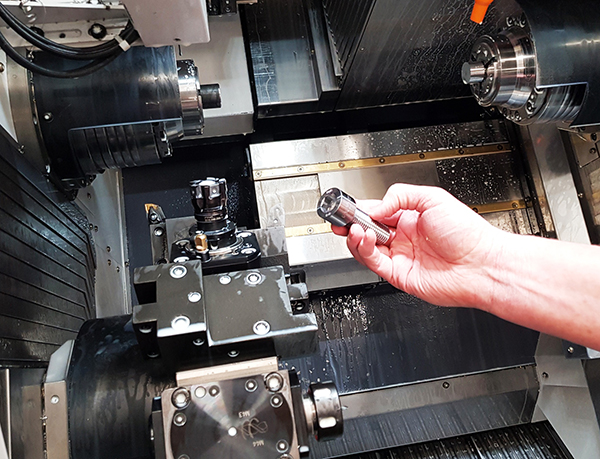
Stand CM40 will be the location for XYZ Machine Tools to showcase its UMC-5X simultaneous five-axis gantry-style machining centre.

XYZ says the machine is available at a very competitive price point, yet comes with technology such as traori (transformation orientation)/kinematic functions for five-axis simultaneous machining, as well as integrated smart machining technology and thermal growth compensation.
Of interest is that due to the table configuration and machine design, when the table is tilted 90° towards the rear (component facing forward), there remains 500 mm of Y-axis travel forward of the table surface. According to XYZ, this distance is much greater than many competitor machines, including those that quote the same axis travels as the UMC-5X, allowing larger workpieces to be machined.
For further information www.xyzmachinetools.com

Finishing first

On stand D50, PDJ Vibro says it will shine the spotlight on its range of new and refurbished bowls, barrels and high-energy centrifugal equipment, as well as its series of consumables and the company’s repair and subcontract finishing services. PDJ Vibro’s main, high-end vibratory bowl range has chamber sizes from 7.5 to 6000 litres. Alternatively, three competitively priced, entry-level models have process chamber capacities of 300, 150 and 75 litres. They are priced at about 25% less but are nevertheless built to a high specification.
For further information www.vibratoryfinishing.co.uk

Field of view video inspection

Vision Engineering will likely promote its TVM field of view (FOV) video measurement system on stand CM7. The non-contact TVM combines a small footprint with larger system performance and ease of use. Time-saving, instant FOV measurements and a moving stage allow larger components to be measured quickly and easily. The TVM series includes the TVM20 and TVM35, with FOV sizes of 20 and 35 mm respectively. Both systems are designed to meet rigorous quality assurance applications in sectors such as automotive, aerospace, medical and plastics manufacturing. Cylindrical, flat or square components can be measured instantly within the FOV at the click of a mouse.
For further information www.visioneng.com

Keynote speakers announced

Advanced Engineering 2018, which takes place at the NEC in Birmingham this week (31 October to 1 November), has announced keynote speakers including Jaguar Land Rover, Atkins, the High Value Manufacturing Catapult, the Aerospace Technology Institute, the Department for International Trade, BARA and Siemens.

This year, the show comprises six co-located zones: Aerospace Engineering; Composites Engineering; Automotive Engineering; Performance Metals; Connected Manufacturing; and Nuclear Engineering. Each zone will have a range of speakers talking about current topics, such as big data, Industry 4.0, space, Brexit, aircraft of the future, electrification and robotics.
Alison Willis, industrial divisional director at Easyfairs, organiser of Advanced Engineering, says: “We are delighted to announce our speakers for the 10th year of the show and are excited to hear their take on the challenges and successes of the industry over the past year. Our expert speakers and industry keynotes will stimulate lively discussions with insightful presentations.”
For further information www.advancedengineeringuk.com

Reasons to use graphite electrodes

There has been a long-standing debate about whether graphite or copper is a better EDM electrode material for aerospace applications.

For this reason, Erodex has taken a closer look at the differences between the two materials and outlined reasons why graphite is likely to be the most appropriate for aerospace EDM needs.
Due to the wide range of graphite materials available, it is proven that some EDM grades are more economical than copper. Furthermore, most comparisons do not consider the cost of machining the electrode. Significant cost savings can be made choosing graphite over copper, generated through reduced machining times and speed of cut, less production time to create electrodes, faster EDM times and better throughput from EDM machines.
Graphite also offers a wide range of material characteristics in order to allow matching of the electrode material properties to the EDM application.
In addition, it should be noted that copper does not have the ability to handle current density as effectively as graphite, which performs exceptionally well at a high current density (even with complex geometry), allowing for various intricate machined details to be designed on the same electrode. The result is that the number of electrodes required to perform a job is reduced significantly.
Further reasons to select graphite over copper electrodes for aerospace applications include EDM performance, whereby graphite is able to achieve electrode wear of less than 1% in relation to the depth of cut, while working to more aggressive machine parameters. Moreover, fine-grain graphite electrodes are able to deliver similar surface finishes to that of copper, while offering much faster speeds and less wear.
For further information www.erodex.com