

Smithstown acquires Bumotec turn-mill centre

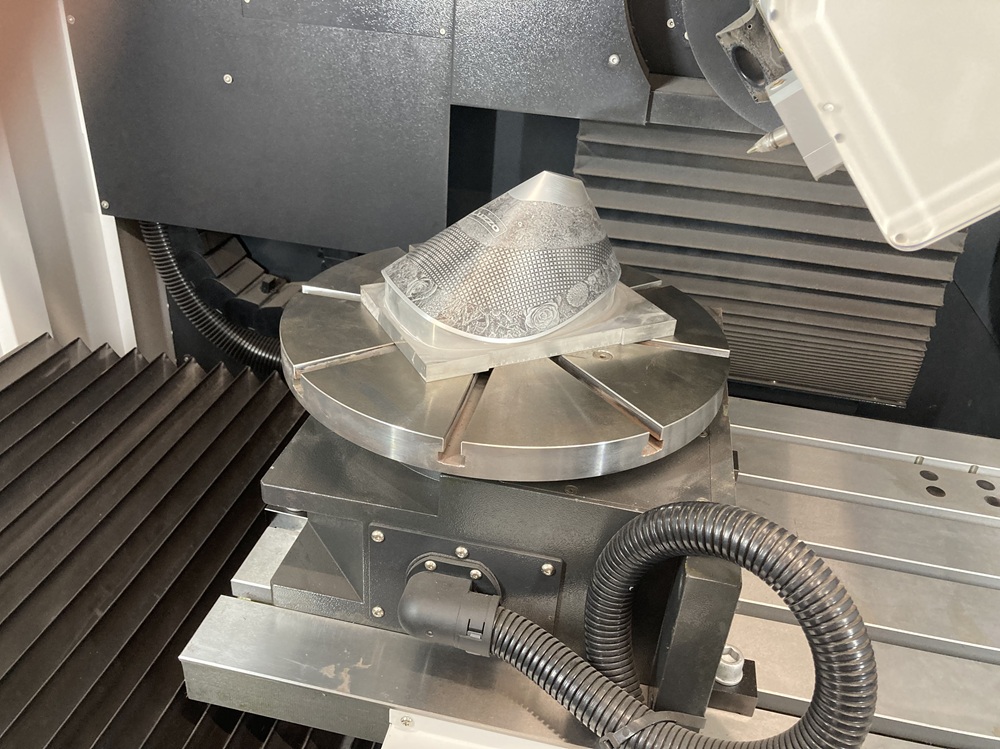
Machine tool manufacturer Starrag will present its latest innovations on stand T7 at the Manufacturing Solutions Ireland exhibition on 11-12 June. The stand’s centrepiece, a Starrag Bumotec 191neo turn-mill machine, will be delivered to Smithstown Light Engineering immediately after the show.

Smithstown opened its doors for business 50 years ago with just four toolmakers; today it has three manufacturing sites and over 285 employees. With two sites in Shannon and another in Rzeszow, Poland, Smithstown has invested in the Bumotec 191 to streamline its throughput and maximise efficiency.

The company transitioned to medical manufacturing in 1990, and it continually invests in the latest technology. This sees Smithstown work with clients such as Stryker, Boston Scientific, Zimmer Biomet and Cook Medical, to name but a few. Producing over 14 million components every year, the manufacturer adopts stringent quality measures that are a necessity for ultra-precision medical device parts used in life-saving surgery. It is here that the Bumotec 191neo will create an impact.

CEO Gerard Henn says: “We’ve been interested in Starrag machines for several years, and it was a case of finding the right opportunity for our business. The Bumotec 191 is perfect for small intricate turn-mill parts, and we bought it for a number of reasons. Primarily, it will support our NPI [New Product Introduction] team, which will eventually dovetail into production.”

At Manufacturing Solutions Ireland, Starrag experts attending the show will also be keen to discuss the merits of other solutions that include the Heckert H Compact and STC series of horizontal machining centres, as well as the new Droop+Rein FOGS HD, a six-axis overhead gantry-type machining centre.

More information www.starrag.com

New Star SR-20RIV Type E sliding-head lathe

Star Micronics is set to launch the SR-20RIV Type E, the latest evolution of its long-established SR-20RIV sliding-head lathe. Building on the success of the Type A and Type B variants, the new model has been developed to meet even broader application requirements across sectors such as automotive and medical manufacturing.

Since the original release of the SR-20RIV in 2012, over 2400 machines have been sold worldwide, thanks to key attributes like reliability and versatility. The new Type E introduces enhanced functionality with a customer-requested B-axis tool post capable of simultaneous four-axis control, enabling more complex machining tasks such as 3D milling. UK availability is scheduled from September 2025.

Alongside the powered tool unit featuring a B-axis with NC-programmable angle control, further features of note include a front-end gang-type tool post that incorporates Star’s proprietary uniform-load cross-guide structure. Here, eight linear guide bearings are evenly arranged around the guide bush, which is the cutting point where load generates during machining. By distributing the load evenly to eight linear guide bearings, the load applied to each linear guide bearing is minimised and tool post rigidity improves. The employment of this tool-post structure enables extended continuous operation with stable accuracy, while prolonging the service life of linear guide bearings.

Importantly, the machine can be switched between guide bush and non-guide bush configurations depending on part length. This capability optimises material use: guide bush mode offers support for long parts, while non-guide bush mode minimises bar remnants for short components, reducing waste and cost.

With capacity for up to 41 tools on a 27-position station, the Type E supports a wide range of complex and multi-process machining applications.

More information www.stargb.com

ULTRASOUND FOR INTERMEDIATE AND FINAL CLEANING OFMEDICAL DEVICES

The manufacture of medical technology products such as implants, instruments and devices
is subject to very strict requirements – including for parts cleaning. Ultrasound is an
indispensable process here. It ensures that the required cleanliness is achieved in a stable,
efficient and sustainable manner during both intermediate and final cleaning.
Ultrasound and medical technology – this combination is initially associated with diagnostic
imaging. However, ultrasound can do much more in this area. Sound with frequencies above
the human hearing range has established itself as an economical and sustainable standard
process for wet-chemical cleaning applications in the manufacture and reprocessing of
medical technology products such as instruments, implants and other devices. And it can be
used for components made of a wide variety of materials such as stainless steel, titanium,
cobalt-chrome alloys, ceramics and plastic.
In co-operation with cleaning system manufacturers and users, Weber Ultrasonics develops
custom-designed generators and transducer systems as rod, plate and immersible
transducers with different frequencies for the very different cleaning tasks in medical
technology. This includes single-frequency solutions as well as dual- and multi-frequency
ultrasonic systems in a frequency range from 25 to 132 kHz.
Weber constructs space-saving cleaning systems that are individually tailored to customer
workpieces and cleaning requirements. The development of vacuum-proof single, dual and
multi-frequency immersible transducers also opens up the use of ultrasonic cleaning in full-
vacuum cleaning systems. For high-purity applications, where particularly high demands are
placed on component cleanliness and cleaning equipment, immersible transducers and
plate transducers are available in a suitable design. With a surface roughness of <0.35 µm,
they meet the requirements of hygiene class 4 in accordance with DIN 11866.
Heinz Schade, managing director of the company of the same name, also relies on the wide
range of highly effective ultrasonic components. Founded in 1999 and based in Reutlingen,
the company develops and produces machines for balloon and catheter production as well
as stent processing, which are sold worldwide. In addition, there is software that is
optimally adapted to the various machines and, among other things, enables the seamless
documentation and traceability of processes required in medical technology. This helps to
ensure that the strict requirements of the MDR with regard to process and product safety
and quality management are met.

One focus of the system portfolio is on manufacturing steps for stent production that follow
laser cutting, such as electropolishing, heat treatment, pickling and ultrasonic cleaning. The
company has been manufacturing the tanks for the cleaning systems in-house for around 20
years. This allows them to be adapted to the various products and the specific requirements
of the respective customer.
“With our own production facilities, we were looking for a supplier for the ultrasonic
components. In Weber Ultrasonics, we found a partner that has impressed us to this day
with its expert advice and straightforward co-operation,” says Schade.
To ensure the quality and safety of the products, the stents are usually cleaned between the
various processes. Final cleaning is then carried out before packaging, usually in a clean
room.
“Increasingly stringent surface cleanliness requirements have to be met,” says Schade. “At
the same time, it must be ensured that the sensitive stents are not damaged during
cleaning.
The key parameters for this are the frequency of the ultrasound and the power in watts per
litre of bath volume. In addition, a homogeneous sound field must be generated in the bath
to ensure a consistently stable result.
“The ultrasonic solutions from Weber Ultrasonics are ideal for these tasks. The power can
be set very precisely by controlling the generator and the sound output is constant and
reliable. So far, we’ve had no problems with the ultrasonic systems.”
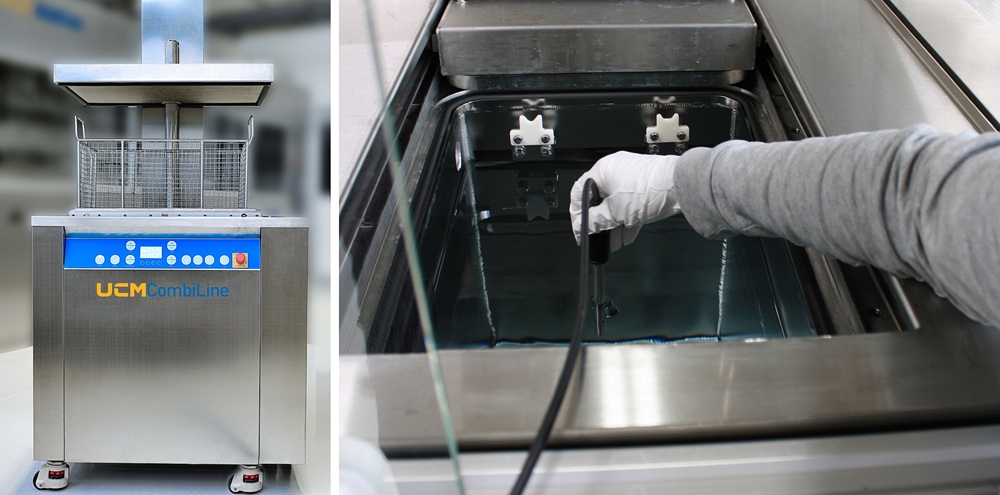
Ultrasound develops its cleaning effect in a liquid bath through the physical effect of
cavitation: the electrical signals generated by an ultrasound generator are transmitted into
the liquid through oscillating elements. The sound pressure is characterised by an
alternation of negative and positive pressure. In the negative pressure phases,
microscopically small cavities form, which collapse (implode) in the subsequent positive
pressure phase. This creates shock waves with considerable energy, which “blast off”
particulate and film-chemical contaminants. At the same time, micro-currents are created in
the liquid, which flush away detached or dissolved contaminants. These effects make it
possible to remove contaminants not only from the surface, but also from complex
geometries, cavities, holes and structures.
For components such as additively manufactured implants with an open-pored sponge
structure or combined porous and polished surfaces – as well as components with very fine
capillaries – ultrasound can be combined with pressure cycling processes. In these vacuum
flood cleaning processes, alternating negative and positive pressure and cavitation effects
are generated by regularly repeating pressure changes. This allows cleaning and

rinsing media to reach areas that would otherwise only be reached to a limited extent or not
at all.
More information www.weber-ultrasonics.com

Multi-purpose measuring device from Blum-Novotest

Blum-Novotest presented it new MG81 multi-purpose measuring device at the Control 2025 exhibition in Stuttgart earlier this month. The compact device, which is the size of a bank card, has been specially developed for sensor-based status assessment of clamping systems. The recorded values are transmitted wirelessly to the machine tool control system in real time, meaning they can be incorporated directly into the process.

Winfried Weiland, head of marketing at Blum-Novotest explains: “The aim of an automated machining process in the spirit of Industry 4.0 is to record all relevant influences and come up with appropriate actions. With the new MG81, we’re integrating the transmission system and sensor technology directly into the clamping systems, making it is possible to record important process data in real time during machining. This includes the current workpiece temperature, the clamping pressure, the presence of the workpiece and the clamping jaw position. As a result, the machining centre can access and react to the process-relevant data of the clamping device at any time.”

For instance, the MG81 is used in automated processes in which workpieces with strongly fluctuating input temperatures undergo machining. Sensors integrated into the clamping jaws record the temperature of the current part, which is then transmitted to the control system, where it can be immediately evaluated in the process.

The system is also used to monitor the clamping pressure. This is how corresponding sensors can detect whether a workpiece is being clamped securely and with constant force. Another example is automatic pre-positioning of the clamping jaws according to the current workpiece size that will be machined: if workpieces with different dimensions are to be automatically fed to the clamping device, the process is supported by integrated position measuring sensors.

More information www.blum-novotest.com

Hexagon launches Maestro next-generation CMM

Hexagon’s Manufacturing Intelligence division has launched Maestro, an all-new, next-generation CMM engineered from the ground up to meet the rising productivity demands of modern manufacturing. Designed to combat global skills shortages and increasing quality requirements, Hexagon says that Maestro sets a new standard for speed, simplicity and digital integration.

Maestro is built upon four principles: to be fast, easy to use, connected and scalable. Its digital-first architecture offers the industry rapid measurement routines, an intuitive user experience and seamless data integration. With modular software and hardware, it is designed to scale with evolving production needs, making it suitable for aerospace, automotive and high-precision manufacturing environments where there is a high demand for accuracy to deliver safety, compliance and performance.

The CMM’s newly-developed digital architecture incorporates digital sensors, a single cable system and a completely new controller. Together, these capabilities increase throughput, streamline the complete measurement operation and ensure future-ready connectivity for modern production environments.

According to Hexagon, Maestro delivers industry-leading throughput through high-speed motion while maintaining exceptional precision. Synchronised axis movements, rapid calibration and cloud-connected software significantly accelerate set-up, programming, execution and reporting.

“Manufacturers told us they needed a next-generation system that tackles rising quality demands and skills shortages,” says Jörg Deller, general manager of stationary metrology devices at Hexagon. “By rethinking our hardware and software from the ground up, rather than iterating on existing systems, we’ve had the freedom to create a high-accuracy inspection solution which is so intuitive that anyone from experts to new hires become significantly more productive.”

Pilot users report dramatic productivity gains and reduced inspection lead times, helping to avoid production bottlenecks and to keep pace with fast-changing customer requirements.

More information www.bit.ly/4mcLOC0