

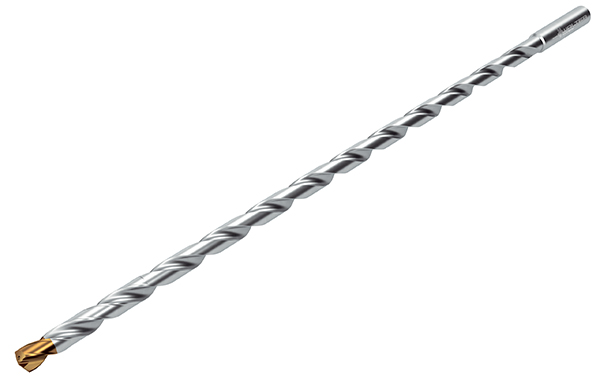
Multi-function tools from Horn

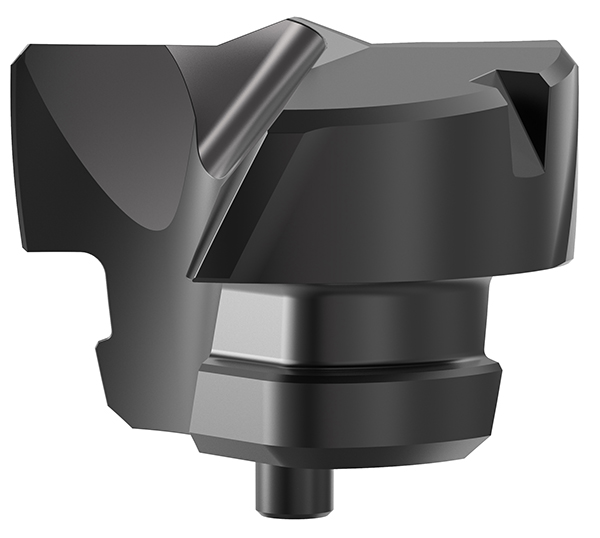
Horn’s Supermini precision tooling system has been enhanced by the introduction of a variant with newly developed HP geometry, allowing higher infeed rates and other cutting parameters. The geometry also enables multi-functional use on a lathe across a range of operations, including drilling, boring, face turning and skimming.

In terms of capability, holes from 3 to 7 mm in diameter may be drilled into solid material using Supermini HP tools without a chip breaker. While the performance data cannot compete with normal drills, the system is a practical solution if the number of cutter locations in a machine is limited. With the single-edged version, various hole diameters can be produced using a single tool.
Horn’s Supermini HP offers the option of immediately boring an inner contour after drilling without having to change the tool. An accurate 90° shoulder can be achieved at the base of the hole, while the wiper geometry produces excellent surface quality, even at high feed rates, says Horn.
Tools can also be provided with a chip breaker, which are recommended for turning applications. Here, the slightly twisted flute helps to remove chips efficiently from the machining zone, while the EG35 coating allows machining of both standard and stainless steels.
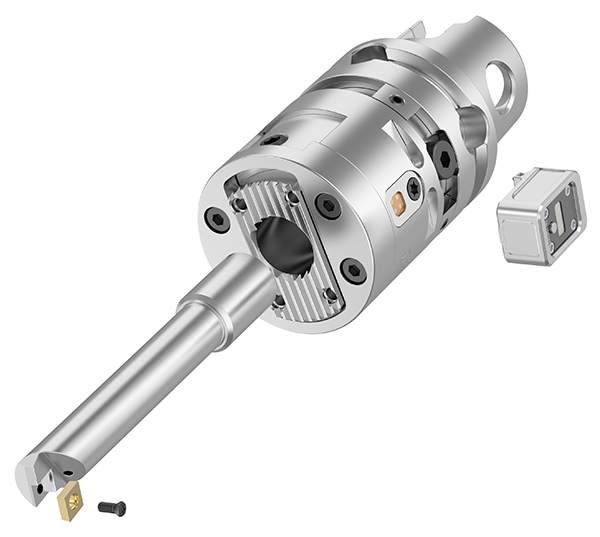
As well as HP geometry, Horn has developed a tool holder for the Supermini type 105, whereby clamping is achieved using a tensioning wedge on the face rather than on the circumference, as was previously the case. The tool is held in place with more force, which in turn makes the entire system more rigid. Furthermore, the design results in a higher level of repeatability when changing the tool and permits more compact construction.
For further information www.phorn.co.uk

Orbis cutters from Quickgrind

The ‘Infinite Possibilities’ portfolio has been expanded by Quickgrind with the arrival of the Orbis lollipop cutter range.

Across its business, Quickgrind is focused on the supply of products tailored to the demands of end users, hence the Infinite Possibilities branding. An example is the newly developed Orbis series of lollipop end-milling cutters. Non-standard sizes and geometries are available to manufacturers on very short delivery times and at “near-standard” prices, says the company.
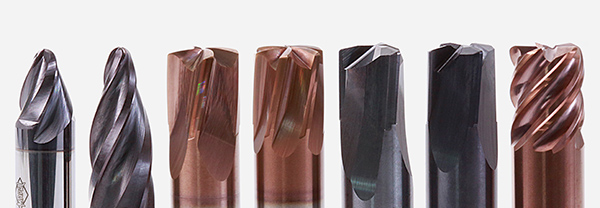
Developed for the five-axis machining of intricate components, the solid-carbide Orbis range enables access to difficult-to-reach features and surfaces. Furthermore, the Orbis series allows manufacturers to use a single tool to follow challenging tool paths and component forms.
Orbis cutters are available with two, three, four, six or eight flutes, with a complete variety of lollipop and shank diameters, overall lengths and a wide range of reduced neck diameters. In addition, the spherical ball profile and unconventional geometry enable the cutters to excel in terms of tool life, machining speeds and feeds, and surface finish quality, says the company.
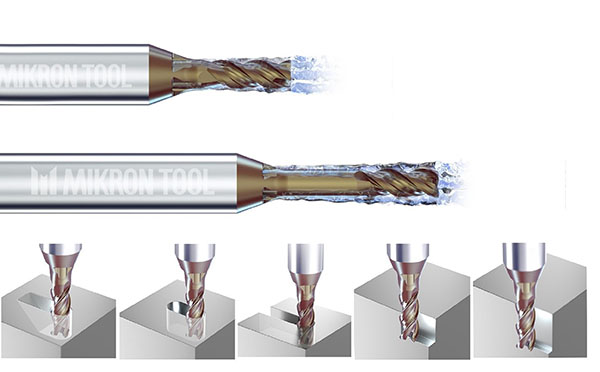
The tools are suitable for the fine finishing of irregular or uneven surfaces, as well as the daunting prospect of tube machining. This capability is credit to the carbide composition of the end mills and the UK-designed tool geometries that minimise vibration, even when reaching difficult-to-access surfaces.
Contributing further to the reduction in vibration and cutting forces, as well as improvements in tool life and productivity, are three geometry styles for alternate material types.
For further information www.quickgrind.com

Update for automatic dispenser

The Mapal Unibase-S automatic dispenser has been enhanced and optimised with ergonomic aspects that improve ease-of-use when storing and managing frequently required consumables. For instance, the display unit is now on the top of the Unibase-S, making operation easier for shop-floor users.

Another development sees the software completely changed to the Unibase system. This move enables the enhanced automatic dispenser to be coupled to existing Unibase systems, or be used as a stand-alone solution.
Featuring compact dimensions, the Unibase-S can be installed directly on a workbench. The 96 or 192 compartments are suitable for storing indexable inserts, cutting tools, chucks or even personal protective equipment. Locating the system close to the workstation or operator can save the employee significant time as it averts the need for continual trips to a central warehouse or stores area.
Taking consumables from the Unibase-S is quick and uncomplicated, and shop-floor staff can access supplies in just a few short steps. Initially, the employee must log in via the touchscreen. To make this even faster, an RFID chip or fingerprint can be used. Only registered employees can remove articles from the system. If an employee is not logged in, it is not possible to turn the dispensing drum and the compartments remain locked.
After the desired item has been selected via the Unibase software, an LED identifies the compartment where it is stored. The dispensing drum is then rotated manually to the withdrawal position where the team member can access his or her consumable. After opening the dispensing compartment, the system automatically registers the removal of the item, while the software automatically updates stock levels.
For further information www.mapal.com

Mastercam accepts Widia Novo

Widia’s online platform, which is available in the UK from Industrial Tooling Corporation (ITC), now allows tool assemblies to be directly imported by users of Mastercam, credit to a newly formed collaboration. The partnership between Widia and CNC software developer Mastercam provides a solution that enables information importing from Novo directly into Mastercam 2018.

Previously, manufacturers may have complained of having to search through large and complex catalogues to find related tools, then having to request or build assemblies from scratch for use in systems such as Mastercam.
The integration of Widia Novo and Mastercam allows end users to save significant time searching for the desired tools and building 3D tool assemblies that can be brought directly into the CAM software for easy use by most machine shops. Accurate tool definitions are a critical factor in modern CAM applications, and tool-path algorithms take advantage of these definitions to provide safe and efficient motion. In addition, the models imported from Widia Novo help to generate accurate in-process stock models that can be leveraged in subsequent operations.
“One of the promises of digitisation in manufacturing is greater precision and speed through effective data use,” says Chris Merlin, director of portfolio commercialisation at Widia. “This is where integration is a must. Users want their systems to work together seamlessly via simple solutions, without extra effort on their part. By connecting Mastercam and Widia Novo, users can effortlessly join cutting-tool data with machining data. The 3D models, drawings and starting parameters are easily available for validation and programming processes. All this leads to less misapplication of tooling solutions, more optimal machining strategies, and increased productivity with better quality in the manufacturing environment.”
For further information www.itc-ltd.co.uk

Plug and play digital adjustment system

Rigibore’s digital adjustment system, Smartbore allows the precise setting of fine-boring tools without the need to unclamp/clamp, thereby eliminating the negative impact of conventional tool adjustment.

“On many high-value components, the difference between perfect and scrap is often a matter of microns; scrap parts are expensive in terms of material and the loss of valuable machining time, impacting heavily on a company’s bottom line,” says Roger Bassett, chairman of Rigibore. “Until now, the conventional method of fine adjustment meant unclamping the boring tool, making the adjustment, re-clamping and taking a test cut. This process requires skilled operators, is time consuming and is never guaranteed to give you a true size adjustment, meaning further test cuts or, worse, scrap parts.”
Rigibore’s design sees Smartbore tools positively pre-loaded in the opposite direction to the cutting force. The result is that accurate adjustment, by as small a movement as 0.001 mm on diameter, is achieved with no measurable backlash. This rigid design allows operators to ‘plug and play’ by inserting the handheld Smartbore adjuster, delivering incremental diameter changes and then removing the adjuster to guarantee right-first-time precision.
The Smartbore adjuster displays the adjustment reading on the LCD, allowing fine tolerances to be set by operators of all skill and experience levels. Tools can therefore be quickly and accurately adjusted in the machine spindle with minimum downtime and in the knowledge that the adjustment requested is the adjustment made.
Smartbore can be applied to a range of designs, including finishing cartridges and a boring head known as Smartbore Nano.
For further information www.rigibore.com