

A new side to Vollmer sharpening machines

Vollmer recently launched its next-generation saw blade sharpening and servicing machines, the CS860 and CSF860. Here, the company explains the new CSF860 technology for the side grinding of circular saw blades in more detail.

With a new foundation, construction, frame, software and hardware, the new CSF860 is an entirely different machine from its predecessor, the CHF270. As with all machines in the Vollmer portfolio, the foundation blocks of all product developments are flexibility, productivity, reliability and quality.

As a baseline statistic, the CSF860 is 2-4% more productive than the previous CHF270, which is a result of the machine’s kinematics and design. Users can also add up to 20% cycle time savings derived from new software updates that precisely calculate the grinding area and eliminate ‘air cutting’.

In addition, there is a new saw carrier and R2 axis for the flange management system that eliminates 10-15 minute changeover times between different blade types. It is possible to eliminate the manual measuring of 2 to 3 minutes per saw blade with the new measurement and calibration system, which also eradicates the 25+ seconds of non-productive grinding wheel calibrating and checking.

While these statistics typify just a few of the cycle time and automation benefits, energy consumption has been reduced by more than 10%, while the new construction introduces ergonomic features for the operator, such as a ‘deep cut’ door that opens further than before. This gives the operator greater access to the work envelope, and for heavy blades that may need lifting via an overhead gantry, the new door design also opens at the top for overhead access.
For further information www.vollmer-group.com

Industry collaborations inspire art festival

Earlier this summer, the fourth Art in Manufacturing series took place at various locations near Blackburn, an event that involved embedding artists into working industrial environments. By way of example, the repetitive beats created by the machines that make giant steel saw blades at the 80-year-old Lancashire Saw Company inspired resident artist Jacqueline Donachie.

Jacqueline Donachie is an award-winning Scottish artist based in Glasgow. She has forged an international reputation for a socially-engaged art practice and was the recipient of the inaugural Freelands Award. Responding to her residency at Lancashire Saw Company, Donachie presented IMPERIAL. Inspired by the evocative sounds of the factory’s machinery and its canal location, the new film work amalgamates the combination of fast beats, slow canals and the repetition of industry.

The original soundtrack makes a connection to the underground dance scene of the late 1980s that was particularly prevalent and influential in Blackburn and East Lancashire. This Art in Manufacturing commission was in partnership with Super Slow Way’s Pennine Lancashire Linear Park pilot project. The film’s premiere took place at the Mill on the Leeds and Liverpool Canal, inviting audiences to experience the canal and rediscover it as a place of cultural activity.

Elena Jackson, co-director of the National Festival of Making and curator of Art in Manufacturing, says: “This was the first time we presented work from resident artists after two years of festival cancellation. In that time, our factory partners have maintained their commitment to the programme and the artists in residence with them, working through the most challenging of periods to realise the artistic outcomes that we saw over the festival weekend.”
For further information www.festivalofmaking.co.uk

App remotely controls sawing machines

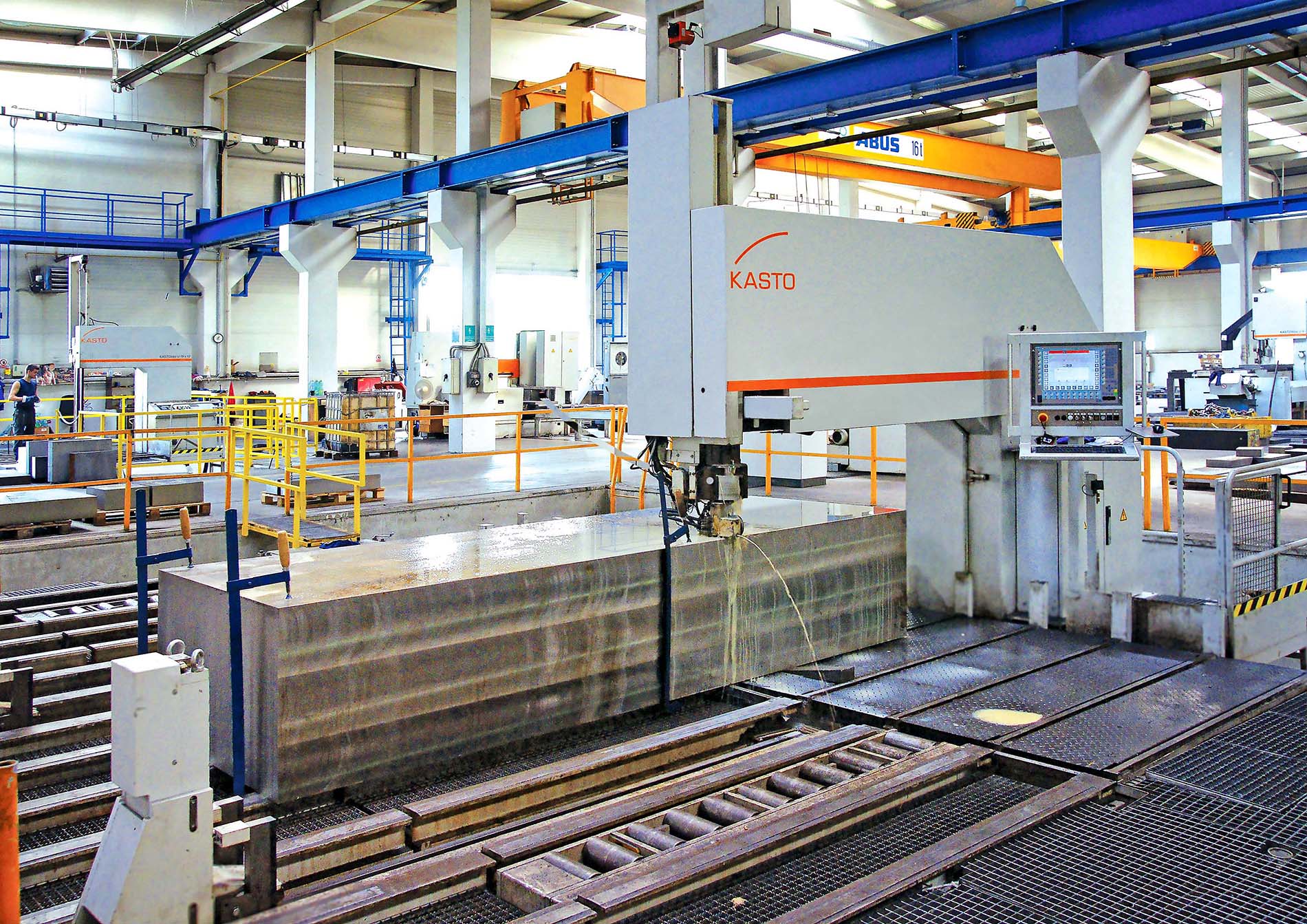
KastoApp facilitates the remote visualisation of Kasto sawing machines on the shop floor. The app displays the operational status of all networked machines equipped with the manufacturer’s proprietary SmartControl, AdvancedControl, ProControl or ExpertControl systems. Users can see the name, machine number and type of saw at a glance. If a machine is running in automated mode, KastoApp can also access the information stored in the program that is running. It provides users with exact information on relevant parameters such as the item, cut length, target and actual quantities, band feed rate, and cutting speed. If a fault occurs, the app displays a graphic of the relevant error message, enabling users to visualise the problem and react immediately to minimise downtimes.

Kasto also has a solution, KastoSort robot link, to automate production processes upstream and downstream of the sawing process and integrate them into a uniformly controlled material flow. Industrial robots can not only remove sawn parts independently, but may also perform additional tasks such as deburring, chamfering, centring, threading, marking, printing, sorting, stacking and picking.

This robotic solution can be further integrated with a container management or driverless transport system. Depending on the customer’s requirements, Kasto can integrate the robot control into either the saw’s CNC system, or its own KastoLogic WMS, or an existing ERP system, enabling users to monitor and control the process with a single interface.

Thanks to customised interfaces ranging from SAP, Infor and Microsoft Dynamics to customer-specific software solutions, the KastoLogic WMS can be easily connected to a higher-level host system within the company, as can individual Kasto sawing machine controls. The resulting communication structure significantly increases transparency.

For further information
www.kasto.com

Automated and digitised sawing system

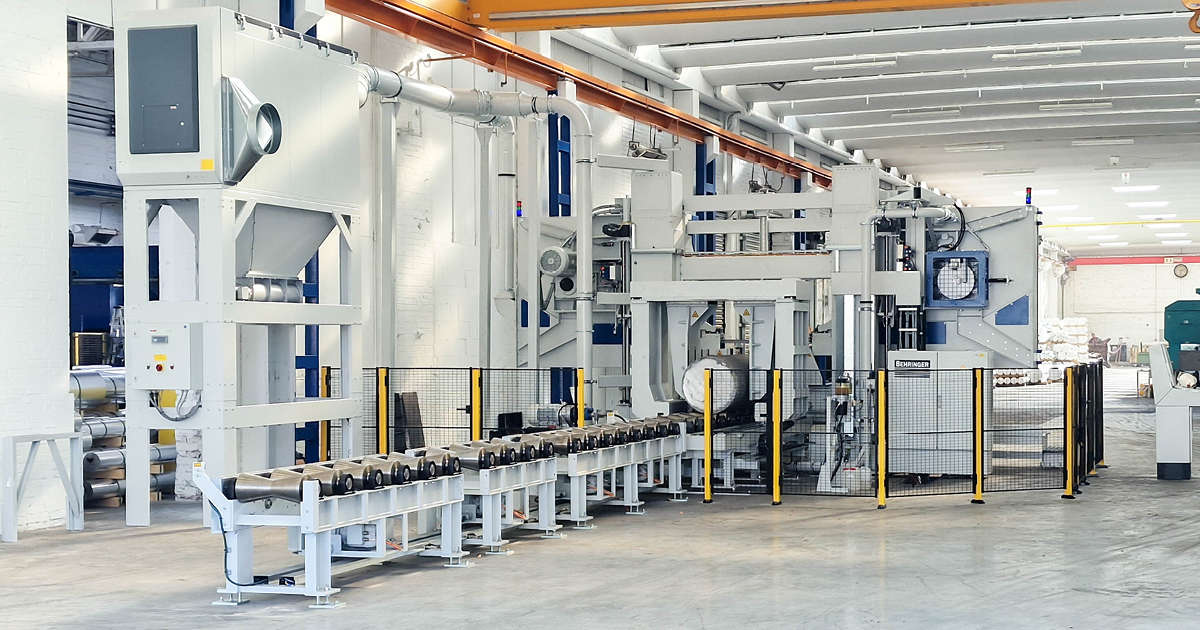
Meba has implemented one of the most complex projects in its company history: the sawing system at Günther + Schramm GmbH, a system service provider for steel, stainless steel and aluminium in southern Germany. In a tight planning phase of under one year, the two companies jointly developed and implemented a fully automated and digitised sawing system with roller conveyors, high-bay warehouse connection, short parts disposal and ground-breaking machinery innovations.

The starting point for the project was two outdated saw mills, a circular saw and a bandsaw, which were due for replacement. The very clear target from the customer’s side was: in principle, the process should remain the same as before, but output must significantly increase.

The high degree of automation and digitisation provided a clearly measurable increase in productivity possible for the steel distributor. In phase one, Meba evaluated the output quantity of the existing machines for two years: the new plant would be able to produce almost twice as much.

For Meba, the special features of this intensive project included the fully automatic system in conjunction with a high-bay warehouse, as well as the implementation of short parts disposal. The basis for the complete sawing system centres on two MebaMat 330 automatic machines. Both are technically identical, but arranged in a mirror image, left and right to each other. Orders generate automatically by work preparation via an SAP interface. Via networking and an interface, cutting values are also generated automatically, after which the integration of conveyor systems to the rack warehouse takes place.

Meba has complete access to all controllers, so that Günther + Schramm can be supported via modem in diagnostics and operation.

For further information
www.meba-saw.com

Taking automation to the next level

Established more than 60 years ago, Phillips Tool was initially founded by Ted Phillips in 1959 as a tool and die manufacturing business serving local customers in the Frankfort, Indiana area. In 1962, the company started sharpening saw blades and welding bandsaw blades, and after more than 20 years of saw blade servicing playing a greater role in the business, the next generation of the family changed the company name to Phillips Saw and Tool (PSAWS). Soon afterwards, the company invested in grinding technology from Vollmer and it has not looked back since.

“Our first Vollmer in 1995 [a CHC025] blossomed and our saw shop today looks like a Vollmer showroom,” states PSAWS president Jeff Chynoweth.

While many machines at PSAWS already provide automated loading/unloading, the company never stands still.

“We changed the automation system on our Vollmer CHD270 machine from the ND230 to the larger capacity ND360, which really takes automation to the next level,” says vice president Jordan Chynoweth.

The ND360 handling system takes the previous three-station system up to six stations, providing the capacity for up to 550 circular saw blades to be loaded automatically. Not only has the ND360 increased automation capacity from 250 to 550 saws and the maximum diameter capacity from 630 to 840mm diameter, it also permits the integration of up to three grinding centres.

Regardless of the pandemic, business has remained relatively strong for PSAWS and the company has reaffirmed its commitment to customer service, ordering an additional two Vollmer machines that arrived in 2021.

“We ordered a CHD271 machine that was incorporated into the existing CHF270, CHD270 and ND360 cell to deliver complete automated production autonomy,” says Jordan Chynoweth. “We also took a CHF1300.”

For further information
www.vollmer-group.com