

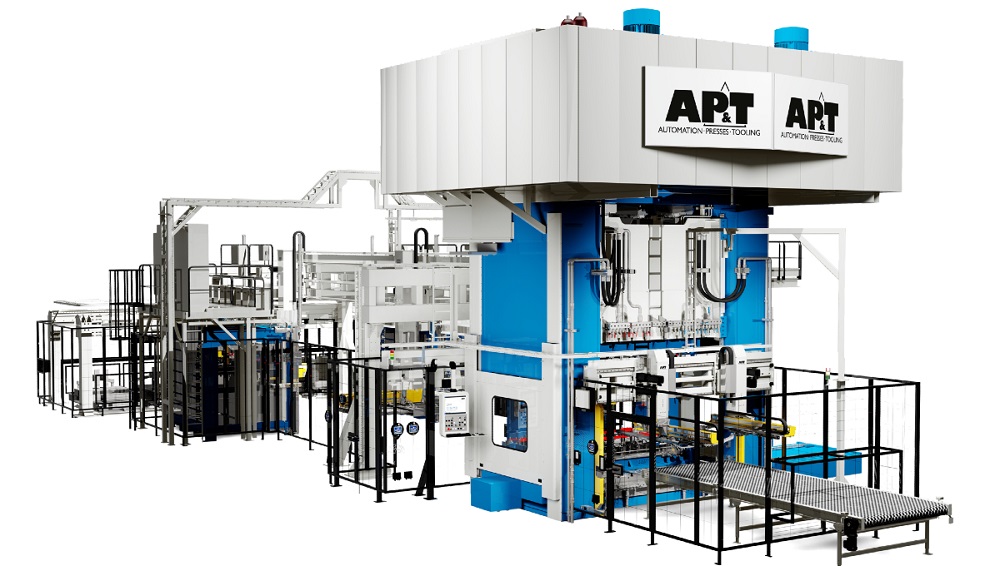
Process monitoring for press-hardening lines

When metal manufacturer AP&T needed an automated solution to monitor the heat distribution during the shaping and pressing of vehicle parts, it turned to Termisk Systemteknik. The answer was a non-contact temperature monitoring solution using thermal imaging cameras from Teledyne FLIR.

AP&T needed a solution to measure and monitor sheet materials before and after pressing. It is necessary to guarantee even heat distribution from the furnace before pressing the sheets, an exact placement of the sheets, and to ensure that there are no hot spots after the sheets cool in the press tool. Failing to meet any of these three conditions means the safety-relevant components will not reach their required mechanical properties.

Termisk designed an Infrared Press Hardening Analysis (IPHA) vision system that can measure the three main factors affecting sheet pressing quality: temperature before and after pressing, and sheet placement in the press. Using Teledyne FLIR thermal imaging cameras mounted to the sides of press machines, the IPHA system 1/3 measures the temperature of metal sheets using the Teledyne FLIR A70 smart sensor camera or Teledyne FLIR A615 camera, depending on the required image quality.

The set-up ensures accurate measurement of the temperature for the whole surface area of the 3D-shaped sheet. Once pieces are inside the press, the press-line controller system signals to IPHA to take an image and analyse it. With the positioning and temperature determined as OK, the system sends a signal back to the press line to proceed. Similarly, it then measures the sheet temperature and inspects heat distribution after pressing and cooling. The high-resolution thermal images make it quick and easy to identify hot spots and measure the areas where the material has not reached the correct temperatures.
For further information www.flir.co.uk
Enerpac Cube Jacks ease tight installation of presses

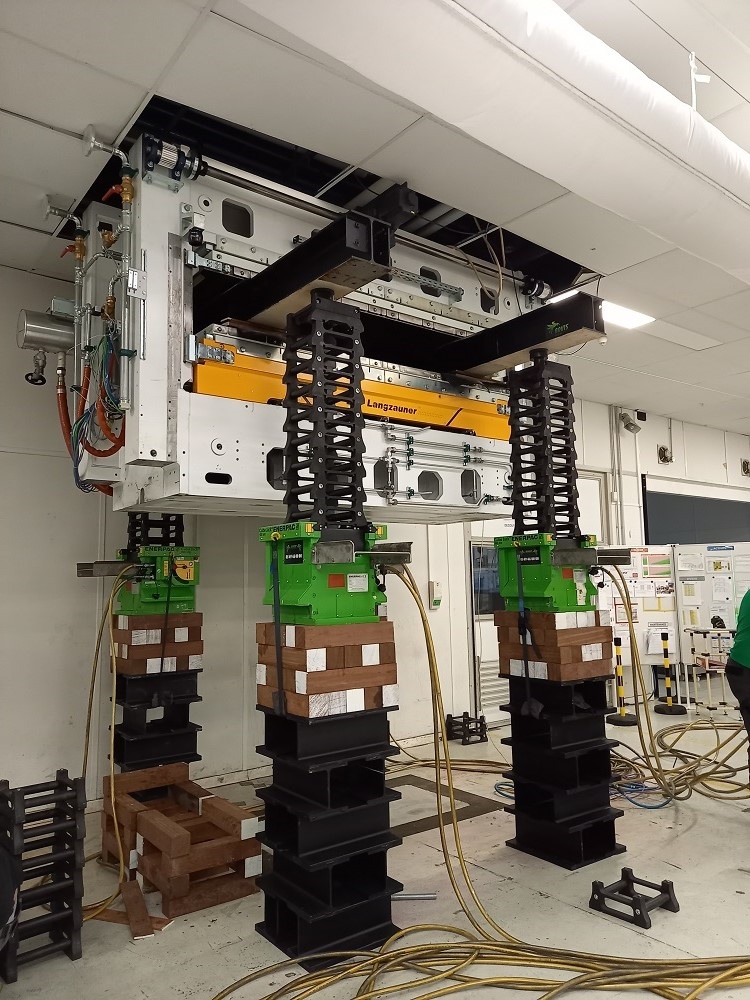
Faced with installing two 16-tonne presses, one on top of the other, with just 30mm headroom, French equipment installer Bovis Group used Enerpac cube jacks to successfully complete the work. By combining Enerpac SCJ-50 cube jacks with load-holding, wooden cribbing and jacking blocks, it was possible to lift and accurately position the presses were within the space available.

Bovis Group’s centres in Poitiers and Trinstal Equipements collaborated on this high-precision handling project for a manufacturer of electronics and advanced materials. The technical challenge was the space constraint. Using 3D modelling software, it was possible to develop a lifting scenario based on progressive jacking of the upper press to within 30mm of the factory ceiling. From this position, it lowered onto the second press to complete the press assembly.

For the vertical lift of the upper press, the Bovis team used four Enerpac SCJ-50 cube jacks connected to a split flow pump, providing synchronised movement of all four jacks. After the initial lift, Bovis supported the press using wooden cribbing and positioned the cube jacks on jacking blocks to repeat the lift. Once the upper press was at the correct height, Bovis used a 30 tonne hydraulic mover to move the lower press into position beneath the upper press.

“This was a very precise operation and demonstrated the lifting accuracy we can achieve with the Enerpac cube jacks,” says Jérôme Lebrequier, industrial project manager at Bovis Group.“Thanks to our meticulous planning, and the ease of using the cube jacks, we were able to complete the installation of both presses on the same day.”
For further information www.enerpac.com

Siderforgerossi Group renews its production capacities

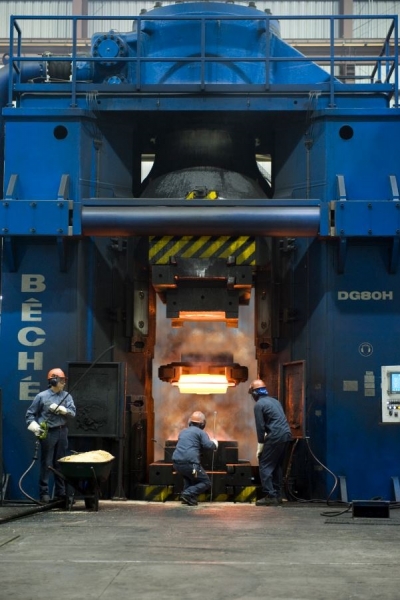
For more than 50 years, the old counterblow hammer from Bêché –now a Schuler brand – has been faithfully performing its duties at the Siderforgerossi Group. But now the time has come for a renewal at the Busano Canavese production site near Turin: in the future, a Schuler DG50h counterblow hammer will take up residence to produce large steel and aluminium forgings for the oil and gas, automotive, mining, and aerospace industries.

“We’re very pleased that our customer has once again awarded the contract to Schuler,” says managing director Frank Klingemann. “Air-powered counterblow hammers are characterised by high availability, as can be seen from the long service life of the predecessor model.”

As the drive components are not in the vibration range, there is low downtime and maintenance,and thus a high degree of utilisation, reports Schuler. The pneumatic drive also allows a high number of consecutive strokes without any drop in stroke frequency – in the case of the DG50h, up to 36 per minute. Notably, the energy-efficient expansion of the drive medium during the impact stroke results in an almost unchanged working capacity of 500 kilojoules at different die heights up to a maximum of 900 mm. Commissioning of the system weighing 355 tonnes will take place later this year.

The scope of supply also includes an intuitive control system, which Schuler has developed specifically for work-bound forging units. Functions include various impact programs, monitoring of impact energy, part thickness and temperature, and documentation of die and production data. Access to the operating instructions is also possible, as is remote maintenance and connection to the customer’s network.
For further information www.schulergroup.com/en

Precision press will advance innovation and sustainability

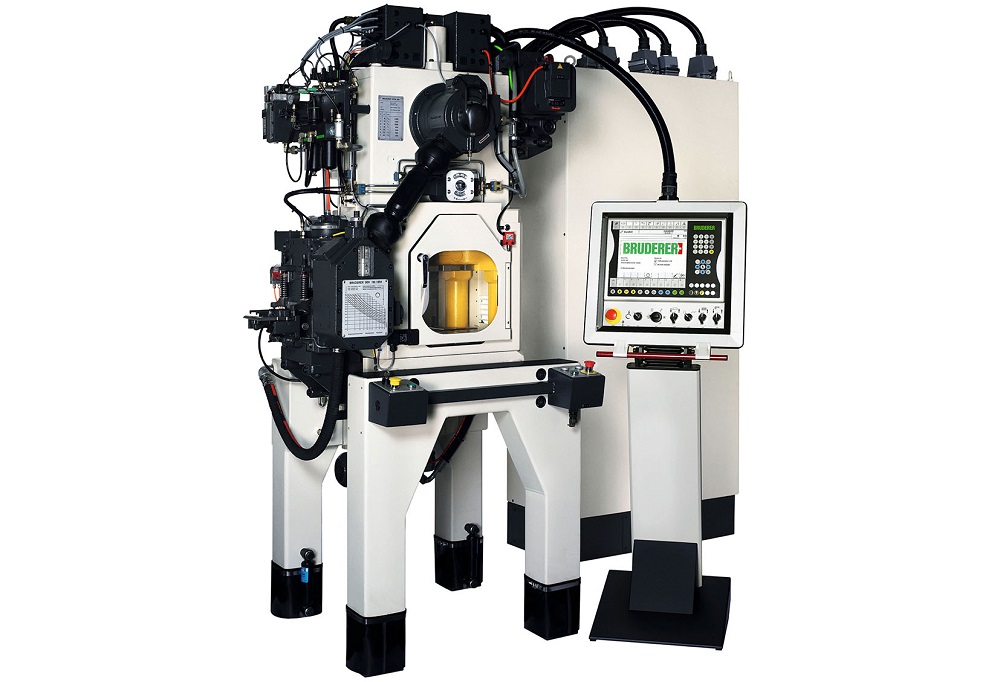
Taking advantage of new export opportunities has seen a Middlesex manufacturer invest more than £300,000 in a new high-speed precision stamping press line.Eden Ltd, a specialist in optical air-blown fibre and cables fittings for the global telecommunication industry, renewed a 35-year working relationship with Bruderer UK to place the order for the BSTA 180-36B press, fitted with the latest high-speed precision servo feeder.

The machine is already delivering greater accuracies, with Bruderer UK’s quick lift-ram technology – that dynamically adjusts bottom dead centre position whilst in operation – meaning the business can guarantee process stability and part quality to customers regardless of the volumes required.

“A pre-owned Bruderer BSTA 30 was one of the first machines I bought when I started the business back in 1993,” explained Dave Hawkins, chairman of Eden.“It’s given us tremendous service and reliability, so when we were looking to advance our press shops technology to make parts ten times quicker to compete with Far East competition, there was only one investment I was going to make and the new Bruderer press is going to be fantastic for us.”

He continues: “We’ve seen demand increase significantly since lockdown, as we’re one of the few companies worldwide that control all elements of manufacturing in-house. We haveinvested some £1.5m over the past 18 months, culminating in the acquisition of the high-speed precision press.”

The Bruderer UK technical team worked with Eden to spec the BSTA 180-36B to its exact requirements, adding a high-speed precision BSV75 servo feeder (including automatic material thickness adjustment) and other options to help accelerate tool development, tool changeovers and the efficiency of the whole process.
For further information www.bruderer.co.uk

Heavy press dies handled quickly and easily

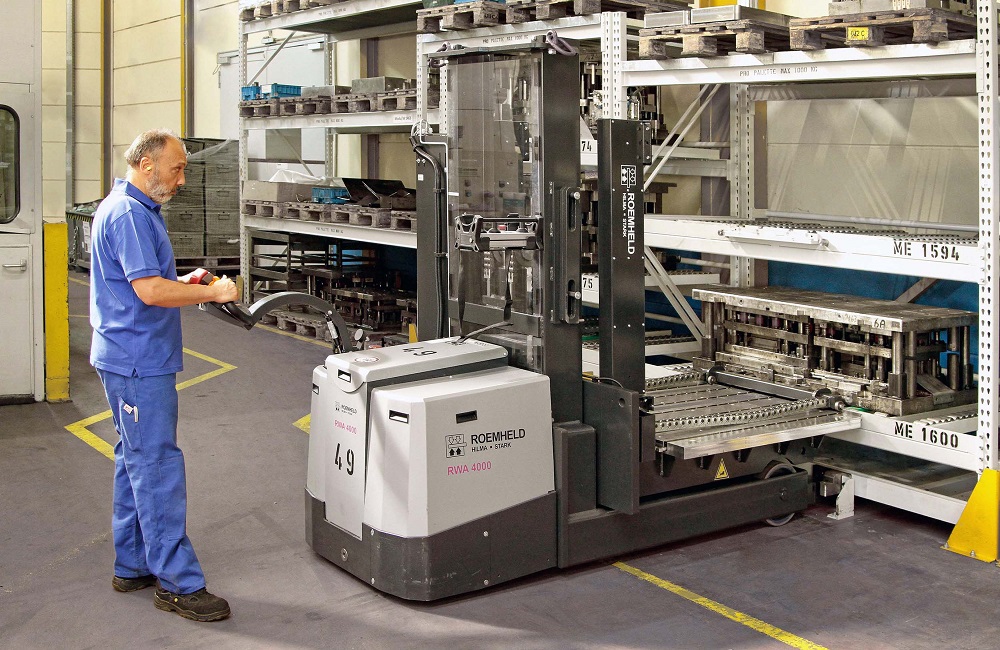
In Eltville am Rhein, Jean Müller develops and produces around 40,000 components for distributing, controlling, securing and measuring electrical energy in low-voltage networks. For handling particularly heavy punch-press tools for manufacturing a new product series, the family-run business was initially looking for a new transport cart. In the end, however, the company acquired a complete die-changing system from Roemheld, comprising racking and a lifting cart with integrated docking system and radio remote control. Similar technology is available in Britain and Ireland through Roemheld UK.

A the heart of the joint solution is the manoeuvrable, electrically-driven Roemheld RWA 4000 die-changing cart, which is capable of carrying a load of up to 4 tonne. It has a die-changing table with integrated hydraulic ball bars and a pull-push system that facilitates automatic insertion of the dies on a press bed.

During transport, the hydraulic balls in the cart table are lowered and, consequently, the die is prevented from slipping. A safety circuit ensures that the RWA 4000 only moves when the ball bars are retracted. Removable safety bars at the front and sides of the support surface additionally secure the die. Users can control the cart from a central panel on the drawbar, on which a multi-function display sits. Alternatively, employees can adjust the most important cart functions remotely via the radio control.

Jean Müller’s new system has been in continuous three-shift operation since the spring of 2022, the year that the company celebrated its 125th anniversary. The distances the dies have to travel to the presses is now shorter, resulting in a time saving of 15 minutes for each changeover, which happens up to three times per shift.
For further information www.roemheld.co.uk