Advanced Engineering opens registration

Visitor registration is now open for Advanced Engineering UK, an annual UK exhibition for engineering and manufacturing professionals. Taking place on 29-30 October 2025 at the NEC in Birmingham, Advanced Engineering is the UK’s only event that connects the entire industrial ecosystem. This year, the show features additions like the expanded Composites Pavilion, SME Village, ADS Pavilion and AMForum.

The 2025 event comes at a pivotal moment for UK industry, following the Government’s announcement of a new 10-year industrial strategy. With measures that could reduce electricity bills by up to 25% for over 7000 manufacturing firms and billions earmarked for innovation, R&D and AI, the strategy signals a renewed focus on long-term industrial growth – a direction that will be reflected across the show floor at Advanced Engineering 2025.More information www.advancedengineeringuk.com

Factories to See Electric Bills Cut

More than 7000 British factories are set to see their electricity bills slashed by up to 25% from 2027, as the Government unveiled its new Industrial Strategy last week. British manufacturers currently pay some of the highest electricity prices in the developed world, but the new British Industrial Competitiveness Scheme will cut electricity costs by up to £40 per MW hour for electricity-intensive businesses in sectors like automotive and aerospace.

These firms will be exempt from paying levies such as the Renewables Obligation, Feed-in Tariffs and the Capacity Market. The Government is also increasing support for the most energy-intensive firms – like steel plants – by covering more of the electricity network charges they normally have to pay through the British Industry Supercharger. Such businesses currently get a 60% discount, but from 2026, it will increase to 90%.

More information www.gov.uk

XYZ MACHINE TOOLS AND CERATIZIT WORK IN UNISON TO ENSURE AWINNING COMBINATION

For over 15 years, XYZ Machine Tools and Ceratizit have engaged in a partnership where
they support each other’s activities with shared values, vision and thinking. The
collaboration, which began with a chance meeting at Edinburgh Airport between Glenn
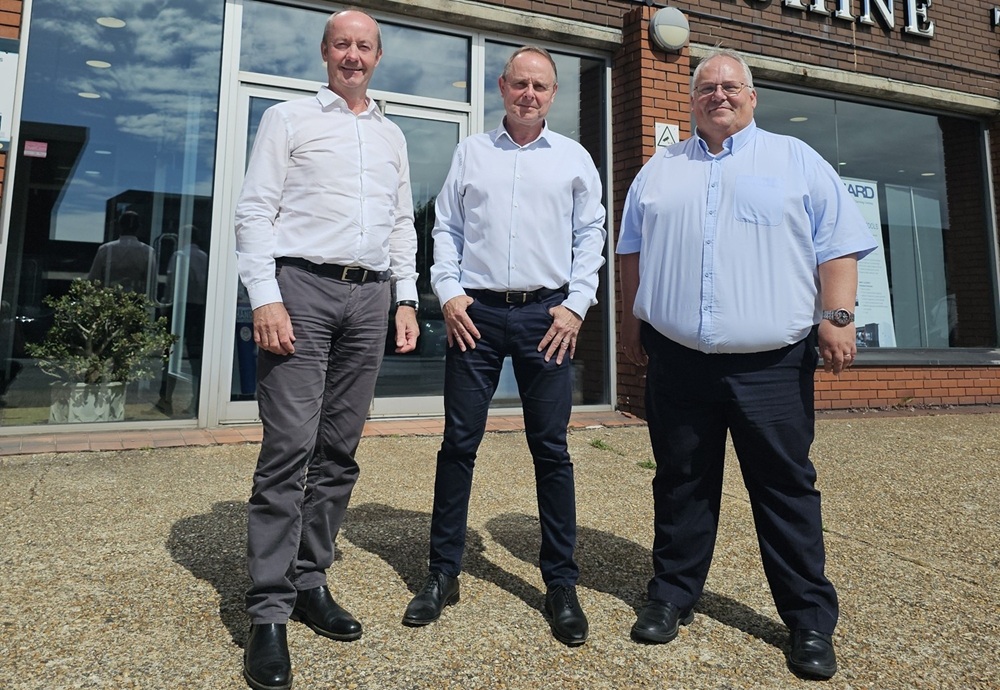
Stanton, sales manager at Ceratizit UK and Ireland, and Nigel Atherton and Mike Corbett of
XYZ Machine Tools, continues to help customers of both businesses.
Says Stanton: “Chatting with the guys from XYZ at the airport, we spotted a synergy
between the companies in several areas, one of which was the typical customers that
purchased from both businesses. Another common theme was the focus and drive we had
to help customers become more efficient at a great price point. Over the past 15 years it has
proved to be the perfect partnership.”
A machine tool is never going to perform without cutting tools or work holding and, during
its formative years, XYZ had never really aligned with a dedicated tooling supplier. At the
start of the relationship, Ceratizit, which was branded as WNT at that point, provided XYZ
with tooling that allowed the company to demonstrate its machines to their full capability
and show production gains to customers at the XYZ showrooms around the country.
“High-feed milling and the development of variable helix/variable pitch solid-carbide milling
cutters were really starting to make an impression in machine shops around the country
when the partnership began,” explains Corbett. “It was ideal that XYZ had access to this
latest generation of tools. We were able to show customers how to reduce cycle times and
improve machine efficiency with the technical back-up of a company that was at the leading
edge of cutting tool performance.”
The partnership took a giant leap forward following the opening of the Ceratizit Sheffield
Technical Centre. With Ceratizit’s business model evolving, space that was once used for
holding tooling stock in the Sheffield Airport Business Park facility, became available for XYZ
to install a range of its machines. This in turn created a demonstration/training facility in the
north of England.
A by-product of having these machines in Sheffield was it allowed the showroom to become
the training hub for Ceratizit technical and sales staff – not only the UK but also from other
countries around Europe. It allowed customer-facing employees to see how they could get
the best from their products.
Ceratizit has subsequently moved its Technical Centre to a dedicated building on the AMRC
complex just down the road from the company’s main offices. However, the facility still

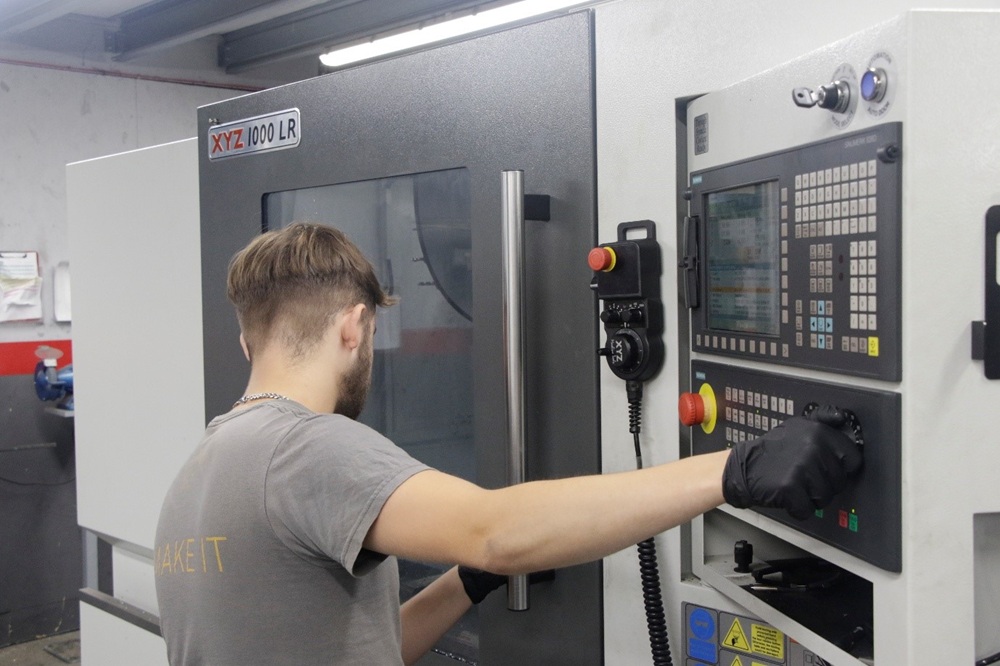
houses XYZ machines, including ProtoTRAK-controlled mills and lathes, an 800 HD vertical
machining centre, and a UMC5X simultaneous five-axis machining centre. The tooling
specialist continues to use the XYZ machines to deliver technical training to both staff and
customers, while another application is the manufacturing of bespoke work holding and
fixtures marketed under the ‘Made In Sheffield’ brand.
Both businesses are seeing a change in the landscape of machine shops around the country,
where gaining access to tooling as quickly as possible is becoming increasingly important.
XYZ is also witnessing this trend, and one of the advantages of its association with Ceratizit
is continuous access to the latest TOM 80 vending machine.
“As customers adapt to the changes that Brexit has brought, many are now taking
advantage of having a vending machine installed on their shop floors if they meet certain
criteria we set,” explains Stanton.
To highlight the benefits the vending machine brings to the XYZ showroom near Tiverton,
Devon, Corbett adds: “Both our production team and applications department use this
machine to dispense Ceratizit tooling. We have full traceability of who vends the tools and
re-stocking takes place without any intervention from XYZ. This facility ensures tooling is
always available to our staff without needing to call upon Ceratizit’s next-day delivery
service, adding to our efficiency.”
When asked about the future of the partnership, Stanton says: ”As we develop new tools,
grades of carbide, and add to our existing five-axis vices and zero-point work-holding
systems, XYZ will always be involved in the development of these products. It allows
customers to see first-hand in any of the XYZ showrooms around the country the latest
technologies we offer.
Corbett closes by adding: “Both Ceratizit and XYZ feel that everybody is a winner with this
arrangement. XYZ get tooling and work holding provided to show the power and robustness
of the products. Ceratizit wins because they can show their cutting tools and work holding in
action to prove the performance gains available from investing in their equipment.
However, as far as both companies are concerned, the main winner has to be the customer,
who can produce parts as efficiently as possible and reduce the cost per part by tapping into
this long-established partnership.
More information www.xyzmachinetools.com

Transforming Wind Turbine Repairs

A research collaboration between Renewable Parts Ltd (RPL), SSE Renewables and the National Manufacturing Institute Scotland (NMIS) has demonstrated the potential to remanufacture critical onshore wind turbine components – restoring worn or damaged parts to their original specification or better. The outcomes could drastically cut waste, reduce carbon emissions and extend part life.

Using additive manufacturing, analysis and inspection techniques, the team successfully restored damaged pinion shafts from a wind turbine yaw gearbox, a key component that keeps turbines facing into the wind to maximise energy capture. Early trials showed that remanufactured parts could perform to original specifications following machining and NDT, saving up to 84 kg of CO2e per remanufactured component.

More information www.nmis.scot

KUGEL RELOCATES AND FOCUSES ON PRE-EMPTIVE MAINTENANCE

Kugel Rotary Services, a rapidly growing machine tool spindle repair and refurbishment
company, moved in August 2024 from Sandiacre to new premises more than five times the
size in nearby Hucknall, Nottinghamshire. The independent firm is one of only a handful in
the UK to offer such a maintenance service across the full range of spindle types and sizes
on the market, covering those produced by both specialist manufacturers and machine tool
builders. Kugel customers enjoy monetary savings of up to 50% compared with obtaining
the service from the spindle manufacturer.
It is not commonly known outside this specialist sphere of activity that certain key elements
of most spindles produced in Europe are made to the manufacturers’ designs by one of
three third-parties, of which OTT-JAKOB Spanntechnik, located in southern Germany, is the
largest. Kugel exclusively sources spares from this company, including the pulling head
(drawbar), the clamping unit (the gripper in front of the spindle nose taper), and the rotary
union (which attaches to the back of the pulling head to provide through-tool coolant
delivery).
Understandably, there is a close relationship between Kugel, OTT-JAKOB and the latter’s
exclusive sales agent in Britain and Ireland, tool holder specialist GEWEFA UK, based in
North Bradley, Wiltshire. It is a three-way relationship that was established when Kugel was
set up in 2017 by managing director Stuart Vere and business partner Kevin Ewing, both of
whom previously worked in a similar spindle and ballscrew renovation firm. Ewing’s son-in-
law Alexander O’Neill and son David are also involved.
So too is Silke Moss, who also worked in the earlier refurbishment company’s offices and is
now the main link person between Kugel, OTT-JAKOB and GEWEFA UK.
“The services GEWEFA provide are amazing,” she says. “They are exceptionally helpful with
providing speedy quotes and trying to shorten delivery times when we receive urgent
orders. OTT-JAKOB personnel also take a direct interest and have visited us. We can always
contact them directly with technical queries and for problem solving. The whole relationship
is based on mutual trust.”
The scope of Kugel’s activities is wide, centring mainly on spindles manufactured in Europe.
GMN, Kessler, Fischer, Gamfior, Setco and Steptec are some of the specialist spindle
manufacturers whose products are routinely rebuilt, while DMG Mori and Heller are two
machine tool builders whose in-house produced spindles are often overhauled. Japanese
and other Asian versions tend to use different internal components, but some are easier to
repair without the need for replacement parts. Recently, a Mazak spindle underwent
refurbishment by Kugel.

“We have a wide customer base, with 90% of our work currently coming from blue-chip
companies in the automotive and aerospace sectors,” explains Vere. “They have production
lines comprising numerous machine tools. If one goes down due to a spindle failure, the line
stops. A situation that would just be an inconvenience to a subcontractor down the road
becomes an all-out emergency, with serious financial implications.
He continues: “The machine OEM or independent spindle manufacturer may well offer a
service exchange and supply a refurbished spindle from stock. However it is an expensive
option, added to which Brexit often delays the paperwork and increases costs further. We
can rebuild a spindle in a similar lead-time at typically between one half and three quarters
of the cost.”

The range of different spindles serviced by Kugel is vast, coming from many different
machine tools including vertical and horizontal machining centres, borers, grinders, honing
machines and lathes, for which both work spindles and B-axis tool spindles are repaired.
Rotary tables and trunnions are also returned to as-new condition in Hucknall. Similarly
wide is the variety of spindle sizes and specifications that are worked on, from a small
120,000 rpm high-frequency spindle for a die grinding customer, through HSK-A63 and HSK-
A100 face-and-taper contact tool interface spindles and their taper-only contact BT 40 and
50 equivalents, to a special 300 kg, 4000 rpm, two-in-one rough- and finish-grinding spindle
for a specialist grinding machine manufacturer near London.
The present trend towards digitalisation in manufacturing and collection of large volumes of
data for analysis means that sensors are often built into modern machine tools, including
the spindle. Information on how long it has run since new or the last refurbishment, how
many tool changes it has completed, at what range of temperatures it has operated,
vibration levels during use and other service-critical data is becoming more readily available.
It heralds an age in which industry will move away from urgent spindle repairs after failure
towards routine preventative maintenance, which can be carried out during shutdowns or
less busy periods.
Even if machines are older and do not benefit from the wealth of operational big data that
their newer counterparts have, there are opportunities to train manufacturers’ maintenance
staff and even machine operators to listen to the sound of the spindle, feel for vibration and
perform other checks that could pick up signs of impending problems. Kugel is increasingly
in discussion with customers using legacy machines about training programmes and the
possible use of sensors for spindle monitoring as a basis for predictive servicing.
Trying to manage these scenarios and help prevent a spindle seizing up completely, hence
significantly simplifying its restoration, is currently very much an area of interest and activity
for Vere. However, with so many older spindles in service around the UK that are likely to
continue operating for a couple of decades, Kugel’s emergency repair service is set to
continue growing for the foreseeable future alongside nascent scheduled maintenance
activities.

More information www.gewefa.co.uk