

Twin machines erode circular saws automatically

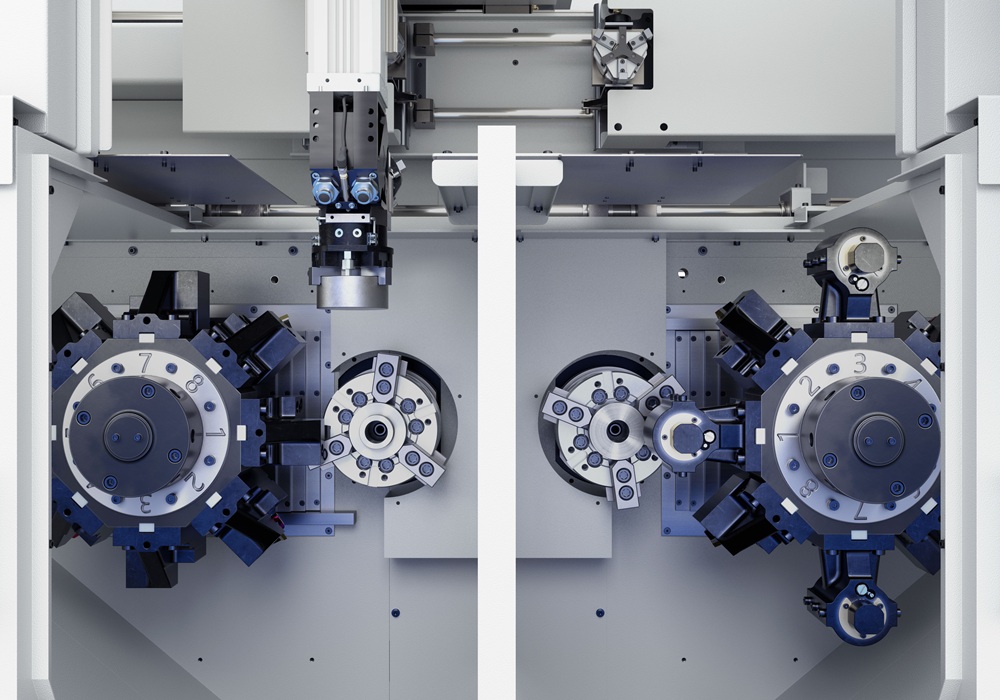
For all that the new Vollmer QS 860 and QSF 860 disc erosion machines may look the same and have virtually identical construction, they do in fact have some key differences. One twin sharpens the free surfaces of PCD circular saws, while the other sharpens the flank-free surfaces.

Intuitive control, integrated measuring equipment and handling systems ensure automated machining, while digitalisation by means of standard IoT gateway, data entry station and DCN operation optimise the erosion processes for the production and maintenance of PCD circular saws.

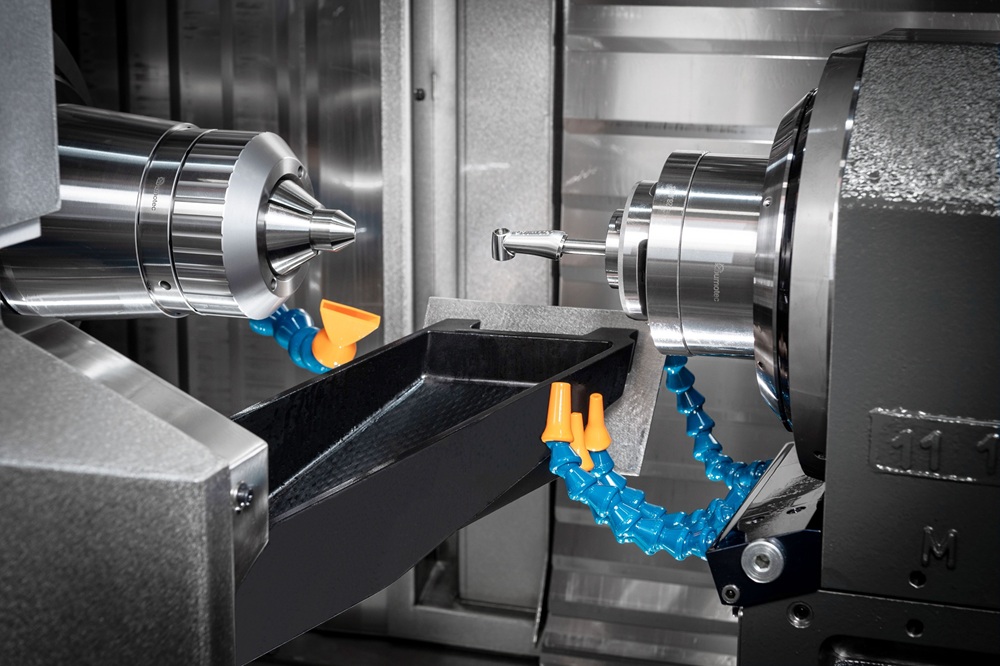
With its hardness rating of 10, diamond really is the king of machining. Circular saws tipped with PCD achieve long operating lives in metal and even highly abrasive composite material machining. To ensure that PCD circular saws retain their sharpness, Vollmer launched two new disc erosion machines.

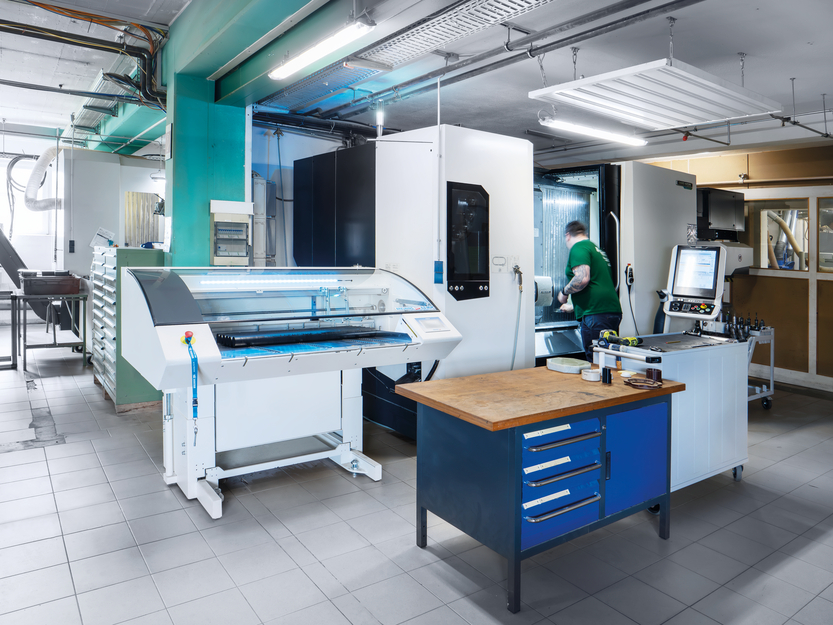
With the QS 860 and QSF 860 twins, saw manufacturers can produce their PCD circular saws with different geometries and diameters from 80 to 860 mm. It is also possible to resharpen existing PCD circular saws. Vollmer’s ND handling systems, which automatically load up to three machines – with up to 650 PCD circular saw blades depending on the model and specification – ensure unmanned machining around the clock.

Both machines have a robust design, complete CNC control and measuring equipment for fully automated set-up and work processes. They have measuring sensors that record all relevant parameters and deliver precise 3D measurement accuracy. The sensors detect newly inserted teeth and sharpen these to size, while the feed pawls automatically detect broken teeth and determine the tooth pitches so that manual adjustment is unnecessary.

Thanks to Vollmer’s tried-and-tested operation, users can control and programme the QS 860 and QSF 860 via touchscreen or keypad. More information www.vollmer-group.com

Precision, productivity and process efficiencies

GF Machining Solutions says its new CUT F 600 is a thermally-stable wire EDM machine that automatically identifies and adapts wire speed during the cutting performance, leading to improved productivity and process reliability.

The CUT F 600 wire EDM is designed to balance precision with productivity for accurate machining and high surface finishes. Designed for ease of use and flexibility, the machine features the UNIQUA control, ISPS (Intelligent Spark Protection System) and iWire intelligent functions and the radio frequency identification (RFID) Smart Wire system. It also offers design improvements for thermal stabilisation, vibration control and precise machine movements.

The iWire function automatically identifies and adapts wire speed to changing erosion height conditions during the wire EDM process. According to the company, this capability eliminates wire breakage while reducing overall wire consumption per job. The iWire function works in tandem with the company’s ISPS, both of which are accessed via the Uniqua control.

Additionally, iWire not only recognises exactly where sparks are occurring during the wire EDM process but also measures and identifies the position of each spark along the length of the wire. Knowing the exact location of a spark enables iWire to adapt the wire spool speed automatically.

For precise machine movements, vibration control and overall process stability, CUT F series machines provide use the work tank and dielectric fluid to cool the machine’s axis optical encoders. A further design innovation is the incorporation of higher accuracy machine ball screws that improve both positioning accuracy and smooth operation.

The CUT F 600’s Uniqua HMI features a 19″ vertical touchscreen, full keyboard and mouse.

More information www.gfms.com

Erowa introduces Robot Compact 150

The new Erowa Robot Compact 150 features a wide range of functions and a transfer weight of up to 150 kg. This new automation solution is suitable for the flexible loading of up to two production machines for all processing technologies – from eroding to milling. Thanks to its design, the loader offers high magazine density within a small footprint. 

An autonomous and flexible production cell, the Erowa Robot Compact 150 loads a die-sinking EDM machine with little space requirement. The two independent drives of the X axis enable long reach and minimal interfering contour to the machine.

It is even possible to load large Erowa MTS 400 pallets with a transfer weight of up to 150 kg and a workpiece height up to 400 mm on to the EDM machine. Over 500 Erowa pallets with different system sizes can be stored in the magazines, with magazine levels set up exactly as required.

An optional loading station can be integrated to save space. It enables large and heavy workpieces (UPC and MTS pallets) to be set up at an ergonomic height while the robot is working. An indexing system (4 x 90°) prevents the pallet from engaging in the wrong position and locks it automatically upon engagement.

Notably, the Erowa EWIS chip identification system (option) is based on RFID technology. It enables the unique identification of pallets and electrode holders fitted with EWIS chips in the robot magazine.

Regarding process control, the Erowa JMS 4.0 connects all data and oversees the entire production process. Due to the automated data flow and real-time monitoring of production processes, JMS 4.0 provides the basis for a seamless workflow, reports the company.

More information www.erowa.com

University’s challenge accepted by ETG

Over its 150-year history, the School of Engineering at Newcastle University can lay claim to being the birthplace of great ideas that changed the world. It is this propensity to push the boundaries of innovation that has recently seen the university invest in a Mitsubishi wire EDM machine from the Engineering Technology Group (ETG). 

Newcastle University recently invested more than £110m to re-develop its Stephenson building, aptly named after engineering pioneer George Stephenson, the renowned ‘father of the railways’. Part of the investment includes new plant and equipment to support students, academic researchers and industrial partner projects.

The university’s technical team leader for manufacturing, Stuart Baker, says: “By investing in a new EDM machine we could keep as much of our work as possible on-site to increase the student experience. Having the technology on-site also enables us to demonstrate the EDM process in considerable depth.”

He continues: “The Mitsubishi MV1200S scored the highest above other applicants on our tendering process, particularly as our new workshop in the new Stephenson Building is very sustainability-focused. Mitsubishi’s MV1200S has a wealth of energy efficiency measures that tie in with our ambition to be a carbon-neutral facility by 2030. One such innovation that caught our eye and scored highly above other vendors was the Mitsubishi E.KO Ioniser system, which is environmentally efficient compared to standard ion resin systems.”

Mitsubishi says its E.KO ioniser system offers the world’s most innovative and ecologically optimal technology for the production of deionised process water used in wire EDM. The E.KO Ioniser completely replaces the mixed bed resin and is therefore one of the most environmentally friendly solutions in the field of process water treatment. 

More information www.engtechgroup.com

Filtermist recruits BDM

A Telford manufacturer that helps machine shops create cleaner and safer working environments is embarking on a major international expansion drive. Filtermist, which employs over 150 people, has appointed Graeme Bell as its new global business development manager. The filtration expert will be responsible for driving new opportunities in the APAC region, particularly India and China. Bell has already spent time visiting customers in China, Korea and India, before serving a central role in the Filtermist delegation that exhibited at the IMTEX exhibition.

More information www.filtermist.com