

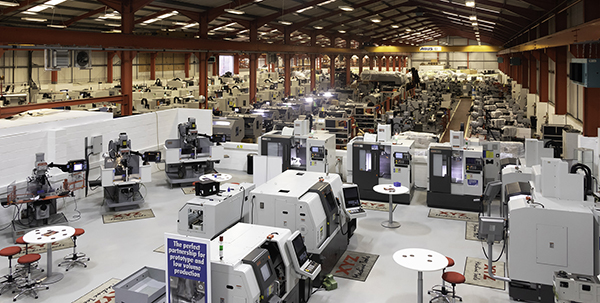
Uptake of Big-Plus spindles continues

Further to an already extensive list of licensed machine manufacturers, eight more have recently signed up to utilise Big-Plus spindle and tooling systems from Big Kaiser on their machine tools. Big-Plus spindles, which are available in the UK from ITC, are now licensed to circa 170 machine tool manufacturers.

Said to be the only system that provides simultaneous taper and flange contact in a 7/24 cone interface, the Big-Plus dual-contact connection between the machine and tool is robust, reliable and accurate. Despite the fact that Big-Plus was developed over 25 years ago in Japan by Big Kaiser’s parent company, Big Daishowa, the adoption of the spindles is still seeing solid growth across industry.
For further information www.itc-ltd.co.uk

TDI 2019

Set to return for 2019, the Technology, Design and Innovation (TDI) Challenge is now open for entries.

This flagship competition for schools (organised by the MTA) encourages students to submit their coursework projects, which go towards either their GCSE, A-Level or BTEC qualifications. There are four prize categories to be judged, two in each age group, 14-16 and 17-19. The closing date for 2019 entries is 15 May, and only one application per student or group will be accepted, although schools are permitted to enter multiple students. Finalists will be notified by 7 June.
For further information www.mta.org.uk/tdi

Work holding for horizontal machines

Roemheld has unveiled newly developed towers for clamping multiple workpieces on the table or pallet of horizontal machining centres.

TS towers feature four vertical faces for holding four, eight or 16 parts, while TS TriStar versions have three faces for securing three, six or 12 parts. The latter models have the advantage of allowing improved spindle access for machining components from the sides.
Every unit employs a patented guidance and sealing system without the need for sheet-metal covers or plastic wipers, while the monobloc design provides stability and accuracy.
Roemheld has released two sizes of the four-sided tower, TS 100 and 125, and three of the three-sided tower, TS 80, 100 and 125 TriStar, the numbers representing the jaw width in millimetres. Stroke is up to 476 mm, while the maximum clamping force ranges from 20 to 40 kN. Manual operation of the vices delivers reproducible clamping force, which may be low to avoid deforming delicate components, making the towers suitable for a variety of applications. Alternatively, the largest of each type can be equipped for hydraulic operation.
In the Vector versions of the towers, applicable to all but the smallest TriStar model, a fixed jaw can be arranged in the centre on each face or, if desired, two fixed jaws can be supplied instead. Workpiece weights above 15 kg can be accommodated.
A range of accessories, including jaws and jaw inserts, is available, as are drawings and CAD models of the equipment, an advisory service and bespoke work-holding arrangements.
For further information www.roemheld.co.uk

Smart factory

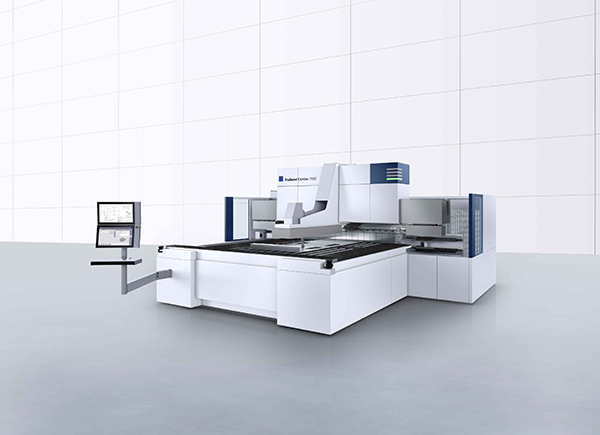
At its open house in Coventry on 19-21 March, Bystronic UK will repeat its Swiss parent company’s presentation on world-class manufacturing entitled ‘The Networked World of Sheet Metal Processing’, which featured at last year’s EuroBlech exhibition. Visitors will learn where integrated automation and new software solutions are heading in the fields of laser cutting and bending.

Dan Thombs, managing director of the UK subsidiary, says: “Bystronic accompanies its customers step-by-step on the path to the smart factory. This is what we will be emphasising during our open house.”
For further information www.bystronic.co.uk

Centric-clamping vices upgraded

The upgraded KZS centric-clamping vices from Röhm are suitable for, among other things, six-sided machining involving two clamping operations on round or prismatic workpieces. KZS range vices deliver clamping forces of up to 55 kN, an increased clamping range of 20% and a reduced interfering contour for optimal chip flow.

For use in three-axis, four-axis and five-axis machining centres, as well as all the usual zero-point clamping systems, both of the products in the range can be operated either pneumatically or hydraulically. In particular, this fact also means they are suited to scenarios involving robot-assisted workpiece loading. Here, the cost-saving opportunities are large. For example, one or two KZS clamping blocks can replace a large number of manual vices in automated procedures.
KZS vices can be loaded directly into the machine by a robotic arm. This potential means that it is not necessary for an operator to pre-position the workpiece outside the machine with an extra clamping device. Furthermore, a separate manual vice needs not be available for each component. When combined with a zero-point clamping system, such an arrangement makes it possible to shorten cost-intensive set-up times. Röhm can even adapt its centric-clamping vices to other manufacturers’ zero-point clamping systems. The direct benefits for the user are shorter set-up times, better utilisation of machine times and higher productivity levels.
With KZS vices, the precision wedge hook system is said to result in superior part quality and a high level of process reliability. Furthermore, an improved lubrication solution ensures that the clamping forces always remain at their highest level. Consequently, the clamping blocks are also suited to sophisticated milling operations associated with high material removal rates, high cycle numbers and tight machining tolerances.
For further information www.roehm.biz