

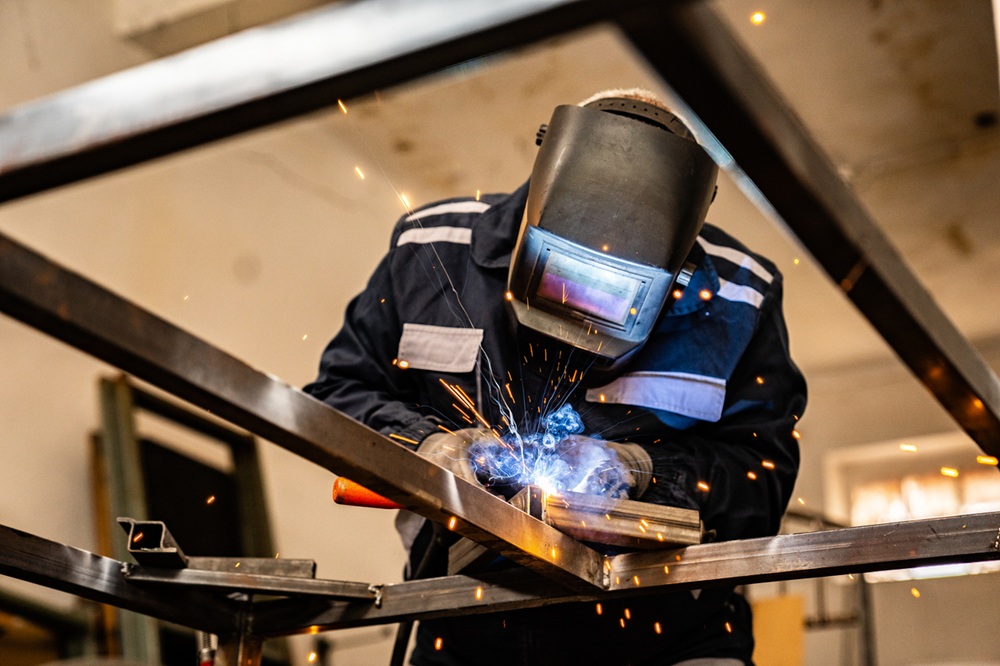
Robots could be the solution to filling the UK’s shortage of welders thanks to existing human expertise, a new study from the University of Nottingham has revealed. The UK’s critical welder shortage threatens certain industries, from construction to aerospace, potentially impacting the economy and infrastructure. Declining vocational training and Brexit, as it becomes more challenging to attract and retain skilled welders from the EU, has further exacerbated this skills gap. According to Axiom Personnel, half of the nation’s welders are due to retire by 2027.
In the new study, the authors asked whether robots could bridge this divide and if expert welder skills could be transferred to automated systems. By developing a robotic welding system that learns from skilled welders, and building a skills library, the system could then tackle new, unseen welding tasks by intelligently combining learned skills, demonstrated successfully with both expert and novice welders.
In the proposed approach, proficient welders execute basic tasks, such as welding simple lines or arcs, while their actions are recorded using an operation tracking system. Then, key welding parameters such as torch travelling speed, welding arc length, welding angle, welding current and wire feeding rate, are extracted and stored in a skill library.
Experiments have also been conducted to verify the system, comparing a skilled welder with a robotic welding system. Welding results from the robot show a quality that is on par with that of a skilled welder, effectively saving time and resources in the long term.
More information www.nottingham.ac.uk