For many organisations, particularly larger enterprises, fluid management and maintaining
optimal fluid performance while ensuring compliance and minimising costs has become a
significant operational challenge. Cutting fluids and oils specialist Oemeta has developed a
comprehensive fluid management service that the company says positions it as a leading
provider of not just advanced cutting fluids, but also the complete management solution.
Says Oemeta UK managing director David Woodford: “If you’re looking to implement fluid
management or you’re not happy with your current provider and looking for an alternative,
that’s where we can fit in.”
The challenge of managing cutting fluids is multifaceted, as Woodford observes: “When you
start to get to large, complex machines, bigger factories, supply chains, consignment stock
and subsequent waste disposal, you have to think seriously about who’s going to do this.
You can either train up your own people or bring somebody in who has the experience.”
He continues: “Smaller companies can typically look after 10 or 20 machines themselves,
but when you start to get to big, complex machines and larger businesses with more
machine tools, those companies don’t have the internal resource and expertise to run the
products effectively.”
Oemeta’s experience suggests significant market demand for either setting up on-site fluid
management or, for businesses where this already exists, an alternative solution.
“Our experience with certain companies is that they’re not getting the most from their
existing providers and are unaware of alternative providers or offerings.”
Unlike traditional approaches that focus on supplying fluid in volume, Oemeta emphasises
process optimisation.
“Our competitors are going in with inexpensive products and selling them in volume,”
explains Woodford. “They’re selling products cheaply, but their consumption is extremely
high. Our approach is to sell a lot less of a better-performing product.”
This philosophy centres on a strategy of continuous improvement.
“Rather than just managing top-ups, we focus on process optimisation, often through
products or services that are unique on the market. In contrast, our competitors provide
more of a monitoring rather than an improving structure.”
Louisa Johns, sales manager at Oemeta UK, emphasises the knowledge gap: “When we go to
shop floors where they have a fluid management agreement in place, the support they
receive can be sub-standard. Internal staff don’t have the knowledge and expertise that we
bring. Every time we go somewhere where a competitor is providing fluid management,
there’s barely any support. We offer so much more.”
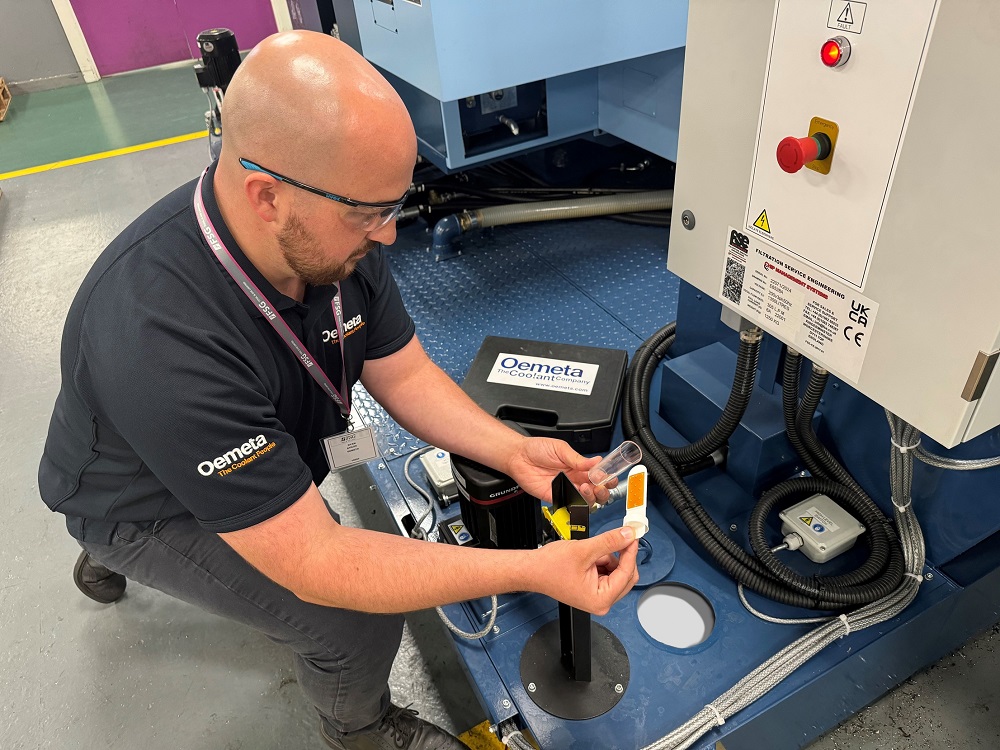
Oemeta UK says its comprehensive service offer encompasses the complete fluid lifecycle.
“We control the stock levels, bring the stock in, and manage distribution into machines and
processes,” explains Woodford. “Oemeta UK does all the testing and analytics, all the
supporting data, and all the health and safety documents. We work to improve the process,
extend product life and, when the fluid is ready to be changed, we handle all the machine
cleaning, waste collection and disposal.”
One example is at a large engine manufacturing facility in the Midlands where Oemeta
manages 42 machines that run 24/7 and require 12 different fluid types.
“We have staff permanently located on-site on different shifts, and the scope extends way
beyond cutting fluids,” he says. “For instance, we also manage their wash systems, chemical
treatment plants and undertake all the titration testing. The cost savings and efficiencies we
deliver more than cover the cost of our staff on-site full-time.”
Johns highlights the bespoke nature of each project: “The requirements and the subsequent
solution is bespoke to each shop floor. One company might want to reduce misting, while
another might want to look at material staining issues or corrosion. The knowledge and
expertise we bring compared with our competitors is a whole new level.”
Central to Oemeta’s offering is its cloud-based software system.
“Customers can look at fluid consumption of machines, operating parameters and the tasks
being carried out by the fluid management team,” says Woodford. “They can sit from
anywhere in the world and see whether tasks are being done. At one industry-leading
aerospace customer we did a process improvement on their neat oil machining and
improved tool life by 30%. They also reduced fluid consumption and the associated costs of
fluid and disposal by more than a third. This more than covers the cost of our engineer on
site.”
He continues: “In addition, their process stability and customer auditability have been
significantly enhanced because we’re controlling the process. When they are audited by
customers in the highly regulated aerospace industry everything is in place, and they no
longer face fluid-related audit issues.”
By identifying hydraulic oil leaks from machine tools into the fluid, the aero-engine
manufacturer will reduce fluid consumption by 20%. It is also able to highlight machine tool
patterns of maintenance concern, which feeds into their preventative maintenance
programme.
“We’re not only assisting in extending machine uptime and maintenance cycles, we’re also
delivering savings that will pay for our on-site technician,” says Woodford. “The cost savings
will pay for our engineers within the first 12 months.”
Adds Johns : “It actually pays for itself and takes the headache away from the customer. The
full management and traceability, extended machine uptime, enhanced performance and
component quality are all benefits stacked on top of the significant cost savings and reduced
environmental impact.”
“Our engineers are embedded into the company when a business agrees to a fluid
management service,” states Woodford. “This approach enables predictive maintenance
where we can set lower and upper limits for hydraulic oil contamination. If we’re topping up
beyond a certain point, it flags to maintenance that there’s obviously a leak. We’re almost
an early warning system. We see all those issues developing. Our team does all the on-site
bacteria monitoring, so from a health and safety point of view, the documentation is all
covered.”
Innovation is central to the offering, as exemplified by an aerospace customer where the
requirement is to reduce misting.
“Our R&D department is working on reducing that misting characteristic. We bring the latest
technology to the customer because we understand their processes. For instance, there was
a new technology that recently became available. We knew their process and forecast a
30% improvement to fluid and tool life – we’re actually going to get more. Most companies
find a supplier and ‘just go with them’ because it works to a small degree. What we’re
offering is something more proactive with more impactful results.”
Modern manufacturing requires specialised expertise, as Woodford confirms: “The material
mix on the shop floor now means that our products have to be specialised. The ‘fit and
forget’ products from 20 years ago are no longer there. Products are more sensitive and
require corresponding management. We’re always aware of legislation long before
customers, so we can position the user to meet any pending legislation way in advance,
rather than having surprise product changes.”
Environmental considerations are also integral.
“Reducing consumption by 30% is a quick sustainability win,” he says. “We also offer non-
fossil fuel alternatives. Our products last forever if you avoid contamination. We help reduce
contamination, which extends life dramatically.”
The final word goes to Johns, who reinforces the market education need: “The cost-saving
potential around fluids is huge. We quite often ask what customers are paying for
competitor products. Yes, the price looks attractive to buyers, but they don’t realise they
will be using twice as much fluid. We approach customers with a better-performing product.
The cost savings come from process improvements, extending tool life, improved surface
finishes and less scrap.”
More information www.oemeta.com