SUBCONTRACTOR RACES TO SUCCESS WITH HYPERMILL

Founded only five years ago, PBE CNC has carved a name for itself as a specialist subcontractor in the five-axis machining of motorsport components. Evolving at pace, the Havant-based company relies upon hyperMILL CAM technology from Open Mind Technologies to deliver components of impeccable quality.

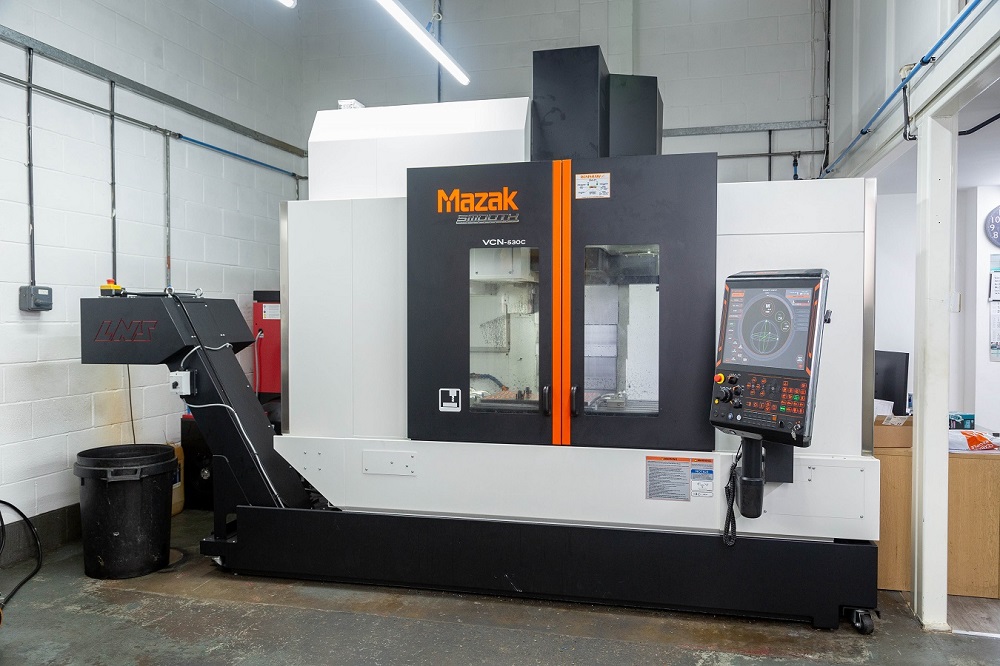
Even before company founder and managing director Jonathan Plumridge started the business, the entrepreneur had purchased a seat of hyperMILL to offer programming services to the subcontract manufacturing sector. Using hyperMILL as a freelance engineer provided Plumridgewith the means to start PBE CNC and buy his first machine, a Mazak i500 Variaxis. The company has since purchased a second i500, a Mazak VCN 430A machining centre with 4th axis and, most recently, a Mazak QT Compact 200L turn-mill centre.

“The work that we do here is primarily for the motorsport and food processing industries, machining components made of aluminium and titanium in anything from 1-offs to runs of 500+,” says Plumridge.“I chose hyperMILLhaving used it at a previous company and it has proven very reliable. The software is very good at importing models, thetool paths are generated very quickly on large parts and the five-axis parts are rock solid. Additionally, the simulation tools are excellent and you can always be sure that the tool path will run safely.”

Discussing ease-of-use, Plumridge adds: “After initial training, the system is very intuitive to use and all of the menus, whether it be for 2D, 3D or five-axis toolpaths, all run along the same theme, so once you know how to do one – they all follow on. The parts are very easy to set up when you follow the model.You can use the project assistant to set your datum and stock, which you can adjust if necessary. Then youcan choose the machine to which you wish to output before adding toolpaths quickly and easily.

“Since I started using hyperMILL, I’ve noticed that the toolpaths are high quality and very consistent, and you can customise them if needed to make them do exactly what you want,” he continues.“In the type of industry we work this is critical because the parts have to look aesthetically pleasing – and hyperMILL gives you all of the tools to do that.”

From time to time, Plumridge will also use hyperMILL to quote parts. Users can quickly import the model and put a few toolpaths on the job if unsure whether the part needs a lot of scanning. hyperMILL will provide an accurate estimation of how long the part will take to produce.

“We’ve recently taken delivery of a turn-millcentre and have a post-processor from Open Mind for that machine,” explains Plumridge.“It enables us to program around the C axis and this is not really any different to programming a normal machining centre. Users can just tell the system what post processor they are going to use, load the program and it runs. I would recommend that manufacturers talk to Open Mind if they are in the market for offline programming software as it’s easy to use and the support is excellent.”

Commenting upon the relationship between Open Mind and PBE CNC, Open Mindsales director Ken Baldwin says: “I’ve known Jonathan since he was at his previous company where he was using a different CAM system due to various reasons. Jonathan brought Open Mind in because they had an expensive machine crash. So, the first reason was safety and hyperMILL offers a lot more security in terms of collision checking and ensuring that the toolpaths created would be the right ones to give the best quality, but also be safe to run.”

He adds: “We’re finding more and more start-ups choose hyperMILL. It may cost more than alternative systems that are cheaper in the short term. However, when businesses have a vision of growing, they invest in hyperMILL from the start because they know that the software can grow with them, whether they move from simple three-axis machining to five-axis, mill-turn and even additive. hyperMILL will cater for everything a business needs within the machine shop, now and in the future.

“Using a CAM system like hyperMILL, there are several benefits you can achieve, although there may be different priorities depending on the nature of the machine shop. So, it could be that a company wants faster programming times or it may be in production where companies are producing thousands of components and they want to optimise the process. With a CAM system, you can visualise the stock condition at every stage and have an optimised tool path that can save those small percentages. When on a longer batch run, it can save a considerable amount of time.”

Manufacturers can also verify everything that is going on within the machine tool, so the tool, the holder and any kind of workpiece and workholding can be visualised in the machine so users can be sure that everything is 100% right before they start to run the machine, avoiding any costly prove-outs.

As a company that utilises a cobot for 24/7 lights-out production and Lang multi-point workholding for setting up multiple parts in a single set-up, this is certainly a casing point for PBE CNC.

Discussing automation, Baldwin says: “There is an automation package within hyperMILL that not many people are currently using. Some people do not understand thatautomation isn’t always a start-to-finish process, especially when factories undertake such a wide variety of work. Automation in hyperMILL is all about picking out sections. There may be a lot of components where you do the same process on a particular type of part and that may only be 15-=20% of the programming, if you can automate that and identify trends – it’s a 15 to 20% reduction in work which doesn’t have to be done every time. That is once again a huge saving on the programming time.”

He adds: “There’s already automation within hyperMILL that leverages the user’s knowledge, as customers know what works on certain types of components. We can integrate and customise these features to end user requirements. There’s also a lot more intelligence in tooling data and we’re working with various tooling companies to get more information on realcutting data and what works, and how we can get that information to applyautomatically. In the next few years, manufacturers will see a lot more progress in this area as the doors to automation open in quite a big way.”
For further information www.openmind-tech.com

£10m HIP Centre

With a £10m investment, Wallwork Group is establishing a state-of-the-art Hot Isostatic Pressing (HIP) centre at its Bury site in Lancashire. Housed in a newly prepared 2500 sq m facility, the company expects its HIP to be fully operational in September 2023. “As the UK’s premier independent heat treatment, vacuum brazing and advanced ultra-hard coatings company, this is a significant expansion of Wallwork’s thermal processing services and is part of a commitment to invest £20m over the next five years,” says director, Simeon Collins. “It cements our position as the UK one-stop shop for component manufacturers.”
For further information www.wallworkht.co.uk

SOFTWARE MAKES TURNING COPPER AS EASY AS BRASS

A large proportion of work going through subcontractor C&M Precision’s Maldon factory involves machining copper that is bar-fed into CNC turn-mill lathes. Two sliding-head models out of the nine turning centres on the shop floor, all supplied by Citizen Machinery UK, have LFV (low-frequency vibration) functionality in the operating system of their Mitsubishi controls. This software results in much higher productivity and increased yield when converting malleable copper into high-end electronic components for OEMs in the medical, radar, satellite and broadcasting sectors.

Owner John Cable explains that for many of these jobs, a particular grade of copper known as OFHC (oxygen-free high conductivity) is required, which is more than 99% pure. One 60 mm long, tight-tolerance component previously produced from 3 mm diameter bar on an early Citizen Cincom M16 slider without LFV required turning in one pass through the guide bush down to 1.20 – 1.22 mm diameter along half its length. The continuous string of copper swarf frequently damaged the component and often became lodged in the counter spindle, preventing synchronous transfer after part-off and causing the machine to alarm out. The result was a severe impact on productivity and the scrapping of up to 20%of parts.

“Transferring the job to a Cincom L12-VIILFV we bought in 2019 was a real winner,” says Cable.“With the LFV function turned on, copper chips like brass. Yield is now 100%, throughput is high and we can even leave the machine to run unattended.”

The other Cincom slider on site with this chip-breaking functionality, a nominally 20 mm capacity L20-VIIILFV, arrived on the shop floor in 2017, making the subcontractor an early adopter of this novel technology. Supplied with a kit that allows feeding of oversize bar up to 25 mm diameter, the lathe is also proving useful for machining other materials that tend to generate stringy swarf, like nickel alloys and plastics, which the Maldon facility regularly turns.

C&M Precision began trading in 1992 as a CNC sliding-head, twin-spindle, turn-milling shop, following research at the time indicating that four-fifths of rotational parts produced in the UK were less than 25 mm in diameter. After starting out with a different brand of slider, Cable quickly changed to Cincoms, describing the transition as “a breath of fresh air”.

The first model to arrive in 2001 was a now discontinued M12, since sold on. The first job it tackled was the production of 120,000 brass connectors requiring the milling of 3/8-inch hex flats. Amazingly, due to the rigidity of the lathe that Cable described as “rock solid”, one 6 mm diameter carbide milling cutter completed all of the flats, 720,000 of them, and still had not worn out.

The subcontractor is an enthusiastic user of Cincom M-series machines due to their inclusion of a tool turret as well as a gang tool post, allowing the production of complex components. A 16 mm diameter bar model installed in 2004 was joined three years later by a pair of 32 mm diameter bar capacity lathes. The latter, third-generation M32 lathes have since been replaced by fifth-generation models to take advantage of Y-axis motion on the turret and an overall higher specification.

2014 and 2015 saw the arrival of three more 32 mm sliders, this time in the Cincom A-series. They have only gang tool posts, so are faster when manufacturing less complicated parts. One of the lathes does not have a guide bush, as it is devoted to relatively limited runs of short components such as mining industry connectors. The other two sliders with a guide bush produce tens of thousands of parts per week, 24/5. One example is a mild steel gas meter part which the customer orders at a rate of one million per year, with the subcontractor making weekly deliveries.

C&M Precision’s latest two acquisitions are from Citizen’s Miyano range of fixed-head lathes. Installed in January and March 2022 respectively, the twin-turret BNE-65MYY models with Y-axis motion on each tool carrier replaced two ageing lathes that had one Y-axis turret apiece.

“It made sense to go the Miyano route in view of our good experience with the Cincom lathes,” says Cable.“People say it is not good to have all your eggs in one basket, but in Citizen’s case it is. We now have a single point of contact for applications, back-up and service, and the supplier is very capable and responsive to our needs.”

He adds that the Miyano lathes have similar capability at both spindles and are highly productive, with advantage taken of Y-axis machining for a large proportion of the time. Simple off-centre holes are frequently drilled and bored, flats are easier to mill up to a shoulder, and roll marking often takes place using the Yaxes. Parts coming off the lathes are accurate due to one-hit production. It is possible to program cycles involving superimposed machining, where three tools are cutting simultaneously, although this facility has not seen use thus far.

Some parts are not possible at all on driven-tool lathes without Y-axis motion on at least one turret and would have to be put onto a machining centre for a second operation. Others, such as a pair of components – one aluminium and the other brass – for a broadcasting microphone, are produced much faster on the twin Y-axis Miyanos compared with the lathes they replaced. The company machines the more complex of the two, the aluminium part, in 4.5 minutes compared with 7.5 minutes previously. As the batch size is 2000-off, the saving is considerable.

As to the future, Cable sees continued purchase of LFV lathes inevitable. While high-pressure coolant systems break swarf adequately on his current larger lathes, as they mainly process free-cutting materials, there is one job presently produced from malleable, oversize, Swedish iron bar on the L20-VIIILFV that would profit from machining on a 32 mm Cincom in the same series with the chip-breaking technology.
For further information www.citizenmachinery.co.uk

New tube laser eliminates outsourcing at Lasercell

The arrival of a new Trumpf TruLaser Tube 3000 Fiber at Salisbury-based lasercell has allowed the company to eliminate the cost of previously outsourcing its tube laser cutting requirements. Alongside the associated reduction in lead time, Lasercell’s new in-house capability also means the company can now design many parts more efficiently.

It was impressive growth over the past decade prompted Lasercell to investigate the potential for an in-house tube laser facility. The company looked at a few major manufacturers of tube laser machines before drawing up a shortlist of two.

After a comprehensive assessment, the company opted for the Trumpf TruLaser Tube 3000 Fiber, a machine that can accommodate tube diameters up to 152mm and process mild steel up to 8mm thick, stainless steel and aluminium up to 6mm, and copper and brass up to 4mm. The 3kW machine acquired by Lasercell, which is the first of its type in the UK, includes a 3D cutting head and LoadMaster Tube automation with bundle space for up to 4 tonnes of unprocessed material.

“Perhaps the most influential reason behind our choice was Trumpf’s Programming Tube 3D software, which was superior to that of the other potential supplier,” says one of three company directors Kieran Bernstein.“With Programming Tube, we quickly and intuitively create NC programs. The software offers flexible data import procedures and efficient design, with step-by-step support.”

He continues: “Although we’ve been really busy, the machine is so quick that keeping it fed can sometimes be a challenge. As well as eliminating the need to outsource our tube laser work, reducing lead times and designing parts more efficiently, the new machine gives us a unique selling point when promoting our services.”
For further information www.trumpf.com

MEDICAL SUBCONTRACTOR BUILDS SUCCESS WITH ETG

Founded in January 2021, Machinelab Ltd was set up when entrepreneur Sean Kehoe identified a gap in the market for a subcontract manufacturing business. Kehoe started a company that could provide everything from prototyping, design and machining,through bespoke automation projects, fixture design and manufacture, to consultation, 3D printing, reverse engineering and even post-project support. However, the Machinelab founder recognised that the fundamentals of the business needed to focus on lead time, pricing and quality – all aspects the company is achieving with the support of the Engineering Technology Group (ETG) Ireland. The company has recently invested in a Mitsubishi MV1200S wire EDM machine,quickly followed by a Nakamura-Tome AS200LYMT turn-mill centre.

Located in Wexford, the rapidly growing business now employs 17 staff. This rapid rise has come from the company’s ability to offer a full lifecycle design and manufacturing service for custom-built parts and assemblies required by pharmaceutical and medical device companies and other highly regulated industries. Machinelab recently moved to a new 15,000sqft facility and, with sufficient space to expand, the company installed the Mitsubishi MV1200S wire EDM machine.

Discussing the company’s rapid ascension to success, Kehoe says: “As an engineer with a background in machine, assembly line and jig and fixture design and build, I spotted an opportunity to deliver a level of service and quality beyond that of existing manufacturers. In Ireland, such a niche service and expertise has been lacking in the continually expanding medical and pharmaceutical industry.This gave our fledgling business a window of opportunity and we’ve fully embraced it.”

Starting out of nothing more than a shed with a router, Kehoe initially made medical vial trays and other components for the medical industry on a routing machine. From there, the company progressed to machining centres.

“I initially bought a router, as it was all I could afford,” admits Kehoe.“I then bought a few three-axis VMCs, a lathe, a surface grinder and a spark-erosion machine; some of these were pre-owned models. Just before Christmas, I bought a used ETG Vulcan 610L VMC [new Vulcan machines are available from ETG] and I was thoroughly impressed. We have several machining centres from a reputable leading brand and found the Vulcan VMC to be far more robust and rigid. The machine has a much better build quality and stability, along with a high-pressure through-coolant facility and a much faster tool changer.All-round, it’s a much better machine. We would certainly buy another.”

With the Vulcan came an introduction to ETG Ireland for service requirements. So, when the company was looking for a wire-erosion machine for precision holemaking and profiling, the company once again turned to ETG Ireland.

“We already had an older EDM machine, but needed exceptional levels of precision,” says Kehoe.“Instead of looking around the market, we asked our industry contacts, competitors and customers about the technology they used; they all recommended Mitsubishi. We ordered the Mitsubishi MV1200S and it was delivered just after Christmas.”

As well as production line projects, the company also manufactures mould tools and components from brass, stainless steel and D2 steel which require a high number of precision holes from 0.3 to 3mm diameter that can be up to 30xD. This demand was creating an issue with part scrapping and excessive set-ups.

“Some of these parts have very tight tolerances and for us to wire a 0.3mm diameter hole on our existing machine, we would have to drill at 0.27mm diameter initially,” explains Kehoe.“The issue here was broken drills and frequently scrapped parts. We were even drilling the holes from both sides of the part on our five-axis machining centres to evade potential drill breakages. We had a lot of parts that would need to be re-set, creating an overall production time of up to six hours. By using the Mitsubishi MV1200S, we can now process a six-hour job in less than 40 minutes. What we’re finding is that we can pre-drill small holes with limited precision – and then wire the holes to a tolerance of tighter than 5µm. We’re EDM profiling over 40 high-precision small holes every month, so the Mitsubishi is saving us a lot of time already.”

Another reason the Irish manufacturer invested in the Mitsubishi MV1200S EDM was for the profiling of components, something that could alleviate capacity bottlenecks on other machines.

“A lot of our machining is small runs of stainless to hard steel parts in quantities of 2 to 5-off,” says Kehoe.“The Mitsubishi MV1200S can be quickly set-up to profile these challenging parts, freeing-up capacity on our five-axis machining centres. Additionally, the Mitsubishi MV1200S can provide a level of precision beyond that of our other machines. We can profile parts to a tolerance of 4 µm with a surface finish of 0.2 to 0.4 Ra, again exceeding the surface finishes of our other machines.”

By purchasing the Mitsubishi MV1200S, Machinelab has improved its precision and surface finishes on components, reduced set-up times and eliminated scrap on particularly challenging parts that require small holes and improved throughput.

“We can set up the EDM and leave it to run while a machine operator is tending to other machines,” explains Kehoe.“The running cost of the EDM is minimal compared with a machining centre consuming lots of tools through cutting hard parts; it complements our machining department perfectly. The longer we have the machine, the more applications we find for it. As a relatively new company, ETG Ireland has offered us an excellent finance package that has made the Mitsubishi purchase possible. The terms are so favourable for start-up companies that we’ve just ordered another machine.”

At the end of March, Machinelab placed an order for a Nakamura-Tome AS200LYMT, which is now in situ.

Says Kehoe: “We have a semi-CNC turning centre and while it’s a capable machine, it cannot provide the precision or productivity we require for the increasing upturn in turning work. We have one regular part that requires 5 µm concentricity over the 5-inch length of the component. Our existing machine struggles with this, leaving us with excessive operator intervention to remain within tolerance.”

He adds: “The Nakamura AS200LYMT turning centre will easily meet our precision requirements. With driven tooling capability, we’ll be looking for this machine to take capacity from our milling department – as the Mitsubishi has. We were transferring jobs from the lathe to the mill and vice-versa for secondary operations. The Nakamura AS200LYMT will eliminate this bottleneck from our business. ETG Ireland are also able to offer us a full turnkey solution to our projects, something that we recently discovered in purchasing the Nakamura Tome. In addition, ETG has the right staff in Ireland, be it sales or technical service, where other companies would have support only from the UK.”
For further information www.engtechgroup.com