Retrofit solution facilitates PcBN tool grinding

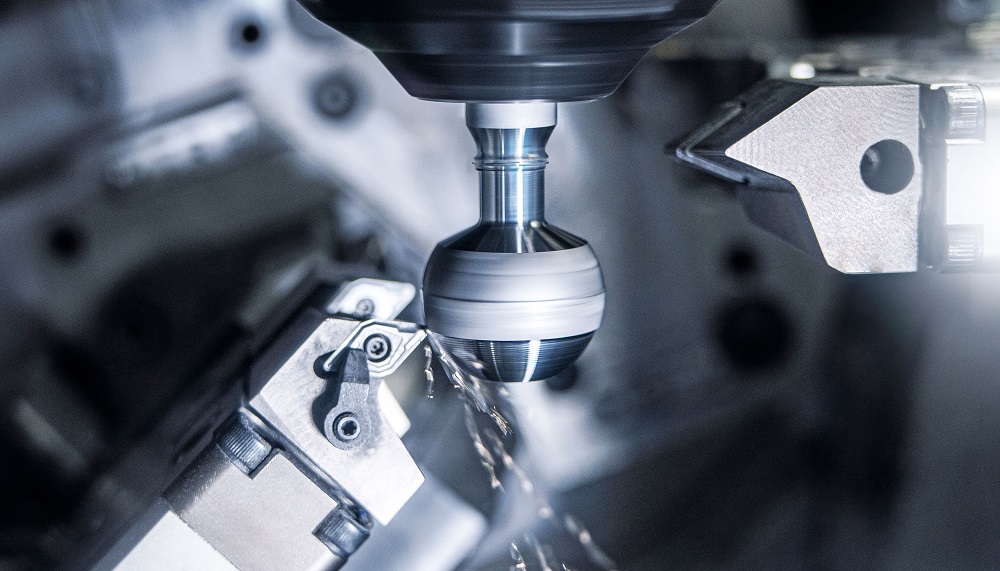
The cutting material PcBN(polycrystalline cubic boron nitride)is both ultra-hard and extremely temperature-resistant, making it a challenge to process. To enable cutting tool manufacturers to grind PcBN cutting edges with high levels of precision, users of the Vollmer VGrind 360S tool grinder can now take advantage of an optional dressing unit.

By adapting its VGrind 360S grinding machine, the sharpening specialist can make it suitable for machining PcBN tools. Considered the hardest cutting material in the world after PCD (polycrystalline diamond), PcBN can achieve an operating life of up to 25 times longer than solid-carbide tools. In fact, PcBN retains almost all of its original hardness at temperatures up to 1200°C.

The VGrind 360S grinding machine is positioned for the precise machining of PcBN tools with its stable wall concept and rigid, compact design. High system rigidity, in combination with the drive of the X, Y and Zaxes via linear induction motors, allows tool manufacturers to machine a PcBN cutting edge with the grinding wheel oscillating across its contact surface for a chip-free, high-quality surface.

To support the processing of this ultra-hard material, the optional dressing unit for the grinding wheel on the VGrind 360S means that after roughing the PcBN cutting edge, the dressing unit re-profiles the grinding wheel to regain its precise concentricity and correct geometric shape. Subsequent finishing operations give the PcBN tool the desired surface finish and geometric accuracy.

Customers can also retrofit the optional dressing unit with software updates to existing VGrind 360S machines. Tool manufacturers can carry out the installation independently or with the support of the Vollmer service team in just a few simple steps.

More information www.vollmer-group.com/en-uk

Automatic shot peening of EV gears parts

BMW’s plant in Dingolfing has integrated an RST 200-S15 indexing satellite table shot-blast machine from Rösler into a new manufacturing line for E-vehicle gear components. The company decided to purchase the Rösler equipment because it had excellent experience with machines of the same type regarding productivity, process stability and ease of maintenance.

The rotary table of the compact shot-blast machine contains 15 rotating satellite stations equipped with workpiece-specific fixtures. Depending on the workpiece type, a component loading/unloading system supplied by the customer places one or several parts on the satellite stations. Thanks to the machine’s design, non-productive idle times are minimal.

After loading, workpieces pass through multiple stations in the shot-blast machine at indexing cycles of 20 seconds. These stations include two blast positions. Special lifting gates prevent any spillage of blast media into other stations. During the peening operation, the satellites rotate at pre-set speeds in front of the blast turbines. In combination with automatic blast pattern adjustment to the respective workpiece shape, this ensures the realisation of homogeneous peening results. A compressed-air cleaning station placed in front of the loading/unloading section blows off dust and residual blast media from the finished components.

The master computer of the manufacturing lineselects the workpiece-specific processing programs, including the setting of the turbine position and blast pattern. For this purpose, the controls of the peening machine were integrated into the upper-level computer system at BMW in Dingolfing. 

To meet the automotive industry’s high standards regarding process stability and traceability, the machine’s controls allow the continuous monitoring of all relevant shot-blasting parameters. Replenishment of the blast media also takes place automatically.

More information www.rosler.com

Floyd releases Schwanog centre drilling system

Now available in the UK from Floyd Automatic Tooling is the new Schwanog interchangeable indexable centre drilling system. Developed to improve the productivity, precision and positioning of drilled holes, the new centre drill system prevents drills from drifting and maintains a chamfer on the drilled hole.

Suitable for everything from one-offs to high-precision series production runs, the Schwanog centre drilling system provides ±0.01 mm repeatability during insert changeovers thanks to an insert pocket seat that locates and clamps the insert. The tool body is available in a range of lengths and diameters to suit application requirements, providing flexibility to accommodate a host of machine tools and application types.

The ‘quick-change’ design of the inserts results in less time spent changing inserts. Schwanog claims that when combined with the tool geometry, the rapid-change system on the new drilling system guarantees a 40% increase in productivity.

Schwanog centre drill designs range from a 60 to 140° point angle and, depending on the workpiece material, it is possible to apply a wide variety of carbide grades and coatings. Users can machine materials that range from aluminium, brass and copper through to steel, stainless and heat-resistant aerospace grade alloys such as Inconel and titanium.

To further enhance the flexibility of the Schwanog centre drill, customers can request interchangeable drill bodies to suit both left-hand and right-hand operations. Furthermore, to enhance flexibility and ease-of-use, customers to utilise the same tool holder for left and right-hand application. Upon request, customers can order the Schwanog centre drill system with edge preparation to reduce potential chatter that may occur with challenging material types. 

More information www.floydautomatic.co.uk

Tiny turning products offer huge results

Tungaloy-NTK UK is giving the small turned-parts industry a ‘shot-in-the-arm’ with a multitude of offers on its latest range of turning technologies. As part of its 2024 promotional offering, the company has a number of special offers that range across the company’s small-part turning, high-feed milling and indexable drilling lines, including the DuoForceCut, MiniV-LockGroove, FaceMiniCut and TinyInternalCut series.

Designed for CNC sliding-head turning centres and cam-driven lathes, DuoForceCut is for turning parts up to 12 mm in diameter. It has the ability to undertake parting-off, front and back turning, threading, and grooving. As part of the 2024 promotional offer, Tungaloy-NTK UK is giving away a free tool holder when customers buy 10 inserts.

For machining intricate and detailed components, Tungaloy-NTK UK has introduced its MiniV-LockGroove range of high-precision grooving and threading tools. Tungaloy-NTK UK is offering manufacturers the opportunity to buy a pack of 10 inserts and get a free tool holder or buy 10 inserts and get one CHP tool holder or CHP head with an additional 50% discount.

The FaceMiniCut is for grooving applications up to 9 mm deep. It features a rigid insert clamping system, as well as inserts with a sharp cutting edge, optimised geometry featuring a chip ‘redirector’ and an advanced SH7025 PVD grade. Again, Tungaloy-NTK UK is giving machine shops the opportunity to try the new system with an offer to buy 10 inserts and receive a corresponding tool holder free-of-charge.

Completing the seasonal offer on small turning tools is the TinyInternalCut series for internal grooving and thread turning in bores down to 5 mm diameter. Customer can buy a pack of 10 inserts and get a corresponding tool holder for free.

More information www.tungaloy.com

Mitsubishi releases tough grade MC6135

Mitsubishi is expanding its MC6100 range of inserts to include MC6135, a tough grade for

applications that range from continuous turning through to rough and interrupted cutting. This new grade will complement the existing range and provide end users with a choice to machine a vast array of steels and of different applications.

MC6135 utilises crystal-orientation control technology that enables thinner but

still impact-resistant coatings for improved chipping and wear resistance. Such features are optimal for use on the tough MC6135 grade. Additionally, the coating is 50% thinner compared with previous types.

In cutting trials of interrupted cutting on DIN 41CrMo4 material, Mitsubishi found the tool life of MC6135 to be 20% more than conventional grades.

Regarding the existing range, MC6115 is a CVD-coated turning grade for steel workpieces that is capable of high-speed machining with its high levels of cutting edge stability. MC6125 grade is versatile, enabling an easy first choice start point when choosing an insert for turning steels and thereby reducing inventory levels.

Both grades have CVD coatings that provide the double benefit of cutting edge stability

and long tool life for machining a wide range of steels, reports the company. MC6115 has the combination of a high hardness base material and new thick Al2O3 outer coating with

improved wear and peeling resistance at high temperatures, while MC6125 has the combination of a tough base material and the advantages of Al2O3 coating. It also has higher peeling resistance and cutting edge stability, achieved through the application of super Tough-Grip technology. This enhances adhesion between the Al2O3 and TiCN base coating layers.

More information www.mmc-carbide.com