

Understanding saw blade terminology

When it comes to bandsawing, it is not just the design of the blade or the workpiece material that is important; it is also necessary to have the correct blade in the first place. With this thought in mind, Saws UK has published a guide to blade terminology and material blade types.

To get the most economic cut possible when bandsawing it is necessary to choose a blade with the correct number of teeth per inch (TPI). This number will vary depending on the workpiece material. TPI also depends on whether the shop is cutting individual pieces of material or bundled amounts. As a point of note: the positioning of material in a vice can also alter the blade’s TPI, as can material size and shape.

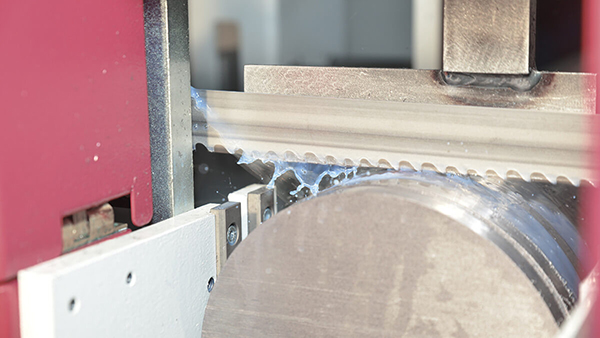
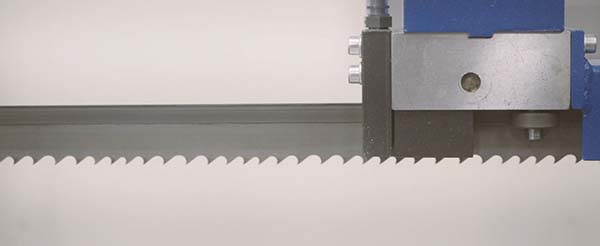
There have been a number of new techniques introduced to the bandsawing sector within recent years. So, to ensure sufficient knowledge to take advantage, the following is Saw UK’s list of blade technology: tooth face – the surface of the tooth; tooth pitch – distance between the tip of one tooth and that of the next one; gullet – curved area at the bottom of the tooth; TPI – teeth per inch (measurement between the gullets); tooth rake angle – angle of the tooth face perpendicular to the direction in which the saw is cutting.

Further terminology includes: blade width – measurement between the end of a tooth and the back of the band; blade thickness – how much the saw measures between either side of the blade; and blade set – clearance from the back of the blade through the cut.

For further information
www.sawsuk.com
Bandsaw or circular saw?

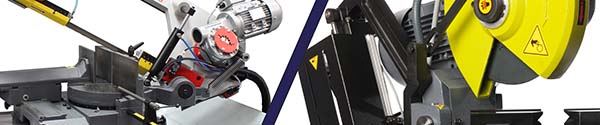
For many years the only successful way of cutting materials accurately was by circular saw. However, as bandsaw machines developed over the past 40 years, the demand for circular saws has reduced. And yet those seeking a clean, square and fast cut on small-to-medium size sections could well benefit from a circular saw, as might any shops exclusively cutting aluminium or plastics. In contrast, those looking at cutting larger sections and solids may likely find a bandsaw is the more favourable option. With these thoughts in mind, Prosaw has published a new beginner’s guide to sawing.

Take mitring, for example: is it necessary? Well, for steel fabricators, some work will involve cutting angles on sections to enable the manufacture of frames or complex shapes. Swing-frame sawing machines offer quick set mitring and even the most basic of saws will often offer a mitre facility, albeit not as quick as a swing-frame model. Even some automatic bandsaws can mitre in-cycle, producing complete components for fabricating.

A common question is whether each material requires a different blade? Not necessarily. For most sections and even solids, one blade will cover a wide range of material shapes and sizes. Of course, for those cutting from a very small section or solid through to the machine’s maximum capacity, then the best choice would be a different blade to cut both extremes. The same applies to the speed of the blade. Prosaw provides a cutting chart with all of its machines to select the most suitable blade speed and cutting rate.

Cutting fluid is another common area of confusion. Many companies can increase their blade life and reduce consumables cost by just taking a close look at their cutting fluid mixture. Unlike machine tools, which generally use carbide inserts, saw blades create a lot of heat at the cutting point, which means that with a low-level mix of fluid the tool will eventually fatigue and break. Prosaw recommends a mixture level of between 8-12%, depending on workpiece material.

For further information
www.prosaw.co.uk

Sawmill opts for Vollmer machine

The Holzwerk Baur sawmill, based in Wain, Upper Swabia, processes around 180,000 solid cubic metres of wood each year and exports its products across the world. Sustainability is a key priority for the sawmill, which sources its material from the local region and puts every last shaving to use.

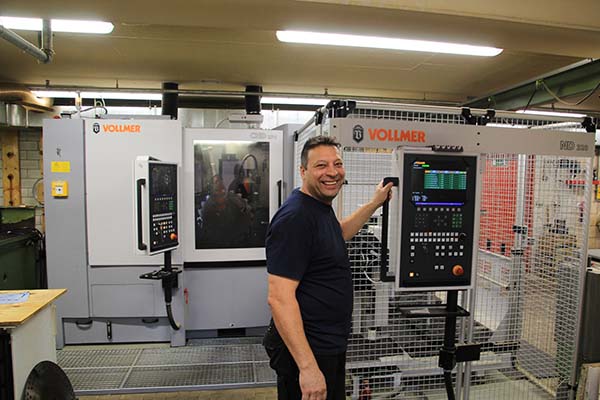
To ensure efficient wood cutting, Holzwerk Baur runs around 250 saws every day, kept sharp using machines supplied by Vollmer. Among many machines in the grinding shop is a Vollmer CHD 270 grinding machine for carbide-tipped circular saw blades, set up with an automated system to run around the clock.

The Vollmer CHD 270 offers eight CNC-controlled axes and measuring equipment able to machine carbide-tipped circular saw blades in a single set-up. It can sharpen even complex tooth geometries, including chip-breaker grooves, chamfers on the pre-cutting and finishing teeth, and Braunschweig tooth or chip-guide notches. Every circular saw blade is loaded into its precise grinding position automatically, regardless of diameter. A measuring sensor then determines the tooth geometry, in other words, the hook angle, radial and tangential clearance angles, cutting width, blade thickness, and side projection. The automated Vollmer ND 320 handling system uses two loading carriages, each of which can be loaded with up to 50 circular saw blades.

For Holzwerk Baur, the Vollmer sharpening machines are the key to sustainable wood processing. Able to process 80 metres of material per minute, the profiling line cuts the logs into clean squares, which are then processed by up to 10 saw blades into boards, frames and floorboards. Every last scrap of wood is used, with wood chips going to the paper mill, sawdust to chipboard manufacturers, wood shavings to the filler industry, and bark to gardening and landscaping firms (or the company’s own heating system).

For further information
www.vollmer-group.com

How to saw pure exotic elements

The conventional user of bandsaws and circular saw machines is familiar with sawing structural steels, tool steels, stainless steels, high-strength nickel-based alloys and titanium. But relatively few have ever machined pure elements.

For Hermsdorf-based HC Starck, sawing elements is daily practice. The company is a specialist in the supply of semi-finished products and components made from refractory metals such as molybdenum, tungsten, tantalum and niobium.

The company recently sought a suitable sawing solution for the task of cutting recycled Mo-ingots or rods made of high-purity tantalum (Ta) and niobium (Nb) with a cross-section of 160 x 60 mm, as well as round material up to 207 mm diameter, which are then cut into thin sheets. Since Behringer had no experience with element sawing applications, cutting tests took place at the company’s technology centre in order to assess various machine and tool combinations, and identify a suitable sawing solution.

“Positive sawing attempts with tantalum, which has a density of around 16.6 g/cm³, were ultimately the main reason for selecting with Behringer,” explains Andreas Mund, project engineer at HC Starck. “The sawing process is very hard; the belt rumbles constantly and you can hear how difficult it is to cut tantalum. In order to achieve reasonable cutting quality, you need a very stable base frame.”

This is where the solid machine base of the HBE321A Dynamic automatic bandsaw scores points, combining a stable frame made of vibration-damping grey cast iron and a precise guide system in a portal design. Control of the saw feed comes courtesy of a precision ball screw and servo motor.

For further information
www.behringer.net

Automated saw line drives efficiency

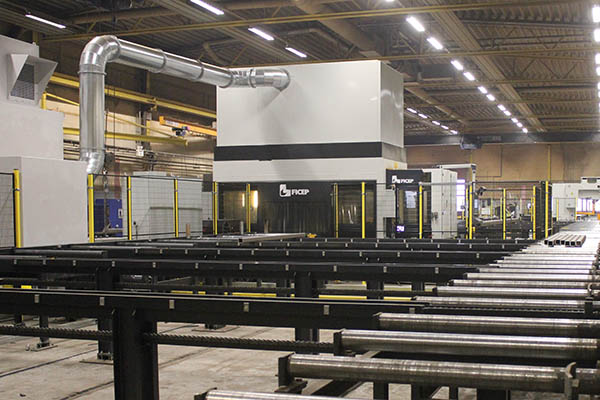
Ficep UK has installed a new automated saw line at Norway-based Contiga AS, helping the business to improve production processing time by up to 40%. The new system consists of a Ficep Orient, a CNC-controlled drilling and combined thermal coping line equipped with rotary single spindle. To prove the time and cost savings of the system and process, Ficep prepared time studies that presented clear indications of the returns achievable from the investment.

Contiga AS designs and develops steel solutions tailored to individual projects, delivering between 7-8000 tons of steel structures to the Norwegian market every year.

Says Mark Jones, Ficep UK managing director: “We overcame several challenges, not least that the machinery was installed during a period of Covid restrictions, but also that the space was limited, and it was important to minimise disruption and reduce operational downtime. There were also added contractual obstacles to overcome due to Contiga now being part of the huge Heidelberg Cement group, with additional levels of communication required across several countries.”

Thor Egil Einarsrud, factory manager at Contiga in Roverud, adds: “We use modern technology and work processes, as well as the best machines, to guarantee that all our steel products offer high quality. To ensure competitiveness, automation is absolutely necessary, and we’re already seeing that in several of our production processes. We save up to 50% in time by using the new automated sawing plant compared with manual operations. The system has transformed our business, allowing better efficiency and precision.”

For further information
www.ficep.co.uk