

Minimising material waste in laser cutting

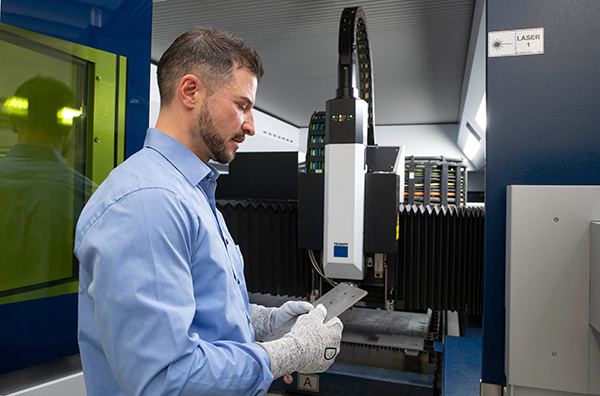
Trumpf will be showcasing a new laser cutting technique at its InTech in-house trade show, which will take place on 17-20 May in Ditzingen, Germany. Offering improved efficiency and even more reliable processing, the ‘nano joint’ method holds parts in place using tiny supporting tabs created at points where the laser does not cut all the way through the sheet. These tiny tabs, or nano joints, prevent the metal from shifting or tipping while the laser is cutting parts.

Nano joints reduce costs and material usage by allowing users to nest parts closer together and minimise how much metal remains in the skeleton. Depending on the shape of the specific parts, users may even be able to nest parts in a way that eliminates raw material waste completely. Nano joints also make it quicker and easier for workers to break parts out of the nest.

Trumpf offers nano joint technology on its TruLaser 5000 fiber, TruLaser 3000 fiber and TruLaser 1000 fiber series machines. Furthermore, it is possible to retrofit the technology to existing machines by means of a software update.

Currently, fabricators typically hold cut parts in place during laser cutting using tabs known as ‘micro joints’. Workers then break these tabs when they remove the parts from the nest. Trumpf says that its nano joints have many advantages over conventional micro joints. For instance, they speed up the process because it is so much faster to produce tiny retaining points rather than conventional micro tabs during cutting. Nano joints also allow the operator to break parts free from the nest with much less effort, saving time and making life easier for workers.

For further information
www.trumpf.com
Pendle opts for BLM tube laser

Nelson-based Pendle Engineering is a subcontract supplier of steelwork, a description that covers its main focus on tube and flat sheet manipulation, as well as turning, milling, welding, painting and design. Along the way the company has also branched into the manufacture of bicycle racks, trailers and storage products for its sister company, Pendle Bike Racks.

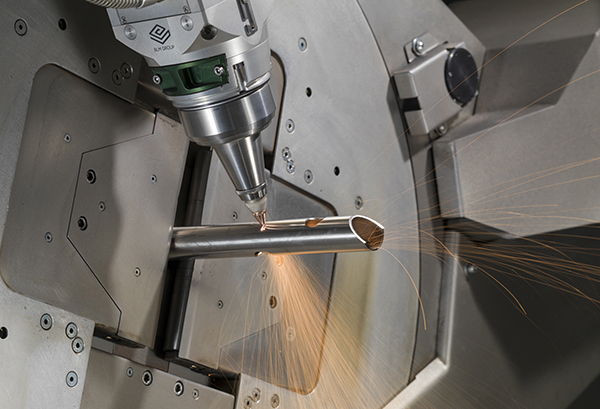
To meet business growth with improved efficiency, the company has invested in Elect 52 and E-Turn 32 tube benders, as well as a Laser Tube LT-Fiber Evo fibre-optic, fully automated laser tube cutting system, all supplied by BLM Group.

“Business has been increasing, especially with increased orders for Pendle bike racks, so we knew we had to upgrade our existing tube processing capacity,” says managing director Chris Smith. “We had a history with BLM for tube bending over many years so when it came to upgrading our 15 year-old tube laser it made sense to talk to them and put a bending and laser package together. A big advantage in doing that was the ability for the controls on the BLM benders and the Laser Tube to communicate with each other, while the ease of use of the BLM software and offline programming was also a significant factor. The less time a machine is idle the better.

“We’re already seeing the benefits of increased productivity, even though we’re not running at 100% yet with the BLM Laser Tube,” adds Smith. “It’s faster and the nesting capability brings a reduction in waste. Furthermore, we can cut more complex components, yet the operation of the machine and software is much simpler.”

For further information
www.blmgroup.com

Large-bed fibre laser from Amada

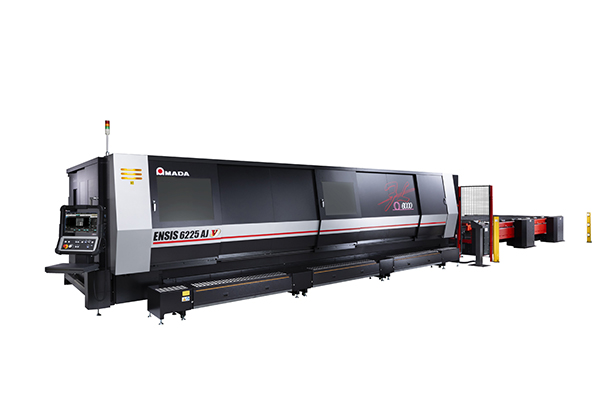
Amada has launched its Ensis 6225AJ fibre laser cutting machine into the European market. With the ability to process 6.2 x 2.5 m sheets, the new machine is available in 6, 9 and 12 kW variants, with all powers able to cut up to 25 mm mild steel, stainless steel and aluminium.

Being able to process larger sheets, or multiple sheets in a large cutting area, leads to several benefits, such as more efficient material utilisation and higher production flexibility. Previously, Amada Ensis fibre lasers were available in 3 x 1.5 m and 4 x 2 m variants. Now, the series has been expanded to incorporate 6.2 x 2.5 m capabilities.

Utilising Amada’s established variable beam control technology, first released in 2014, the Ensis 6225AJ automatically adapts the laser beam mode (not just the focal position and spot size) to each material and thickness combination. This technology also allows the beam mode to be changed between the pierce and the cut, providing a high-power density beam shape for high-speed piercing, then instantly changing to the optimal beam shape for providing high-speed, high-quality cutting. Notably, a single lens can process all materials and thicknesses.

Amada has also added several new laser integration system features to the Ensis 6225AJ that provide more autonomous functionality, rather than relying on the operator to carry out certain checks.

For instance, the i-Nozzle Checker automatically checks the nozzle condition and changes it in conjunction with the standard 16-station nozzle changer if damage is detected, thereby removing any subjective operator decision. This system also incorporates automatic beam to nozzle alignment, significantly reducing start-up times and processing issues.

For further information
www.amada.eu

FlexPunch arrives at HV Wooding

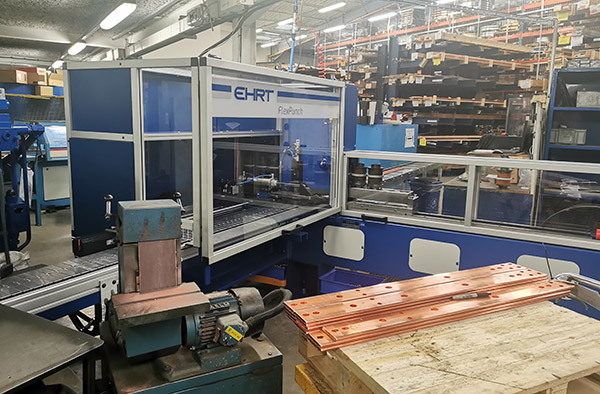
One of Kent’s fastest growing precision engineering specialists has completed a £1.5m investment drive with the installation of a new EHRT FlexPunch machine. Employing over 100 people at its factory in Hythe, HV Wooding has taken delivery of the new technology, which comes equipped with three CNC controlled axes that virtually guarantee perfect accuracy on production parts destined for the electrical switchgear, data centre, electric vehicle and energy markets.

The latest cell represents a £400,000 spend and offers an immediate 40% increase in punching capacity, which will enable greater flexibility and faster lead times. It follows a concerted investment programme that has seen the acquisition of a high-speed Bruderer BSTA 25H press, Bystronic Xpert 80 press brake and a Trumpf TruLaser 3030 laser cutter which can produce thin gauge laminations and busbars for use in electric cars, lorries, buses and commercial vehicles.

Matt Lacey, sales and marketing manager at HV Wooding, says: “Since the pandemic has eased and we’ve got back to a more normal trading environment, we’ve seen monthly sales increases of 15-25%. This is being driven by our ability to take on complex projects from prototyping through to volume production, embracing multiple manufacturing methods such as wire erosion, laser cutting, presswork and tooling, assembly, and electroplating.”

He adds: “These capabilities make us a very attractive proposition for companies involved in developing new components for electrification and we wanted to cement this position with the £1.5m investment in four different but complementary technologies. Our quality team has been really pleased with the parts produced on the new FlexPunch and we’re looking forward to taking on more projects that utilise its accuracy, repeatable quality and speed.”

For further information
www.hvwooding.co.uk

Optimised cutting efficiency for Össur

Waterjet cutting machines are a popular choice for fabricators that desire speed and efficiency when cutting a variety of materials. If the quality of the waterjet is lacking, issues like noise control and poor cutting accuracy will hamper production outcomes. This is the situation that Össur Sporting Solutions was experiencing using a waterjet with a robotic arm purchased from another company to trim prosthetics parts. However, after connecting with WardJet in 2015, the Iceland-based company discovered WardJet’s tailored waterjet system approach and has since purchased five machines.

After initial discussions with Össur, it was clear that the company needed a waterjet solution that met specific business objectives, and at the same time addressed the issues resulting from its previous waterjet system, which included accuracy, footprint and noise.

Using a gantry-based motion system greatly improved Össur’s path accuracy versus the previous robotic arm. Furthermore, eliminating the secondary hand finishing of parts saved valuable time, making the total production process more efficient overall.

With regard to footprint, using a standard WardJet motion system as a starting point, X-Y travel was decreased to 1.0 x 1.0 m, ensuring the size of the machine is as compact as possible. This configuration keeps the overall system footprint smaller than the robotic arm solution.

Össur also implemented a high-speed, dynamic water-level control system which sets the water level to follow the Z-axis motion of the cutting head automatically, keeping the part and waterjet nozzle continuously submerged 25 mm underwater throughout its full 610 mm range of travel. Cutting underwater keeps sound levels below the threshold of necessary ear protection.

For further information
www.wardjet.com