

New honing tools available for XXL bores

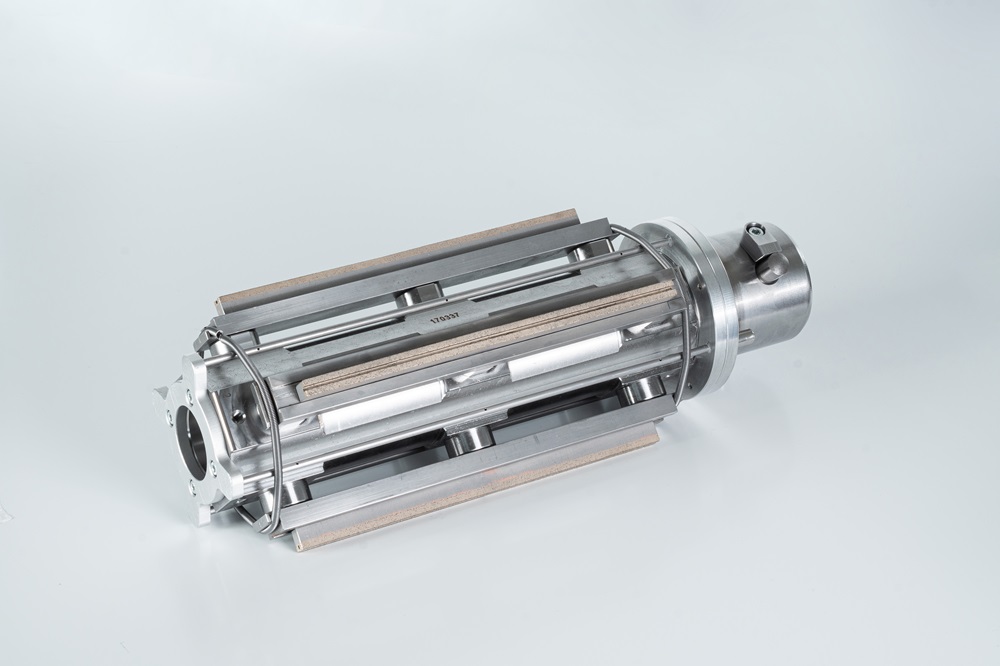
The precision honing of large components is a special challenge. In some cases, the bores are large enough to fit a ball or even a person, and the depth of the bores can be several metres. This is what the experts call tube honing. Gehring Technologies says it has optimised this technology with the company’s newly developed DH series of multi-strip honing tools.

With it Deephone series, Gehring offers special machines for honing large components. The machinable diameter range for these machines is between 37 and 600 mm, in special cases even larger. Typical applications include large hydraulic and pneumatic cylinders, precision tubes in general plant engineering, extruder housings, aircraft landing gear, and moulds. In this concept, the tool body mounts on a driveshaft matched to the machine spindle. The length of the driveshaft determines the drilling depth. As the driveshafts connect to the machine spindle via an adapter, the DH tool series has an extremely wide range of applications.

“We’re happy to help machining companies that have other, perhaps older machines to adapt them,” explains Holger Gehrung, sales manager for tools and cutting materials at Gehring. “The modular concept of our solution leaves many options open.”

Two features of the DH series are likely to be decisive for many users: the tools, including driveshafts, are optionally available with internal cooling and air metering. Internal cooling ensures that coolant arrives precisely at the point of machining, delivering higher performance and cutting capacity with better surface quality. Air measurement allows checking of the diameter during the process.

For further information www.gehring-group.com
Automatic loading and blasting without ‘teaching’

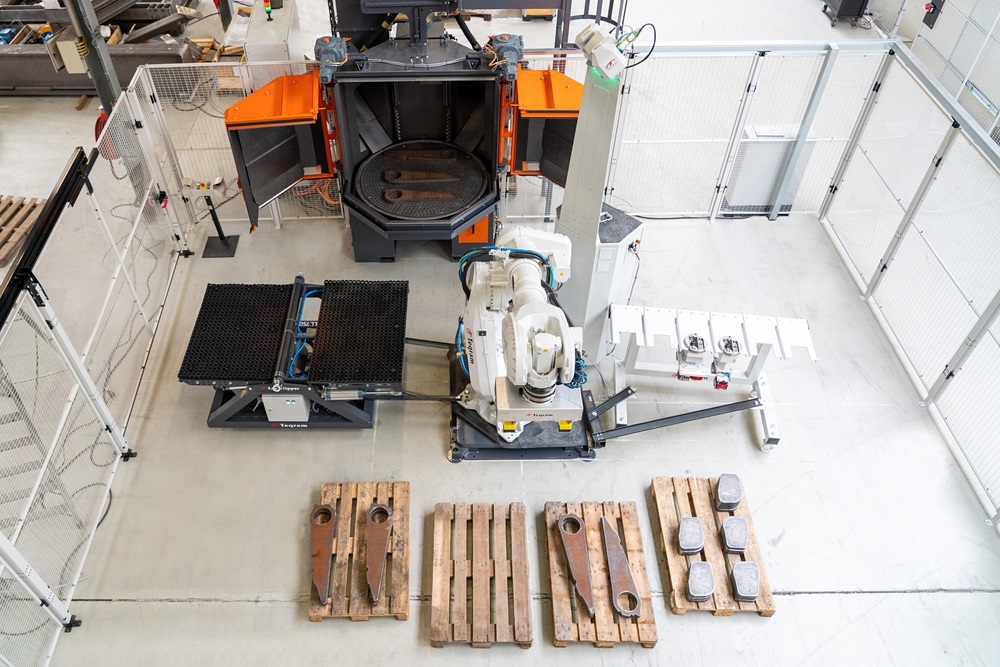
When Ottostahl GmbH had to replace an old rotary table shot-blast machine, the company insisted on short cycle times, high energy efficiency and relieving its personnel from strenuous and monotonous physical activities. Rösler and automation specialist Teqram met these challenging demands with the universally deployable Easy Shotblaster RDT 150 rotary table, equipped with a stationary ‘intelligent’ robot. This robot places workpieces on the rotary table in a manner that optimally utilises the entire table area without requiring any ‘teaching’ operations.


Ottostahl in Magdeburg produces up to 30 mm thick, highly precise plasma-cut and up to 300 mm thick flame-cut components. In its shot-blasting department the company is
utilising three machines (two continuous flow roller conveyor machines with an operating width of 3800 mm and a rotary table blast machine). After more than 60 years of use, the company is replacing its old rotary table blast machine with an RDT 150 system from Rösler.

The entire blast system integrates within a manufacturing cell measuring 8 x 8 m, consisting of an intelligent stationary robot and the RDT 150 shot-blast machine.

With its image processing technology, the vision-controlled robot automatically recognises components placed into its working section, completely independent from their position on the pallet. This capability eliminates the normally required time-consuming teaching or programming of the robot. Moreover, with the intuitive interface, no special knowledge is necessary.
After the automatic selection of a suitable gripper from the magazine, the robot picks up components and places them on the rotary table in the optimal position. It provides component data to the machine controls for selecting a suitable processing program. Halfway through the cycle, the robot automatically turns the components to blast the other side. The robot then returns finished workpieces to the pallet.

For further information www.rosler.com

New technology cleans parts with dry CO2 granules


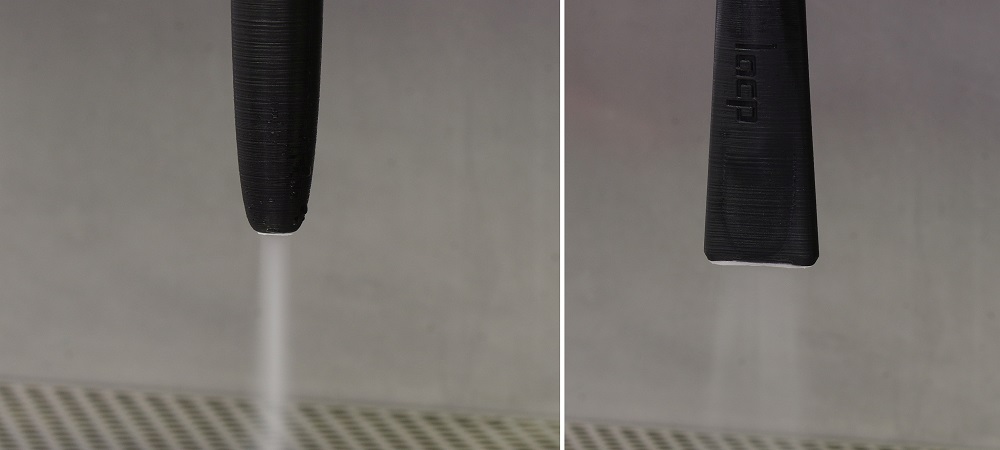
For in-line dry component cleaning applications, ACP systems is releasing itsPowerSnow QuattroClean technology. The process compresses recycled liquid CO2 into cleaning granules using an integral unit. Compressed air then accelerates the granules, fed through a purpose-designed nozzle, for blasting on to surface that requires cleaning. Thanks to the elimination of the customary external pellet production and logistical effort associated with conventional dry ice cleaning, it is possible to realise a fully-automated and uninterrupted cleaning or deburring process.

The new cleaning process efficiently removes stubborn particulate and filmic contamination from virtually all materials and material combinations. Using cleaning granules made from recycled liquid CO2, the process can clean entire surfaces or selected areas in a reproducible manner. Applications range from surface finishing in body-in-white automotive processes and the removal of welding beads, to the fine deburring of medical instruments and fine-tolerance watch components.

Cylinders or tanks feed the mediato the QuattroClean PowerSnow system, thus offering unlimited shelf life.The jet of compressed air containing the granules has a temperature of around -78°C.

On impacting on the surface, four effects occur. A thermal effect leads to sudden local cooling, where the different expansion coefficients between the substrate and the contaminants cause cracks to form in the latter. A mechanical effect also takes place, where the transfer of momentum detaches impurities. When the snow granules impact on the surface, they undergo a transition from the solid to the gaseous phase, with an abrupt increase in volume of around 600 times. This so-called sublimation effect creates micro-pressure waves that also detach contaminants. In addition, during the transition phase, a solvent effect removes filmic/organic contamination.
For further information www.acp-systems.com

First-rate contacts, new projects and concrete deals


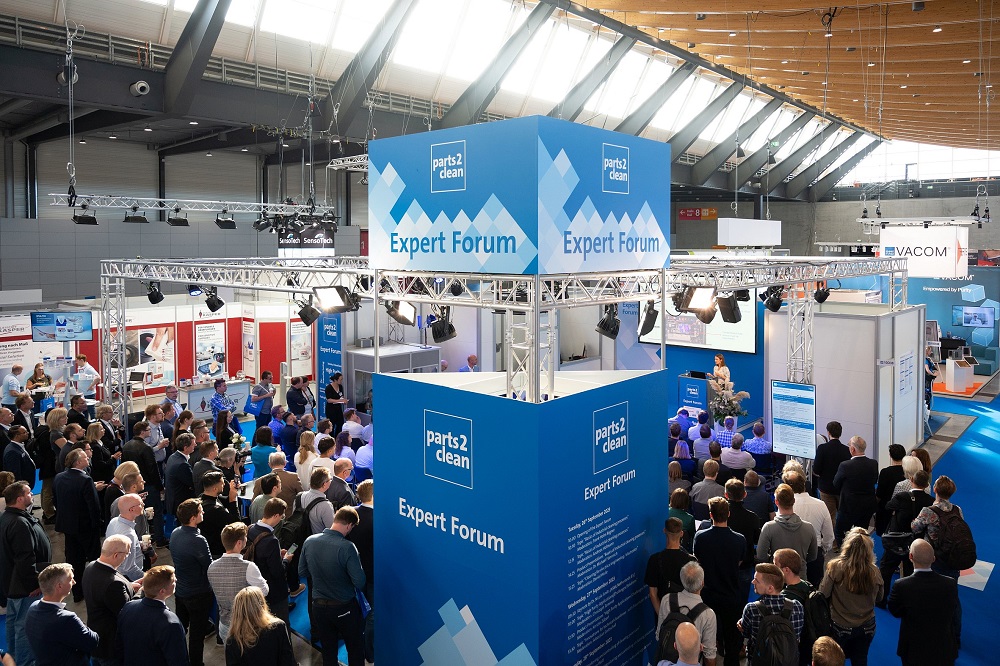
Technical discussions, a strongly attended expert forum and a positive overall mood on all three days of the trade fair testified to the fact that the recently concluded 20th parts2clean exhibition fulfilled all expectations. More than 3000 trade visitors came to the event, the majority of them armed with tasks and projects, as well as a thirst for new information. This resulted in numerous high-quality contacts, new projects and even direct business deals for the more than 150 exhibitors (from 14 countries) at the event.

“We placed a stronger focus on the range of solutions offered at parts2clean for tasks where the highest cleanliness requirements need to be met,” reportedChristoph Nowak, project director at Deutsche Messe, “We thus succeeded in attracting more visitors from this segment of the industry to parts2clean.”

This was confirmed by Dr Günther Schmauz, board member at ACP systems: “With our high-purity snow-blast cleaning solutions, we were previously more of a niche supplier at parts2clean. At this year’s event, however, we were able to welcome a large number of trade fair guests from the fields of EUV lithography, including system partners and suppliers, as well as e-mobility.”

Rainer Straub, board of management and VPsales andcustomer service at
Ecoclean, expressed similar sentiments: “Parts2clean was significantly more successful for us this year than in 2022, certainly due to the ‘high-purity’ theme, which is a focal point in our programme.”

According to Manfred Holzleg, general manager of Safechem Europe “parts2clean always provides the opportunity to meet a diverse audience. This year, we were able to hold numerous discussions, especially with visitors from industries that are new to us. As a result, we can open up new fields of business.”
For further information www.parts2clean.de/en

Eight times faster shot blasting at ML Constructie


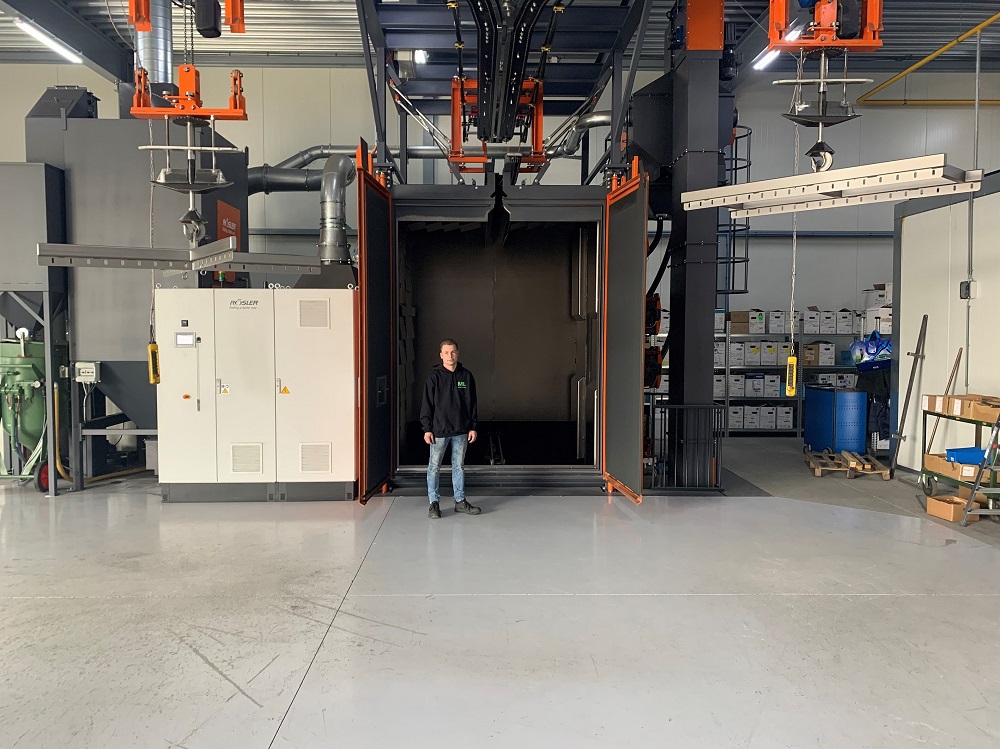
The lack of flexibility and unsatisfactory powder coating qualities at external job shops induced a Dutch manufacturer of industrial furniture to bring its coating operation in-house. Unlike its competitors, ML Constructie decided to also perform paint preparation by shot blasting in-house with an automatic shot blasting machine from Rösler. Compared with manual processes, the shot blasting cycle times are not only eight times faster, the
automatic solution also produces better qualities at lower costs.

Since manual blast operations are hard and exhausting, it is very difficult to find and keep the people for this kind of work. With the Rösler blast machine, however, employees must only place workpieces onto the respective fixtures and remove them after the blast process.

Another significant contribution towards a better working environment is the low noise emissions, which are considerably lower than manual blast rooms. Moreover, the automated shot-blast process is eight to 10 times faster, while another benefit is the blast machine’s two rails in ‘Y’ design. This configuration allows the operator to place workpieces onto the fixture at one rail branch, while workpieces from the other rail branch undergo blasting. Therefore, unproductive idle equipment times aremore or less a thing of the past. Last but not least, the overall blast cleaning quality is considerably better.

“In the automated shot-blast process, blast media gets into even the tiniest workpiece
corners,” says Ben Luizink, co-owner atML Constructie.”This is nearly impossible with manual shot-blasting operations. Furthermore, the Rösler shot-blast machine is very
tight and emits practically no dust. Since we are coating the workpieces in the same production hall, this is a huge benefit.”
For further information www.rosler.com